Kitchen Sink Dramas of the 1980’s

A while back I did a post about the kitchen sink dramas that emerged in the 1960’s but I thought I’d look now at some later films that have continued that tradition of focusing on working class life. I’m not really sure that today in the 21st century the working class still exist. Modern UK is, to a great extent a classless society. Then again, perhaps it’s just a society of the haves and the have nots. That concept relates particularly well to the 1980’s. The decade of Thatcherism and Yuppies and inner city riots. Kitchen sink dramas were almost exclusively northern, set in places like Manchester, Liverpool and Lancashire with strong no nonsense northern characters. Here are four films from the 1980’s that fit that category.

Educating Rita (1983)

This was a breakthrough film for Julie Walters and I remember Michael Caine who also stars in the film saying that this film would do for Julie what Alfie did for him. Maybe it did, maybe it didn’t. The film is about a Liverpool hairdresser played by Julie who wants to better herself. She decides to take an Open University course in English Literature. Her tutor played by Caine is initially confused as he has the name of Susan White on his documents and Susan explains that she has now changed her name to Rita after reading Rubyfruit Jungle by Rita Mae Brown. Frank Bryant (Caine) is not keen on taking Rita on as a student but she convinces him otherwise. Rita finds Frank has ignited her passion for literature but has to contend with her husband who wants her to be a traditional wife and produce babies. Husband and wife finally split leaving Rita to pursue her studies. She moves in with a fellow student and gradually, as she mixes with more students and studies more, she becomes less and less like her former self. Frank becomes more and more fond of her, possibly even in love with her but his position as a university lecturer is compromised by his heavy drinking.

In a lot of ways this is such a good film. Julie Walters is outstanding as Rita and Michael Caine is excellent too. The big problem for me is that while Julie plays Rita as a typical scouser with a superb Liverpool accent, the setting clearly isn’t Liverpool. Not only that but the other accents in the film all grate with Julie’s as they are a mix of various northern accents. Caine of course as the lecturer, doesn’t have to have to be a Liverpudlian but the hotchpotch of brogues, some from Manchester, some from Liverpool just seemed to jar to my ear. The film was apparently filmed in Ireland so why not make Rita and her family Irish? That would have made more sense although filming in Liverpool with a local cast would have been the better option. Perhaps production finances made that impossible.

Shirley Valentine (1989)

Like Educating Rita, this was a film based on a play written by Willy Russell. In this one Liverpudlian Shirley is getting a little bored with her life. Unlike Rita in the film above it’s not learning that Shirley wants, it’s a good holiday. She is getting a bit fed up of waiting hand and foot on her husband and when the chance comes to go to Greece with her friend she wonders if she could really do it, really leave her husband behind and swan off to the sun? A couple of things make her decide that it is really time to put herself first. The first one is when her husband gets really annoyed when she serves chips and egg instead of steak for their Thursday evening meal. Surely she knew Thursday was steak night? The other is when her daughter comes home and like her dad, expects to be waited on so off Shirley goes to Greece. Things don’t go quite to plan when her mate finds herself a man on the flight over and leaves Shirley to her own devices. After a few days Shirley finds her confidence and begins to enjoy things alone. She meets Costas, a bar owner and spends time with him on his small boat and when the time comes to leave, Shirley decides she is going to stay.

Like Michael Caine in Alfie, Shirley talks straight to the camera and reveals she is in love. Not with Costas but with herself. At the end of the film her husband arrives in Greece and the two sip wine together by the sea. Will Shirley return with him? The film leaves the question open.

Shirley Valentine is a much better film than Educating Rita. Shirley and her husband played by Pauline Collins and Bernard Hill come across as authentic Liverpudlians and the whole film, especially Shirley talking to the camera, works very well. Both films were directed by Lewis Gilbert who directed amongst other things, the Michael Caine classic Alfie. With some better casting in the smaller roles, Educating Rita would have been just as good.

Rita, Sue and Bob Too (1987)

Like the two films above, this too was based on a play, in fact it was two plays that were adapted and merged together into a screenplay by the play’s author Andrea Dunbar. Andrea was raised on the Buttershaw council estate in Bradford, West Yorkshire and became pregnant at 15. This event inspired her first play The Arbor. It was written originally as a classroom assignment and encouraged by her teacher, Andrea developed the work into a full blown play. The film was filmed on the Buttershaw estate where Andrea continued to live, despite several residents threatening her because of the negative portrayal of the area in the film.

In the film, two babysitters Rita and Sue, begin an affair with Bob for whom they have been babysitting. Bob’s marriage later breaks down when his wife finds out. Sue later gets involved with an Asian taxi driver called Aslam who becomes violent. He attacks Sue but Rita arrives and the two both turn on the taxi driver, disabling him long enough for the two to escape. They flee to Bob’s house where Aslam turns up and pleads for Sue to forgive him. Bob arrives and then the Police, who have been called by the neighbours. The Police leave in pursuit of Aslam and Bob decides to have a bath. When he goes into the bedroom, the two girls are in bed waiting for him.

This is really an incredible film on many levels. It is funny but also shows northern council estates for what they are, a mix of rough and ready characters, some of whom take pride in their homes and the way they conduct themselves and some who do not. The tone of the film shifts quickly from humour to drama and back again and the documentary style of filming gives the film a gritty realism.

Gregory’s Girl (1981)

Gregory’s Girl was a low-budget movie made in 1981 and was written and directed by Bill Forsyth. The film is a gentle comedy about a young lad who fancies a girl who has just joined his school football team. The film was one of those special films where so many things come together to make a truly great and memorable film, in fact it is ranked number 30 in the British Film Institute’s list of the top 100 British films.

It reminds me so much of my own schooldays in so many ways even though it was filmed in Lanarkshire in Scotland. The hairstyles in the film were similar to those of myself and my friends back in 1973, the year I left school (armed with only four O levels to take on the world). The school ties and jackets were similar to mine, as were the classrooms and lead actor John Gordon Sinclair’s clumsy and shy manner both on and off the football field was just like mine.

Gregory lives on a new estate just like the one my family moved into in the mid 1970’s. He develops a crush on a new girl who has just joined the school football team and eventually he plucks up the courage to ask her for a date. He borrows his friend’s jacket and off he goes to meet her although things don’t turn out quite how he planned. Gregory’s Girl isn’t as gritty as the films I’ve mentioned above but for me it’s like a nostalgic trip back to my schooldays. Look out for the film on TV or you can even find the complete film on YouTube.
What to do next:

Share this post on your favourite social media!

Hit the Subscribe button. Never miss another post!

Buy the book! Click here to visit Amazon and download Floating in Space to your Kindle or order the paperback version.

Statistics, 2020 and a Troll Through Some Popular Posts

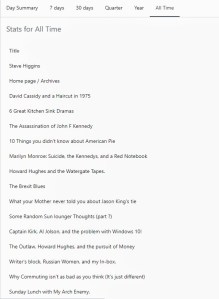
Being a creature of habit, I always tend to do a blog post at the start of the year, looking back to my posts of the previous year. In one of my first posts of 2020 I did one looking back through what had happened to me in 2019 and linking it to my best posts of the year. My best or favourite posts are not necessarily the ones that picked up the most views or the most likes. WordPress has a pretty comprehensive stats page so this year I thought I’d spend a little time going through them. All the links to previous posts open up in a new page.

image courtesy wikipedia

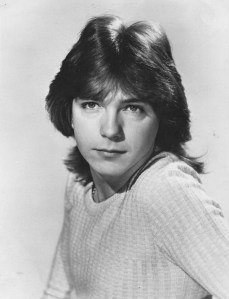
My all-time top scoring blog post is this one about David Cassidy. Cassidy became a big star on the hit TV show The Partridge Family about a family that formed themselves as a pop group. When the songs from the TV show were released as singles they quickly became hits and Cassidy himself soon began making his own records. His star shone very bright for a while but then faded leaving Cassidy trying to make his way in film and TV almost as a has been when he was still young. My post is actually about me and the time I went to the barber’s -sorry, hair stylist- and asked for a style like Cassidy’s. One of the reasons for the success of that post might be that its very search engine optimised, meaning that it always comes up in any search for Cassidy. I like to think it’s a pretty good read too. The post also showed up as my second most read post in 2020.

My most read post in 2020 was one from 2016, 6 Kitchen Sink Dramas which is a post about a new style of films in the 1960’s that focused on the working class. The post looked at 6 particular films that I thought were the very best of the 1960’s. A similar sort of post from 2020 was this one, Films, Allegories and McCarthyism which was about films which were in some way related to the McCarthyism of the 1950’s. Hollywood was particularly affected with many actors, writers and other film professionals having their careers either compromised or in some cases, completely ruined. The post was also one of the first for which I decided to make a short video trailer for use on social media to bring in those new readers. The post doesn’t seem to register that well in my stats, but it was one that I personally thought was good and I enjoyed doing the research and writing.

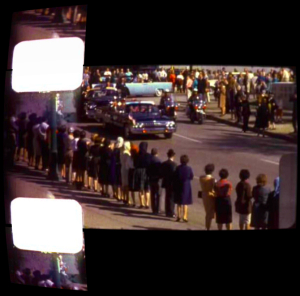
Coming in third in my all-time most read posts was one from 2014 about the JFK Assassination. Again, this is another post that always seems to do well. I spent a lot of time on the post doing research with the stack of books I have on the subject. In this post I stay clear of wild theories and tend to stick with the basics in particular Lee Oswald’s rifle, famously found on the 6th floor of the Texas School Book Depository. The rifle had a telescopic sight which the FBI found later was not only mis-aligned but actually impossible to set up. They solved the problem by adding metal shims to the mounting, meaning that FBI shooters who test fired the rifle used it in a configuration that was not available to the alleged assassin Lee Oswald.
While I’m on the subject of the Kennedys, another post that’s showing up well in my stats is an old one from  2015 about Marilyn Monroe. Researching from various books and websites I tried to piece together the events of Marilyn’s last day. Marilyn was very angry in her last days. She claimed to friends she was fed up of being tossed around ‘like a piece of meat’ by the Kennedy brothers and threatened to blow the lid on her dealings with them in a press conference. Bobby Kennedy wanted her notebook, the one in which she had noted down details of her meetings with him. Kennedy wanted it destroyed and Marilyn kept quiet. The Mafia wanted derogatory information on the Kennedys and had even had Marilyn’s home bugged. A press conference was arranged for Monday August 6th, 1962. Was she about to reveal her affair with Bobby? Sadly, Marilyn was found dead in the early hours of the 5th

Another of my favourite topics concerning the USA are the Nixon years and coming up third in my 2020 stats was a 2016 post about Howard Hughes and the Watergate Tapes. Billionaire Hughes wanted the US government to shift their underground nuclear tests from Nevada to somewhere else. In his dealings with President Nixon he bandied around a figure of a million dollars. Was this the same million dollars that Nixon mentioned to presidential aide John Dean?

Fourth in this year’s rankings and also fourth in my overall stats was a post about American Pie, the hit song by Don McLean. I’ve always loved that song and years ago I used to read a magazine called The Story of Pop. One edition was dedicated to the song and it fascinating to read about the true meaning of Don’s lyrics. Who was the Jester? Who was the King? All is revealed in the post.

Jason King

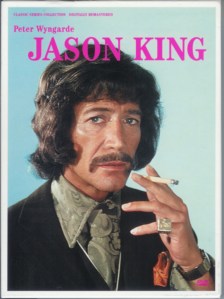
In fifth place in my 2020 most read posts was one from 2014 about Jason King. Jason who, did I hear you asking? Back in the 1970’s Jason King was a character in the TV show Department S. Jason was played by Peter Wyngarde. He was an author who worked with two colleagues in a government investigatory department set up to solve the most baffling of mysteries. Jason was a very avant-garde character, especially in his clothes and Wyngarde himself, no slouch in the fashion department, used his own clothes in his portrayal. Chief among his fashion items was a tie with a fashionably large knot and as a teenage schoolboy, I made it my mission to emulate that super knot! Did I succeed? Click this link to find out.

A lot of my 2020 posts seem to have been eclipsed by views of posts from bygone years but one of this year’s posts was my 6th most popular. It was a book post and reading, especially second hand books, is one of my great loves. During the first Lockdown in 2020 the weather was good and the sun was shining so Liz and I spent a lot of time reading and generally pottering about in the garden. One of the books I read was the diary of Michael Palin of the Monty Python team. The diary talks about Palin giving up smoking, making the first series of Monty Python and various other film and TV projects. It was interesting especially the peripheral things Palin mentions, the Apollo 11 moon landings, the strikes, the three day week and so on and it also brought back a lot of memories of my schooldays when my fellow pupils and I were great fans of Monty Python. Click here for the full post.

Coronavirus is basically a total pain in the neck and has ruined everything from Christmas celebrations to our regular quiz night down at the Lord Derby in St Annes to our random nights out in various pubs and our regular meals at a whole host of restaurants that we used to frequent. I hope 2021 turns out a lot better. We started off 2020 in Lanzarote and while we were there we found a fabulous villa close to all the bars and restaurants we loved. What the heck we thought and spent a shed load of money to book it for 2021. Now we’re in the middle of the second wave of the pandemic but I still live in hope that we may still be able to go there. So apart from that trip last January we didn’t do much travelling. We did do a few trips in our motorhome though and my post from this year, The Ups and Downs of Motorhoming did pretty well, coming in as my 8th most popular post. This was another post for which I used a short video trailer over on Twitter; here it is below:

Later in the year, in October we went off to Scotland visiting the Highlands, the Isle of Skye and Plockton among other places. I even managed to put together a video which pulled in some reasonable stats over on YouTube. Pity I didn’t spot a few typing errors in the post’s captions but now it’s got such a lot of views I don’t like to replace it. You can read the post and see the video by clicking here.

There are plenty of other stats that I’ve gleaned from my WordPress stats page. In my first year of blogging, 2014, I wrote 58,895 words. That figure has gradually expanded and this year, up to the 26th of December as I write this, I published 76,659 words (plus however many words are in this post). Average words per post in 2014 were only 633 words so these days at an average of 1446 words per post the reader is getting real value for money. I say value for money but as SteveHigginsLive.com is an entirely free service that’s not strictly true but I like to think I am doing something towards keeping readers amused during this locked down, mask wearing, hand sanitising time.

76,000 words though, I wish I could motivate myself to write that much on the sequel to Floating in Space!


What to do next:

Share this post on your favourite social media!

Hit the Subscribe button. Never miss another post!

Buy the book! Click here to visit Amazon and download Floating in Space to your Kindle or order the paperback version.

A Bit of a Blog or a Blog of Bits: Christmas Version

Well, we’re at that time of year again, Christmas. This time it will be Christmas with a difference; no parties, no meals out, no pub nights. The Coronavirus has changed everything. When it comes down to it, I’m not a great Christmas fan. It was good years ago as a child, waking up with the excitement of it all; the presents, the food, the cosy evening watching classic TV. But now I find myself wishing it was all over. I find myself looking forward to my favourite time of the year, the spring when days are getting longer and warmer and the bad weather is beginning to ease and  things are gradually becoming more light than dark and more warm than cold. This Christmas I will be working, even though I only work three shifts out of nine it turns out that my three days this week have fallen on the 25th, the 26th and 27th. Still, I’ve worked Christmas days before now as well as New Year’s day and Easter and other holidays. This time however, I’ve promised myself I won’t be working another one.

There isn’t much to do during the lockdown and apart from work, the only excitement in my life has been TV, books and writing.

TV.

The good thing about Christmas, speaking strictly as a couch potato, is the good stuff that will be on the television. At least, the good stuff I expect will be on. Last week I sat and watched one of my favourite films Fantastic Voyage. It’s a brilliant film in many ways. Firstly, it’s so incredibly original. We’ve all heard of outer space and seen a hundred or more films on the subject but this film is something different, it’s about inner space. An important scientist lies stricken with an inoperable blood clot on the brain and the solution is this: take a team of doctors, put them in a submarine and shrink them down so that they are so small, so very tiny that they will fit in a hypodermic and can be injected into the scientist’s bloodstream so they can journey towards the brain and clear the blood clot from the inside. Brilliant, wish I’d thought of it. Some of the special effects are a little tame and to be honest, it’s a film that is ripe for a 2021 remake with 21st century CGI special effects. Even so, I enjoyed it just the same.

The film stars various well known actors, from the glamorous Raquel Welch to the villainous Donald Pleasance. Also starring is Stephen Boyd. Boyd was an Irish actor who appeared in over 60 films. Boyd was a good actor who seemed to vanish quite abruptly from our film and TV screens. I looked him up on Wikipedia to find out what had happened to him and discovered that he had died suddenly at a very young age. He hailed from County Antrim in Northern Ireland. His big movie breakthrough was the film Ben Hur in which he played the part of Roman Tribune Messala for which he won a Golden Globe award. He was only 45 when he died of a heart attack whilst out playing golf at a course in California.

A few days ago I watched a repeat of one of the Christmas episodes of Everybody Loves Raymond. One of the great things about that show is Liz and I both enjoy it. In this episode Ray, just like me, is wondering what presents to buy. In particular he wants something for Debra, his wife. Previous failed presents were a set of pyjamas, he bought the wrong ones and his present idea, a space heater. Brother Robert, the funniest character in the show suggests a first edition of Debra’s favourite book, To kill a Mockingbird. Ray gets the book, Debra is over the moon -Ray finally bought her a good present- but Robert ruins everything by revealing the book was his idea. That show always makes me laugh especially as I’m so bad at buying gifts.

Just as I was doing the final edit for this post I took a quick glance at the TV guide. Bypassing Stalkers who Kill scheduled for Christmas Day –somehow I don’t think I’ll be watching that– I noticed It’s a Wonderful Life showing on Christmas Eve. I love that film and come to think of it, I haven’t seen it for quite a few years. It’s about George Bailey played by James Stewart who looks forward to an interesting life of travel but then finds obligations force him to stay in the small town where he has always lived. George is beset by problems and even considers suicide but then his guardian angel -literally- arrives to help him. The secret of this film is, I think, the fact that despite the fantasy premise of the film, everyone plays their parts as if they were in a serious drama. The result is that the drama and emotion of the situation rises to the surface and we are left with a vibrant and dramatic piece of cinema.

Books.

Hollywood has always fascinated me, especially Hollywood’s Golden Age. Just recently I’ve been reading Murder Hollywood Style written by Samuel Marx and Joyce Vanderdeen. Samuel Marx worked in Hollywood for many years and was a story editor and later a producer. He was a friend of Paul Bern who had married the original platinum blonde, Jean Harlow, in 1932.
On the morning of September the 5th, 1932, Marx received a phone call advising him that Bern had been found dead that morning. Bern was a former script writer who now worked as a producer for MGM where he was assistant to Irving Thalberg. Thalberg was known as the ‘Boy Wonder’ of MGM having produced a number of hit films such as Grand Hotel and Mutiny on the Bounty. Marx was shocked by the news and went quickly over to Bern’s house. Thalberg was already there and Marx spoke to neighbour about a mysterious veiled woman who had arrived the previous night. She arrived in a limousine and the neighbour heard various sounds that evening. Some sounds of laughter, some of anger. Marx went to go inside Bern’s house but Thalberg told him not to enter. Bern had committed suicide by shooting himself in the head. It was not a pretty site. Louis B Mayer the famous head of MGM had been to the house already and the head of the studio police force was also there. Marx, who had dined with Bern and his wife Jean Harlow only recently was shocked and left for home.

Strangely nothing appeared on the news until the next day. Who was the woman in the limo and had Bern really committed suicide? Marx takes us on an interesting tour of 1930’s Hollywood and along the way talks about many of the famous personalities of the time as well as the background to MGM studios and the films they made. He explains how the studio managed the press and dealt with the law enforcement officials of the day. Nothing was allowed to upset the carefully managed careers of stars like Jean Harlow and Clark Gable, her co-star in the hit movie Red Dust which was completed after Bern’s death.

All in all, a fascinating read.

Writing.

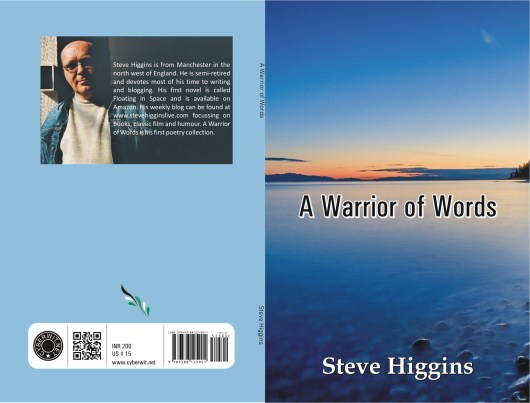
I was watching a TV quiz show the other day and one of the celebrity contestants mentioned that he had just finished writing a book. He did it by setting himself a target of 2000 words per day. Now sometimes I’ve hit 2000 words myself although certainly not every day. Sometimes it’s just 200. Writing isn’t always that easy and working from home there are so many distractions like emails and time wasting web sites like Pinterest and eBay. On eBay you can not only waste time but also spend money that you didn’t want to spend. When I’m stuck on a blog post or any other writing project I tend to look back at my half finished projects and work on those. I have a whole stack of half written poems, some of which I wrote many years ago and recently I put together a collection of poems with a vague idea of publishing them on Amazon. Lo and behold, just then a publisher contacted me asking to publish my poems! It was an Indian publisher and over on their web page there was a lengthy portfolio of their published editions which will soon be joined by my own book, A Warrior of Words.

Hope you’re having a good socially distanced Christmas. All the best and I’ll see you over in 2021.

What to do next:

Share this post on your favourite social media!

Hit the Subscribe button. Never miss another post!

Buy the book! Click here to visit Amazon and download Floating in Space to your Kindle or order the paperback version.


The Story of My Life Part 2

OK, here we go. Remember the post from a few weeks back? Life story in less than 2500 words? You do? Great stuff. Here’s the continuing story then, this time restricted to 2390 words.

Only 2390 words? What can I say? I did 1000, then 1500 then after 2200, I felt I’d gone as far as I could, not only that, I felt I had to go out and do some Christmas shopping instead of living dangerously and waiting until December 24th like I usually do. The funny thing is, when we get to Bonfire Night on November the 5th, I always think that this will be a good time to take a crack at Christmas shopping. I always think that. I never actually do it, you know, actually buy anything but I do think about it.

I think I finished part 1 at a point where I was working at an insurance company in Manchester city centre. If you want to refresh yourself with that earlier work, feel free to click here. I really did enjoy my time working in the insurance world. Well, I liked being in Manchester city centre and I liked the world of after work drinks in the city centre, evenings after work in the city centre. Actually, I suppose I just liked the city centre.

Back in the 1970’s there were a number of great bars and pubs in Manchester. I remember an exclusive looking bar I sometimes ventured into on a side road just off Deansgate. It was called Sims as I remember. I used to get myself a bar stool and order a very James Bond dry martini. For a while I wore a grey trench coat and it has just occurred to me I must have cut a figure similar to Delboy in the classic TV comedy Only Fools and Horses. Remember that scene where he leans on the bar but doesn’t realise the bar top has been lifted up? Well happily that didn’t happen to me although I must have looked like a right plonker sat at the bar sipping my dry martini. Of course, in those days I knew nothing about drinks or what to order. I spent quite a few years ordering a pint of mild in pubs all because I hadn’t a clue what to ask for. I remembering ordering a beer and the slightly stunned barmaid asked ‘what sort of beer?’ Luckily just then I overheard someone nearby asking for a pint of mild so I asked for the same having no idea what it was. Later on, when I realised all my mates were drinking lager, I started drinking that.

Sometimes, I felt that I wasn’t in the mood to quaff a full pint, especially at lunch times. We had a short lunch break at the insurance company where I worked so I felt I had to order something smaller. I’m not sure why I didn’t just ask for a half pint but for some reason, perhaps I had read too many James Bond books, I ordered a dry martini and lemonade. My work colleagues were always rather amused by this so I decided to try and change back to beer. It wasn’t easy. The barman at the time in the Beef and Barley had made it his mission to have my martini all ready when I came in. I’d approach the bar and before I could say, pint of lager please he would whip out a dry martini. If there was a bunch of people at the bar, he’d always find time to sort out the martini before I could put my order in. I wouldn’t mind but it wasn’t as if I was giving out big tips, after all, as a committed and fully paid up tightwad, tipping is not only not part of our mission statement, it is completely against our cultural ethos. These days I’d just say, look, I’ve stopped drinking martini, give me a lager. Back then, the only answer was to just stop going in there and walk the extra 100 yards to the Salisbury.

The Salisbury pub in Manchester City Centre

Incidentally, my uncle Raymond, who lied about his age in order to join his older brothers in World War II, once told me he had been arrested by MPs in the Salisbury so that pub has a particular bit of Higgins history that I have always liked.

Another bar I used to frequent, especially on a Saturday night, was the ‘Playground’, a small disco bar on Oxford Rd. Flickering multi- coloured spotlights rotated across the red carpeted room, which, on Fridays and Saturdays was generally packed. It had a small dance floor sunk low like a pit, where people up on the raised bar level could look down at the gyrating girls, and where also, on week day lunchtimes, a topless dancer appeared at the stroke of one o’clock to translate the soul and disco music of the time into pulsating physical motion, the eyes of jaded office workers glued to her as she did so.

My friends and I used to meet up in the Salisbury, by Oxford Rd station, have a few pints and a bit of a natter to any Insurance colleagues who we might find there, then make the short walk to the Playground. There was a paltry fifty pence charge to get in, the solitary bouncer was silent, but not unpleasant and the DJ, who always began the night with ‘Love’s Theme’ by the Love Unlimited Orchestra, played alternate sessions of rock, disco and chart music.  We were all mad about Jenny, the barmaid. She was lovely. She had a kind of round, open face, framed by thick blonde hair and her skin was a creamy white. She served us Worthington ‘E’ and we melted into the hubbub of people on their Saturday night out while the music of the seventies drifted through us.

The Playground as it is today

I’ve got to admit, I’ve cheated a little bit here because that last section about the Playground was lifted straight out of Floating in Space. I loved that bar and I was pretty gutted when it closed down. It’s still a bar today in 2020 but not quite the same. The dance floor has gone although there is still a bouncer on the door. I spoke to him last year before this whole nightmare Covid 19 stuff and he showed me round and said it was OK to return with my video camera and take some shots. Maybe I will in 2021.

Sometimes my friends and I went down to our favourite club. It was a place called Genevieve’s. Genevieve’s was in Longsight, which was a pretty rough area of Manchester and one of the hazards of the place was that you never found your car quite the same as how you left it, if you found it at all.

I remember one long ago Saturday night. My friends and I had to queue up for about ten minutes to get inside but we took that as a good sign. After all, a queue meant the club was busy. A group of grizzly bouncers scrutinised us and under their intense gaze we paid the entrance fee then went on inside. We were met by the warm fireside glow of soft lighting and the loud, pulsating beat of disco music. Coloured spot lights flashed over the four dance floors, in the hub of which sat the DJ, turning slowly around in a revolving booth.

There were five bars. Two small corner bars, two long bars, and a circular bar at the far end of the club. It really was a well set out place. We headed for one of the corner bars and my mate asked “bitter Steve?” I nodded and he called out to the barmaid.

A small army of bouncers was wandering around the club and as we waited for our drinks an argument broke out at one of the slot machines. Without any questions two burly bouncers grabbed the offender and propelled him expertly to the door. Another hooligan tried to come to the rescue by jumping on the back of one of the bouncers but a third bow-tied, black suited gorilla punched him solidly in the side, twisted his arm up his back and quickly removed him also. It was the sort of place where they didn’t stand any messing and the beer tasted like 3 parts water to one part beer and your feet stuck to the floor as you walked around. No one to my knowledge ever decided to complain to the management.

Genevieve’s attracted all sorts of people. There were smartly dressed, obviously wealthy people, peeling off rolls of bills to pay for whiskies and gins and other spirits. There were many attractive, well dressed girls. The younger girls drank halves of lager, sat in groups, and danced in groups to the Motown music of the sixties. They would drop their handbags onto the floor as they converged together for the formation dance routines for ‘Jimmy Mack’ and ‘Third Finger Left Hand’.

There were groups of lads too, who held cigarette packets and lighters in their hands, or placed them down in front of them on the tables while they drank, talked and eyed up the girls.

I spent a lot of my young life in that club. Tracks like Bus Stop by The Fatback band and Young Hearts Run Free by Candi Staton always remind me of Genevieve’s. Despite the watered down drinks and the frequent fights, my friends and I had a lot of fun there until one day it either closed down or we found a better place to go.

Just to try and give you a better idea of the times, in 1978, Jim Callaghan was the UK Prime Minister and Jimmy Carter was the US President. The movie Grease was released starring John Travolta and Olivia Newton John. The Bee Gees released Night Fever and the biggest selling hit of the year was Rivers of Babylon by Boney M.

Anyway, after a few years of working as an office clerk my friend Chris and I decided to pack our jobs in and go and work in Spain in a place called Lloret de Mar. His sister was based there and according to her it was a great life; sun, sand and of course, the young ladies.

We both decided to finance the deal by selling our cars. My car was a major mistake. It was a Mini Cooper and although it was a great car the insurance for that particular vehicle for a young man back in 1978 was pretty horrendous. When I came to sell the car, it attracted young men like me, all of whom were pushed to pay the insurance. Then a whole lot of problems occurred with the car and so I ended up selling it for a measly £50.

Chris and I hitchhiked down to London then got the boat train to Paris and then after being becalmed in French hitchhiking hell for days, we just jumped on a train direct to Lloret.

We met two girls on the train and had a fun time travelling together for a few days. ‘My’ girl was called Lee, which she said was short for Emily.

On arrival in Lloret we found a small pension consisting of a couple of rooms and a bathroom and spent a lot of time going down the pub drinking beer and chatting to girls.

We were pretty popular for a while. A short while. Later I realised our popularity was directly related to the money we had. The locals we met, by locals I mean the British ex pats who had flocked to the area just for the same reasons we had, all had pretty much nothing and anyone else who either was a new arrival with money or an expat who had some kind of a job was fair game to cadge off. For a short time I worked in a pub. I wasn’t paid any money but they gave me a meal for my trouble. Any time I was behind the bar collecting plates and glasses for washing, my new mates all hissed ‘Steve, pour us a lager while no one is looking!’ I didn’t and as a result my popularity plummeted. One night I was in the pub drinking with friends and after an evening of fending off various cadgers I told one of them to, in polite terms, go and have sex with himself. Alas this did not go down well and I became somewhat unpopular in that small Spanish town. After a few weeks I got a little fed up of this and so I moved on and left my friend behind. He was happy, he was a popular guy and he spent the summer with new friends loitering about Spain.

I started hitchhiking back north through France. I remember meeting an American guy. He was doing something similar to me, he had packed in his insurance job, sold his car and was travelling around Europe. We travelled together for a while. Every night he checked into a hotel and I put my tent up somewhere nearby. He had his evening meal in the hotel, I had some bread and cheese from the local shop and we had a few drinks together of an evening. Like all Americans, certainly those I have met, he was a friendly guy. It was clear to me he was dining well and I of course wasn’t. I must have ponged a little though after all those weeks on the road and I have to say I wouldn’t have minded using his shower, but the offer never came. After a while we parted company.

Not so long ago I found my old notebook from those days and written neatly in there are his name and address and phone number in the USA. I’ve always wanted to visit the USA and the Americans are such friendly, outgoing people. Wonder what he’d say if I turned up on his doorstep. Remember me? Steve Higgins? France, 1978? Any chance of using your shower?

I fondly remember turning up at home. My mum answered the door with a look of shock. ‘What are you doing here?’ she asked. I thought you were going away for six months?’

I’d returned after about six weeks. ‘I don’t know where you’re going to sleep’ she went on. ‘We threw your old bed out the other week!’


What to do next:

Share this post on your favourite social media!

Hit the Subscribe button. Never miss another post!

Buy the book! Click here to visit Amazon and download Floating in Space to your Kindle or order the paperback version


A Few Pandemic TV Thoughts

Lockdown may have finished on December 2nd in the UK but if you live in a tier 3 region, like me, it’s still going on. OK, I understand the need for the lockdown, I know we have to prevent the virus from spreading but that doesn’t stop the whole thing being a pain in the neck. No quiz nights at the pub, no restaurant meals out and so on. Not only that but why does the virus have 2 separate names? Is it Covid 19 or is it Coronavirus? And where does the 19 come from? Was there a Covid 18?  Does this mean there have been 18 previous versions of this insidious plague? If so, why have we never heard of them? We, the public, need to know.
This being December it certainly isn’t the time of the year for relaxing in the back garden but at least we have our TV set to keep us entertained. What TV gems have I found this week?

Showing on an obscure TV channel, Forces TV, I found the old Gerry Anderson TV series UFO. The show still looks pretty good after many years on the shelf. Ed Straker, the boss of SHADO is still trying to defend the world from alien attack and he and his colleagues look pretty good in their natty suits. In fact the whole thing looks pretty futuristic despite its obvious 1980’s origins, more so than Star Trek which, as much as I love it, does look very 1960’s.

It just so happens that I can remember that SHADO stood for Supreme Headquarters Alien Defence Organisation. What is interesting about that is this: The other day I went into the bedroom to get something and forgot what it was I’d gone in there for and yet I still knew what SHADO stood for.  A contributory factor might be that as a youngster I fell off a playground roundabout right onto my head. In fact, I can remember it like it was yesterday, falling off head first and heading towards the ground, actually a concrete slab and taking a hell of a whack on my bonce. Yes, that hurt, it really did but I’m still wondering what I wanted in the bedroom.

Anyway, when I mentioned Star Trek above. I’m talking about the original Star Trek, not the slightly lacking Star Trek:The Next Generation. Captain Picard and the cocktail lounge atmosphere of his space craft was not my cup of sci-fi at all and while Picard was running all the command decisions past everyone from the ship’s counsellor up, Kirk was already hitting the aliens with phasers on stun and getting up close and personal with some gorgeous interplanetary beauty.

The original Star Trek, like UFO was shot on film and today looks pretty sharp compared to the Next Generation which was shot straight to video. The original series was given a digital makeover a few years back with digital effects and new CGI spacecraft and is looking pretty good these days. The franchise has spawned quite a few follow up series and films. After the Next Generation came Deep Space 9 which was just as bad as the Next Generation if you ask me and then Star Trek Voyager. I actually like Voyager but it didn’t start off well for me and as much as I liked Captain Janeway, her oddball hairstyles just annoyed the hell out of me until in the later series they decided to employ someone who actually knew how to style hair and Janeway ended up looking pretty normal.

As Janeway became normal, the writers decided to shake things up with the pretty sexy Seven of Nine character. She was rescued from the Borg, an alien race whose catchphrase is you will be assimilated. Seven was given a very appealing tight fitting catsuit to wear instead of the Space Federation regulation uniform. Catsuits are OK and maybe they are pretty popular in the 24th century but they never seem to have any pockets. What Seven does with her handkerchiefs, lip gloss, mobile phone and purse I really don’t know. In the future people must prefer looking sexy rather than worrying about their stuff, at least they do in the eyes of the Star Trek writers.

While on the subject of cat suits, I feel I must mention, even just for a fleeting moment, the original cat suit girl who, at least in my mind, was Mrs Emma Peel played by Diana Rigg in the TV show The Avengers. The Avengers started off as a crime drama starring Ian Hendry as a police doctor, assisted in solving crimes by the dapper John Steed. Hendry left the show leaving Steed, played by Patrick MacNee needing a new assistant. His assistant was Kathy Gale played by Honor Blackman. She left the series to star in the film Goldfinger and Emma Peel was recruited as Steed’s new assistant. Kathy Gale was also a catsuit wearer although she seemed to prefer a leather version. When Emma Peel joined the series, the show moved from video to film and the production values increased enormously. The show also began to move in a sort of sci-fi fantasy espionage direction. Off the top of my head, I remember episodes about a mad scientist who shrinks other scientists and Steed, down to a small size, killer robots, time travel and cats that become wild animals.

Another problem with tight fitting cat suits must surely come whenever the wearer needs a bathroom break. Imagine having to strip right down just so you can have a wee. On board the Enterprise I can imagine that, like in any spaceship, space must be at a premium so the toilets must be pretty small. Now this is the perfect opportunity to introduce my own personal experience of using a ladies toilet. Years ago, when I had a cigarette vending machine round (writer, blogger, vending machine repairman -I’ve done it all) I remember visiting a pub in Prescot in Merseyside. I can’t remember the name of the place but it was the reverse of a normal pub in that most old pubs usually have a big room; the lounge and a small one, the vault, where men play cards, pool and darts. In this pub, the big room was the vault and the lounge was the small room. Anyway, after servicing the cigarette machine I wanted to use the toilet so I asked the cleaners, who were pretty fierce in that place, could I go in the gents. No she said, the floor was still wet but I could go in the ladies.

The ladies I soon found was actually two rooms, one with three toilet stalls and an outer room where you could wash your hands. The outer room had two huge mirrors for making sure your hair and makeup were OK and two comfy couches where the women could sit and presumably have a good natter before going back to join the men. Yes, that ladies toilet was a real eye-opener for me used to, like all men, smelly urinals.

Diana Rigg left The Avengers to become a Bond girl, just like Honor Blackman before her. Diana starred in On Her Majesty’s Secret Service as the woman who finally got 007 to the altar only to be shot later by Bond’s enemy Blofeld.

Anyway, getting back to Star Trek, the latest series in the franchise are Discovery, which is rather like watching a very fast music video, I gave it a good 15 minutes and then had to switch off, and Star Trek Picard, which sees the return of Captain Picard and various other characters including Seven of Nine from Trek’s back catalogue. I actually quite fancy watching that but alas, not having Amazon Prime I’ve yet to do so. Pity because it actually looks pretty good from the clips I’ve seen on YouTube. Eventually it will filter down to the Freeview channels and one day I’m sure I’ll see it late at night on BBC2 perhaps.

William Shatner who starred as Captain Kirk in the original series is a firm favourite of mine and it would be rather nice to see his character pop up again. Star Trek: Kirk sounds like a pretty good idea for a new series to me. Shatner is now 89 years old and still going strong. His character was actually killed off in the Star Trek film Generations which started off pretty well, combining the usual sci-fi elements of Star Trek with an intriguing mystery; who is the mysterious Soran and what is he up to? As it happened what he was up to wasn’t really that interesting but the film marked the cinema handover from the original Star Trek cast to the new one. Pity really because as I mentioned above, I never really took to the Next Generation.

Star Trek is ultimately about three people, Kirk, Spock and McCoy and the producers probably realised that, which is why, in the latest Trek films a new generation of actors have been asked to recreate the old roles meaning that Captain Kirk lives on again for a new generation of sci-fi fans.

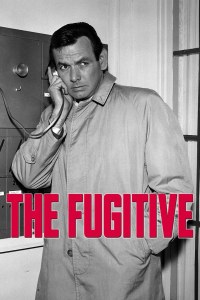
Another old show repeated currently on the CBS justice channel is The Fugitive starring David Janssen as Dr Richard Kimble, falsely accused of the murder of his wife. The show ran for four seasons but as viewer ratings began to fall, the series was cancelled. It was then that the producers hit on what at the time was an unusual idea. Instead of the show just ending, they decided to make an actual finale. Yes, they would wrap up the story of Kimble’s wife’s murder. Kimble had been searching for the supposed one-armed man he had seen leaving the murder scene for the past four seasons, now he would finally find him!
Back in the 1960’s, TV was not very highly thought of even by the TV networks themselves. So what if Kimble never finds the murderer. So what? It’s only a TV show. Of course, the viewers would disagree. They had kept faith with the series for four long years, they deserved a proper ending.

The final episode aired on August 29th 1967 and in the USA the viewing figures were a sensation: 72% of US TV viewers were watching that final episode and the show held the most watched record until November 1980 when someone shot JR in Dallas.

When I watched The Fugitive yesterday, I think we were up to episode 20 in season 4. Hope I remember to watch that final episode, then again, I still can’t remember what I wanted from the bedroom!


What to do next:

Share this post on your favourite social media!

Hit the Subscribe button. Never miss another post!

Buy the book! Click here to visit Amazon and download Floating in Space to your Kindle or order the paperback version

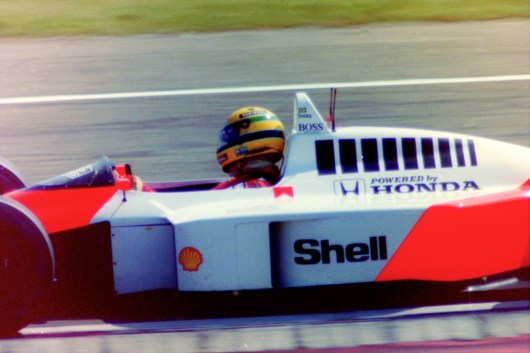
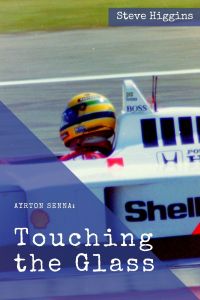
Ayrton Senna: Touching the Glass

As the 2020 Formula One season comes to a close, many people must speculate about those who race these amazing F1 cars at such incredible speeds. Measuring high speed lap times against car control and the desire to go ever faster is the juggling act performed by the Grand Prix drivers every time they step into their hi-tech carbon fibre cockpits. The consequences of a mistake can range from an embarrassing spin in the gravel trap to a cruel death. Romain Grosjean crashed in the recent Bahrain Grand Prix. His car split into two and his cockpit, jammed in the crash barrier turned into a deadly fireball. Happily, he escaped with only minor burns.

This year, 2020, marked the twenty sixth anniversary of the death of Ayrton Senna, one of the greatest racing drivers of all time.  Aryton was killed on the 1st of May 1994 at the San Marino Grand Prix at Imola. Anyone who knows anything about motor sport can tell you that. The date lingers in the back of the collective mind of all racing fans, along with other tragedies of the sport, like the deaths of Gilles Villeneuve and Jim Clark to name but two. Clark’s death is unexplained to this day. His Formula Two Lotus left the track at an easy, straight section of road. The facts of Villeneuve’s accident are well known – he crashed into a slow-moving car – but his death is perhaps only really explained under close analysis.

Villeneuve was on a slowing down lap, on his way back to the pits after a handful of fast qualifying laps but still, he kept the hammer down, his right foot pressed down to the floor when there was no real need for absolute speed. So why? Why was he going so fast?

Grosjean escapes from his burning car

One answer is simply that that was the way he drove; fast. Foot down to the floor. Full stop. Another was that he was still estranged from team mate Didier Pironi, who he thought had unfairly beaten him in the previous Grand Prix at San Marino in Italy. The two had diced together for the length of the race, team leader Villeneuve thought they were putting on a show, Pironi thought they were racing. When Pironi took the chequered flag it was an act of betrayal, or so Villeneuve thought and when they arrived at Zolder for what would be Villeneuve’s last Grand Prix, Villeneuve was still seething. And so, perhaps that state of passion was a factor on his last lap. Jochen Mass was slowing down and saw Villeneuve approaching at high speed. He moved over to the right to let Villeneuve through on the racing line but at the same moment Villeneuve also moved to the right to overtake and the two collided sending Villeneuve’s Ferrari into the air.

For Ayrton Senna in 1994 that intense rivalry with a fellow driver seemed to be a thing of the past. Together, Senna, Alain Prost, and Nigel Mansell dominated most of the eighties and early nineties in Formula One racing. Mansell had left the stage for Indycar racing in the United States and Prost had retired, leaving Senna to take his vacant seat at Williams, or perhaps he retired because Senna had been offered a seat at Williams – it depends on which story you believe. Certainly, after the intense animosity that developed between the two at McLaren you can hardly blame Prost for not wanting to work in that same situation again.

So now, the Young Pretender had become the Elder Statesman of Grand Prix motor racing and his two closest competitors had gone. Perhaps he even hoped that he could relax, let up the pace a little bit, just as Prost had thought in 1988 before Senna began to push him harder. But a new phase had begun for Aryton Senna, a new Young Pretender had appeared to challenge him in the shape of Michael Schumacher. Schumacher had won the first two Grands Prix of the year and Senna came to Imola without a single point. “For us the championship starts here” he told the TV cameras, “fourteen races instead of sixteen.” Further pressure mounted on Senna when fellow Brazilian Rubens Barrichello was injured in a crash and then Roland Ratzenberger was killed, the first fatality at a Grand Prix meeting since that of Riccardo Paletti 12 years before.

Many sources have said that after these twin disasters Ayrton did not want to race in the Grand Prix. That is something hard to believe, a man as focussed as Senna, not wanting to race. Could it be that he was finally becoming more like his once deadly rival Alain Prost? Prost had always put his own life before winning motor races and as a consequence had driven a dismal race at the rain soaked 1988 British Grand Prix and completed only a token lap at the similarly affected 1990 Australian Grand Prix. Events may have pushed Ayrton’s thinking from the neutrality and detachment of the past towards a greater concern, a concern beyond the continual winning of races.

Whatever his inner feelings he started the San Marino Grand Prix in his usual fashion, leading into the first corner from pole position. Behind him though, JJ Lehto stalled his Benneton and was hit from behind by Pedro Lamy. Lesser events had stopped races in the past but on this occasion the organisers sent out the safety car and the grid cruised round after it in formation for five laps while the crash debris was removed.

At the end of the fifth cruising lap the safety car pulled off, the lights turned to green and Senna, Schumacher and the rest floored their throttles. The Williams was not handling well and it felt nervous through Tamburello, that evocatively named but most dangerous of corners. Still, Senna kept ahead of Schumacher, he kept the hammer down. On lap six the Williams entered deep into Tamburello and Schumacher saw the spray of sparks as the car bottomed out and side stepped slightly. Senna caught and corrected the Williams and throttled onwards for the charge down to Tosa, the next bend. Both Senna and team mate Damon Hill knew their cars were nervous and to a certain extent unsuited to the bumpy surface at Imola. Someone like Alain Prost might have eased off slightly, settled for second or third, collected some points and used the rest of the San Marino Grand Prix as part of a learning curve, collecting mental and electronic data to develop the car into another Williams race winner. For Ayrton Senna, a third defeat by Michael Schumacher was not acceptable. Putting points on the scoreboard held no interest for him either, except for the ten points that in those days came with a win.

The next time round Ayrton entered Tamburello at 192 mph. We know his exact speed from his car’s electronic management system, which records such data. Tremors went through the car as it bottomed out again on the undulating track surface. This time Senna couldn’t catch the Williams, or perhaps something failed on the car. Later on, the steering column was found to be fractured. Did it fail before the crash or was it damaged in the impact? Some have speculated that his tyres were not up to pressure after many laps circling the track at low speed. We will never know. Whatever happened, the car went straight on towards the tyre barrier masking the concrete wall that lay behind. Senna’s last act was to slow the car down to 131 mph, but it was not enough.

I have never met Ayrton Senna. The last time I had seen him, in person, was at the Silverstone tyre tests of 1991 and even then, he was a blur of yellow in the red and white of his McLaren. To understand someone we have never known is not an easy task. Sometimes we can only do so by looking into ourselves and searching for similar experiences.

A long time ago, I must have been eight or nine, my Mother took me to visit my Grandmother. Sat alone in the lounge while the two women gossiped in the kitchen, I became fascinated by my Grandmother’s new fireplace. It was a coal fire and the fire glowed dormantly behind a glass door. A real fire was not new to me, indeed we had one at home, but the glass door seemed to attract me, so much so that I reached forward and held my hand a fraction of an inch from the glass. On an impulse I reached out further and put my hand on the glass. As you can imagine, I recoiled in agony having burnt my hand.

Courtesy Wikipedia creative commons

That moment, in 1994, as I watched my television images in disbelief, I came to think of that small boy, reaching out towards the glass door that enclosed a coal fire almost as one with Ayrton Senna, reaching towards the barriers of absolute speed, touching the zenith of his car control and going ever so slightly over his limits. He had done it before and had come back from the brink. Indeed, it may have even been vital to him to occasionally push and go over his limits just to fix in his own mind where those limits lay. Ayrton was a man who could learn from his mistakes and could go on to better and faster things, but on that tragic day fate stepped in and stopped the process. A suspension arm crushed in the impact, sprang back and hit Ayrton, piercing his most vulnerable point, the visor of his helmet.

Prost and Stewart, two of the all-time greats of motor sport, were men who came closer than anyone to touching the glass without ever being burned. Perhaps that was their secret. Stewart was a man in absolute control of his skills as a racing driver, both on and off the track. After three world championships and twenty-seven Grands Prix wins Stewart was able to say goodbye to it all without ever looking back. What other driver can boast of doing that? Schumacher retired again after a disappointing comeback. The careers of both Nelson Piquet and Gerhard Berger fizzled out inconsistently at Benetton. Mansell called it a day after joining McLaren and then realising that their epic run of success had run out of steam. Alain Prost retired after cantering to his fourth championship. It was clear that in Prost’s final year he was no longer willing to push hard. The motivation of his youth had evaporated with the Grand Prix seasons and with the relentless high-speed sprints of Formula One.

The day had arrived, as it will no doubt one day arrive for Hamilton, Alonso, and Vettel, when he was no longer trying to touch the glass.


This is an edited and updated version of a previous post which as you may have correctly guessed means that this week I was running out of ideas for blogs. Normal service might be resumed next week.


What to do next:

Share this post on your favourite social media!

Hit the Subscribe button. Never miss another post!

Buy the book! Click here to visit Amazon and download Floating in Space to your Kindle or order the paperback version.

Sandwiches: More Ramblings of a Locked Down Blogger (Part 3)

While the lockdown is still ongoing there is not much going on my little life except for work, television and eating. I’ve written a lot about TV in the past, in fact as a couch potato of the highest order, TV viewing is one of the few activities in which I can claim to be an expert. Still, when it comes to food I’m an expert too, an expert in knowing just exactly what I like. Just in case you the reader ever decides to ask me over for dinner I thought it might be an idea to blog about my favourite foods.

Sandwiches.

What I thought I’d do is just stick with sandwiches for now. Now you might be thinking sandwiches, wow, that’s not really grabbing me, what else is available on WordPress? Where’s my google tab when I need it?

Let me see if I can just stop you from navigating away, just for a minute.

Personally, I love sandwiches. I have sandwiches every day at work and even on my days off, I tend to look longingly towards the bread bin round about early afternoon, especially if I’ve had an early breakfast.

A while back I was eating in the work’s mess room and one of my colleagues, a lady, in fact a lady of somewhat larger proportions sat nearby, and we began talking about healthy food. A lot of what she was saying was some sort of a rant about people who eat unhealthily and regrettably not a lot of what she was saying has quite caught in any lasting way onto my memory banks, but I was able to remark, in response, that my lunch, ham salad on a brown bun, was pretty healthy.

Healthy? She replied in a very shocked and surprised manner. Bread?

What’s wrong with bread I asked? It’s one of the oldest foods known to man.

As a general rule I should add that it is better never to argue with a woman who has found an almost religious fervour for the techniques of dieting and weight loss. Bread as far as I am concerned is one of the oldest and healthiest forms of food. Over on Wikipedia it is described thus:

Bread is a staple food prepared from a dough of flour and water, usually by baking. Throughout recorded history it has been a prominent food in large parts of the world. It is one of the oldest man-made foods, having been of significant importance since the dawn of agriculture, and plays an essential role in both religious rituals and secular culture. 

The name sandwich comes from John Montagu, the 4th Earl of Sandwich who one night asked his valet to bring him some meat between two slices of bread so that he could continue his card game, apparently cribbage, and eat without using a fork or getting his hands greasy. Sandwiches though, at least a form of sandwich, arrived in the world at a much earlier date and bread in various forms has been used to scoop up or wrap food in many cultures all over the world. I have always liked the humble sandwich because the sandwich enables one to eat on the go and as a hungry bus or van driver I’ve always taken advantage of that fact. Even today working in a purpose built hi tech control centre, my colleagues complain when the microwave is out of order or the oven has failed. Ha, I think, you should have brought a sandwich!

Anyway, here are a few of my favourites.

Bacon Sarnie

We in the northwest of England sometimes call a sandwich a sarnie or a butty and one universally loved in the north is a bacon butty or bacon barm. A barm, actually a barmcake, is a round white bread bun or bap. Cut one across the middle, butter it and slap on some grilled bacon and there you have the perfect way to start the day. As a further refinement, slap on some brown sauce or even an egg.

Sausage Sarnie

Similar to the bacon sarnie. Slap a few sausages on the griddle or pan. Cook until ready. Slice down the middle and arrange on your bread. Perfect with brown sauce.

Bacon Grill Sarnie

Bacon grill comes in a tin and is similar to spam in appearance and texture although in taste it is similar to sausage meat or bacon. Like a Big Mac it’s supremely unhealthy but one sandwich every now and again won’t hurt. Open the tin, slice the bacon grill and slap it on either a frying pan or under the grill for a few minutes. Transfer straight away to some buttered white bread and enjoy.

Ham salad

Probably what I’ll be eating tonight at work, I prefer this on a brown bun, split it in half, slap on the butter or margarine then chop some iceberg lettuce, some red onions, some sliced tomatoes, salt and pepper and then plenty of thinly sliced ham.

Cheese and onion

Not much to this one, get a brown bun, cut in half, slap on the butter or margarine and then you’re ready for some cheddar cheese either sliced or grated. Throw in some red onions to taste. This is nice on some plain white bread too.

Cheese and ham Toastie.

You really need a toastie maker for this but if you haven’t got one you can either grill your toastie or dry fry in frying pan. Butter the bread on the outside so it won’t stick in the toastie maker. Throw on your ham, grate some cheese and add a little onion. Slap it into the toastie maker until the cheese starts to melt. Great after a busy late shift at work. Serve with chilled lager.

The Steve Higgins Special

There’s a great moment in the Woody Allen film Broadway Danny Rose. The films starts and ends with a group of comedians, actually real-life US comedians discussing the world of comedy in New York. The conversation turns to Broadway Danny Rose, an agent who has a stable of not so great artists. Later, at the end of the film they mention that Danny Rose has received the ultimate New York honour, a sandwich named after him in the deli where they congregate. Here then is my own contender for that special honour. If I ever get to New York I might just mention it to any deli owner willing to listen.

I prefer this with a fresh white bap but it’s equally as good with a brown bun: split and butter it. Slap on some thinly sliced honey roast ham, then some grated cheddar and to finish off add a generous portion of coleslaw. Settle down, tune the TV onto your favourite channel, pour yourself a cup of tea and enjoy!

Fires.

I very nearly added a line in that last paragraph above about turning up the heating, after all, summer is long gone and now the temperature has dropped considerably. Liz still has a traditional fireplace and it is nice to sit in front of a roaring coal fire (with a steaming hot cuppa and my ham, cheese and coleslaw special) while we still have the chance. The government has banned the sale of coal from next year, so we have been buying extra supplies.

Our first few coal fires this year were a little smoky, so we felt that maybe the chimney could do with a clean. Many years ago, when I lived at home we had a coal fire. My Mum used to get up early and sort out the fire which would have been left murmuring away from the previous night. In those days the fire also heated the water in the house so no fire, no hot water.

I can fondly remember evenings sat in front of a fire watching television. Our old family dog, Bob, so named because all my Dad’s dogs were called Bob, would make his way forcefully to a spot right in front of the fire. After forcefully pushing either me or my brother out of the way he used to get as close as he possibly could to the fire and gaze thoughtfully into the flames until his nose dried up and Mum would shout at him until he reluctantly moved. A dog with a dry nose? No, not on Mum’s watch!

The visit from the chimney sweep was a big event for us kids back then. The lounge would be covered with white sheets and the sweep would bring his collection of brushes and connecting rods. Firstly, the brush would be shoved up the chimney then the next rod would be screwed on and the brush shoved up further. Then the next rod or pole would be connected until the chimney sweep would ask me and my brother to nip outside and look out for the brush popping out of the chimney.

It was always pretty exciting to see the brush pop up out of the chimney. We’d rush back in and advise him of the situation. Then he would bring down the brush, disconnect the rods and pack things away. Mum would spend forever then cleaning up despite the sheets that covered all the furniture. The dark fingers of soot would appear on the window frames and mantelpiece but the fire that evening would be brighter than ever.

I’m not sure if there still are chimney sweeps in the 21st century but it so happens that Liz has a set of chimney rods and brush, so we set about cleaning the chimney ourselves. The fireplace was sealed with a sheet of plastic and the brush poked through a small hole keeping the lounge free of soot. Ramming that brush up wasn’t so easy but finally I made some headway and started on the next connector and then the next and so on. Luckily for me Liz lives in a bungalow so there wasn’t too far to go but after a while I ended up stripping off my top as I was pouring with sweat. Afterwards, covered with soot and sweat it was time for a shower.

They must have been a tough old lot those chimney sweeps!


What to do next:

Share this post on your favourite social media!

Hit the Subscribe button. Never miss another post!

Buy the book! Click here to visit Amazon and download Floating in Space to your Kindle or order the paperback version.


So Who is the Greatest F1 Driver Ever?

As I write this Lewis Hamilton is the Formula One driver with more wins to his name than any other driver. More F1 wins that is; how he stands on actual wins in any form of racing I don’t know but back in the 1960’s and 70’s, Formula One drivers competed in a number of other non F1 races such as Formula Two or Three, Sports Cars, Saloon Cars, Can Am racing and all sorts. Now the F1 driver has an unprecedented tally of over 20 races in a season; making one every other weekend, they don’t have much time for other racing. Either way 103 F1 wins is a pretty impressive total and everything Hamilton wins now is a new record because the previous winner of the most Grands Prix, Schumacher won only 91. Only 91? Well 91 is pretty good too. The previous record holder before Michael was Alain Prost and his total was 51.

Fangio (Picture courtesy Wikipedia)

Of course, can we really understand a driver’s greatness just from his winning record? F1 racing, like all forms of motorsport is really about winning. In every Grand Prix TV interview, drivers will talk about aiming for a podium, looking to score points but really none of that matters, except the maximum points and the top step of the podium,  you know, the one where the winner stands. Hamilton, at the time of writing this has stood there 94 times which is a pretty hefty claim in the all time greatest driver stakes.

So who are the other contenders for the title Greatest Driver Ever?

Juan Manuel Fangio

Alberto Ascari was Formula One’s first ever World Champion but then came Fangio, winning an incredible 5 championships in the 1950’s, a record that stood for 46 years until overtaken by Schumacher in the 1990’s. Like Hamilton, Fangio drove for Mercedes as well as Ferrari and Alfa Romeo. Fangio won 24 F1 races out of the 52 he entered, an amazing percentage of 46.15%, the best of any F1 driver.

Jim Clark

Clark equalled Fangio’s record of Grand Prix wins and pushed the record up to 26 before he was killed in an F2 event at Hockenheim in Germany. He won only 2 world championships and drove exclusively for Colin Chapman’s Lotus team.

Jackie StewartJackie Stewart

Stewart won his first F1 race for BRM in the 1960’s and then moved to Ken Tyrell’s team in 1968. Stewart was a close friend of Clark’s and was devastated when his fellow Scot was killed. Stewart took the world championship in 1969, 1971 and 1973. He was due to compete in his 100th Grand Prix when team mate François Cevert was killed in practice for the US Grand Prix. Stewart withdrew from the race. Not only was Stewart fast, he was intelligent as a driver and had a great capacity for not only understanding his car but explaining the issues to his engineers. In 1988, he test drove the Lotus Honda of Nelson Piquet who was being soundly beaten by McLaren despite using the same world beating Honda engine. Stewart correctly divined the issues with the car after only one test drive. He took the record to 27 wins before retiring. Today Stewart is one of the elder statesmen of the sport but from what I have read on social media, he is not universally popular. He mentioned recently that neither Hamilton or Vettel are on his personal list of great drivers.

Ayrton Senna

Senna is a controversial driver in many ways. He was killed in 1994 at Imola during Formula One’s black weekend where he and fellow driver Roland Ratzenberger both lost their lives. Senna was dedicated to his profession, completely focussed on taking pole position in qualifying and from there winning races. He had a great natural talent but his ruthless attitude and determination made him few friends. I remember once being at Silverstone and heard him soundly booed although today he is revered as a legend of the sport. Senna won three championships and took the record for wins and pole positions to new heights.

Ayrton Senna

Alain Prost

Prost was known as the Professor, a nickname which reflected his intelligence and race craft as well as his undeniable talent. He and Senna enjoyed a fierce rivalry which ended with Prost stepping down from the race winning Williams team rather than accept Senna as a team mate and repeat their toxic relationship from their days at McLaren. Prost won 51 races and four world championships.

Prost

Sebastian Vettel

Vettel won four world championships but later moved to Ferrari where things have not gone quite so well for him. He has been involved in various controversies over the years. He overtook Red Bull team mate Mark Webber despite a radio message asking the drivers to hold their status as first and second and he was once involved in a wheel banging incident with Lewis Hamilton when he perceived Hamilton had unexpectedly brake tested him. He left Ferrari at the end of 2020 for the new Aston Martin team and has just (July 2022) announced his retirement.

Michael Schumacher 

Schumacher is another controversial driver. A hard racer, he won his first championship by pushing Damon Hill off the track in Australia. He moved to Ferrari taking with him the key technical staff from his previous team Benetton and went on to retire after collecting 7 world championships and 91 Grand Prix wins.

Lewis Hamilton 

Hamilton’s victory in the 2020 Turkish Grand Prix confirms his win of the 2020 championship and came with his 94th win. By 2022 he had upped it to a massive 103 wins. That Turkish race was actually an epic win where he started down the grid due to a poor qualifying performance but kept things together, gradually moving through the field to the top spot.

Hamilton has of course had the best car just like all the other great drivers. F1 is a team sport and the days when a driver could manhandle a bad car to the front of the pack, just with driver skills alone are long gone. Another advantage Hamilton has had is coming straight into F1 driving for the top team which at the time was McLaren. There were no up and coming years for Lewis, no trying hard to show off his talent in a poor back of the grid team.

McLaren’s days at the top have waned in recent years but perhaps Hamilton saw McLaren’s fall from the top coming, which may explain why he moved to Mercedes. Mercedes have brought on board other great talents in both the managerial and engineering fields and today, Mercedes are the undisputed kings of F1. I think Hamilton has a strong claim to be the number one of all time and it’s sad that some people still refuse to admit as such.

Still, any judgement of drivers across the many decades of the sport is bound to include personal tastes. Many would include Gilles Villeneuve in the hallowed halls of the greatest ever drivers. For me he was a good driver, nothing more. Conversely, I always thought Ronnie Peterson was one of the future greats and would go on to multiple championships; sadly, he never did and was killed in 1978 but I have always thought of him as high on the list of great drivers. Nigel Mansell with his one and only championship in 1992 was another great driver. His was not a natural talent. I’ve always thought that like Graham Hill, he was a man who had to work hard for his victories. It was not for nothing the Italian Tifosi named him ‘Il Leone’, the lion. Spare a thought too for Stirling Moss, the greatest driver never to win a world championship. His record of 16 victories stood for a long time as the best of any British driver.

Hats off to Lewis Hamilton then. 103 wins and will take some beating.


What to do next:

Share this post on your favourite social media!

Hit the Subscribe button. Never miss another post!

Buy the book! Click here to visit Amazon and download Floating in Space to your Kindle or order the paperback version.

Locked Down Blogger Part 2

It finally happened last week. It had been rumoured and expected. It had been predicted many months ago and so here it is. I’m talking of course about the second wave of the Coronavirus epidemic and the resulting second lockdown. There was some advance notice and as a result Liz and I were able to book a table and enjoy a last meal out. We even thought what the heck and went for a second bottle of wine just like the other couple in the next table sitting a socially distanced two metres to our left.

So that’s a month coming up with no nights out at the pub, no meals out and no quiz nights. The big problem with this second lockdown is the weather. In the first one I was quite happy sitting out in the sunshine reading a book. Now we have entered November here in the north of England it seems as though it has been constantly raining. What can we find of interest then? Well the big interest for me just lately is the American election. Like many people, I thought the election was a foregone conclusion, that Trump would be out and whoever the democrats chose would be in. It just so happened that the democratic candidate was Joe Biden. Joe is getting on a little bit for the top job and wouldn’t necessarily have been my choice but then again, neither would Donald Trump. As I write this the election is still ongoing, they are still counting the votes in a few remaining states. Both candidates are claiming victory and one is claiming huge voter fraud. Biden has so far been pretty much acclaimed as the winner, having received congratulations from previous presidents Obama and George W Bush. No congratulations have been forthcoming from Donald Trump and his legal team has already initiated legal action. I’m not sure who exactly they are planning to take to court but either way, that has not stopped Joe Biden getting his transition team together and making plans for when he takes office.

I wrote something back in 2016 about the smooth transition of power in the great democracies and even wondered what would happen if ever the outgoing president refused to budge. That was just wild blogging speculation but now some commentators are saying it could actually happen. This is almost as interesting for me as Watergate.

There was a time when I thought I understood the US election, now I’m not so sure. Hillary Clinton and Al Gore both won the popular vote in previous elections but failed to get enough electoral college votes to take them to the White House. I’m even confused about the primaries, I mean I was convinced Bernie Sanders would be the democratic candidate, but he stepped down earlier in the year and then Biden seemed to become the candidate virtually unchallenged and his projected walkover victory over Trump has just not happened. Many people actually support Trump. Some give their support because they are dyed in the wool Republicans, some presumably admire him but either way, 48% of the votes were for him.

I was watching TV the other day and a female black voter was being interviewed and surprisingly, she was voting for Trump. She wouldn’t vote for Biden she said because he was a socialist, which in the USA is one step from being a communist. Maybe that explains why Trump has such a following; in many places he must be seen as the anti-socialist. Trump did well in Florida where many Cubans found home after leaving communist Cuba.

When Nixon won the election in 1968 he spotted a supporter in a crowd with a banner proclaiming Bring us together and made that a campaign slogan. Bringing Americans together is a big ask for whoever wins in 2020 but I wish him luck in doing just that.

Theoretically this should be a great time for writers. What could be a better time to write than the lockdown, after all there isn’t much else to do. A few months back I shelled out a hundred or so dollars to list my screenplay on a web site called InkTip. InkTip is a way of bringing producers and writers together. They produce a newsletter for producers listing scripts and also provide subscribers with weekly lists of producers who want scripts. My screenplay has seen a lot of action lately with various producers reading either the synopsis or the script itself but that million-dollar deal has yet to surface. I live in hope.

My screenplay was one I wrote quite a few years back and I read through it recently and had an idea for a new ending. I added the new ending, tidied everything up and that final version was the one I added to InkTip. As I reviewed it again the other day – I don’t know about you but I’m always reviewing my old stuff- I realised that it was written before today’s mobile phone, Twitter and Instagram age. Not one of the characters has a phone. I might have to spend the lockdown adding mobile phones to my screenplay and bringing it into the 21st century.

Another project I’ve been working on during the lockdown is a video covering my recent trip to the Scottish Highlands. It’s mostly GoPro video from a camera stuck to my motorhome window. I’ve added some stills and some bits where I talk straight to the camera. I had a lot of technical problems putting it together, particularly recording the voice over. The voice over is pretty important because the actual visual stuff isn’t that exciting. When I recorded it, my laptop clearly couldn’t keep up with playing video and recording sound at the same time, so I had to record my voice separately and then add it to the video. That makes it difficult because normally as I’m reading the narration I tend to react to what is on screen so I can slow down or speed up if required or just add lib if I need to.

I was feeling pretty pleased with myself when I finished it and quickly got it uploaded to YouTube. I added the video to a video creators page that I follow and got some pretty reasonable feedback. What was really annoying was when I decided to tinker with it and spotted a couple of things I hadn’t noticed. One was in the credits at the end where I credited the music as Soul Grove instead of Soul Groove. Oh, and there was one more. In one of the stills of the motorhome I hadn’t picked up that Liz was rather cheekily giving me the V sign through the window! The thing is, the video had already garnered 72 views so do I delete and add the updated version or just leave things as they are? Decisions, decisions.

I’ve has a couple of nights on my own this week, as usual keeping my mothers house ship shape and lived in. One night I thought I’d make one of my favourite dishes, bruschetta. It just so happened I had some ciabatta in the freezer as well as onions and tomatoes. So here we go, I sliced the bread and popped it in the toaster for a light toasting. While that was going on I chopped the tomatoes and onions, mixed them up with a little garlic and olive oil. I Popped the bread out, slapped on the tomato and onion mixture and settled down to eat. It was wonderful.

It was so good I decided on another Italian favourite for the second course. aglio olio peperoncino. It’s basically spaghetti with olive oil, garlic and chilli. What could go wrong with that?

The quick answer is everything, overdone spaghetti, burnt garlic and those chillies I used last week on a curry that weren’t very hot: this week they were hot!

When is my favourite Italian restaurant opening again?


What to do next:

Share this post on your favourite social media!

Hit the Subscribe button. Never miss another post!

Buy the book! Click here to visit Amazon and download Floating in Space to your Kindle or order the paperback version.

My Top Ten Books of All Time Part 2

I do love books and like everyone I have my favourites. Last week I wrote about reading a blog post asking the reader for their top 5 books of all time. I decided to go one better and work out my top ten. I gave you the first five of my top ten books of all time and this week it’s time for the other five, all in no particular order.
The Spy Who Came in from the Cold

This book is a cold war thriller from the famous spy writer John Le Carré. Leamas runs the Berlin station and his opposite number over in East Germany is bearing down hard on his agents. Back in London Control, the head of the Secret Service has an idea to deal with this man. Leamas becomes a little fed up with himself. He gets a new job in a library, he drinks too much. He gets involved with a young librarian who turns out to be a communist party member. He assaults a small shop owner and ends up in prison. When he emerges, he is approached by various persons all wanting background information for a foreign news service. Leamas becomes a defector and only then do we realise what his mission is all about. Le Carré isn’t actually one of my favourite writers but in this book his slow burning style is perfect as the plot evolves slowly and methodically. A great read.

2001 A Space Odyssey

I first saw the film version of 2001 in the summer of 1968. I was only 11 at the time and I remember my Mum being surprised I had spent hours at the cinema on a lovely hot day. I watched the film in the huge movie theatre in Northenden, now a Jehovah’s Witness assembly hall. There were only a few people in the picture house that day and it was wonderful having this huge place almost to myself and seeing this incredible film in 70mm on the big screen. I recall being somewhat confused by it all, especially the jump from Neanderthal times to the future. I was so confused that I had to buy the novel by Arthur C Clarke which explained things in a way the movie did not.

The book is a wonderfully well written, plausible space adventure. It is about a mysterious monolith which appears on earth in Neolithic times and helps the ape men of the day to develop. Later, in the future, the mysterious monolith is found buried on the moon and when it is exposed to sunlight for the first time, it blasts off a signal to Saturn. Anyway, the scientists of the day decide that the monolith is part of some extra-terrestrial intelligence and set up a manned space mission to investigate. As the mission progresses, the onboard computer, HAL, decides to have something of a nervous breakdown which creates an unexpected hazard for the crew. All the technology that Clarke wrote about had its origins in science fact, both the space missions and the computer technology which make up the main parts of the story.

Verdict: The book is a wonderful read, one of the classics of science fiction.

The History of Mr Polly

This is not a science fiction story despite being penned by H G Wells. Our hero, Mr Polly finds himself in a very dull job with a very dull wife and resolves to commit suicide. Anyway, events unfold and instead of committing suicide, Polly accidentally starts a fire which threatens the whole street and he then mounts a brave rescue of an old lady. Instead of dying, Mr Polly becomes a hero and when the insurance money comes in, he leaves his wife, nicely settled with the insurance money, takes a little for himself and departs for pastures new. He sends some money to a post office in another village and gradually meanders in that direction, sleeping in fields and hedges, getting himself a tan. He works occasionally when he wants and sleeps when the mood takes him at other times.

He comes across the Potwell Inn and asks for work and right away finds himself at home. He potters about happily at the Potwell Inn, cleaning, serving and doing various odd jobs. One day the landlady’s nephew appears. He is a violent bully having been in and out of prison for years. He doesn’t like Mr Polly getting in the way so he decides to scare him off. What should Polly do, stay and help or just leave?

I first read this book many years ago and I’ve always liked its simple philosophy. If you don’t like your situation, change it says the author.

The History of Mr Polly is a lovely gentle read by a classic author.

My well thumbed copy of David Copperfield

David Copperfield by Charles Dickens.

I couldn’t tell you what my number one favourite book of all time is, but a strong contender must be ‘David Copperfield’ by Charles Dickens.

It’s a book written by a wonderful wordsmith and is rich in powerful and subtle images.

A lot of Dickens’ characters display their personal characters and traits through their names. Uriah Heep and Mr Murdstone for instance. Even when we are yet to be introduced to these fictional people we can understand a lot about them from the sound of their names. This is how Dickens works, giving us numerous hints and pointers to who these people are and what they are like.

James Steerforth though is something of an exception. He is my favourite character from within Dickens’ pages and he is neither a Heep nor a Murdstone; neither a Pickwick nor a Bumble. Apart from David Copperfield himself, he is the most human of Dickens’ creations. He is kind but can be unpleasant, caring and yet selfish, thoughtful but also unfeeling. In short, as Mr Micawber might say, he is full of human contradictions.

The best part in the book probably, for me at any rate, is the storm when David returns to Yarmouth. Dickens builds the storm slowly and each word and phrase adds a new layer to the sense of danger and foreboding and when Copperfield is finally reunited with his old friend Steerforth at the height of the storm’s ferocity, death comes between them and Steerforth is sadly drowned. Dickens reveals this in a unique way for he does not tell the reader Steerforth is dead. He leaves the reader to realise this themselves and in the process, makes the reader almost at one with the narrative.

Throughout the book, Dickens mentions in passing Steerforth’s habit of sleeping with his head on his arm. It’s referred to many times in the narrative almost as matter of non-interest. Something unimportant that the reader doesn’t really need to know, but when David Copperfield spies someone aboard a stricken ship trapped in the fierce storm who evokes some faint remembrance for him, a tiny warning bell is set off.

Finally, when the body of a drowned man is brought ashore and lies mutely on the sand, his head upon his arm, we know just from that simple bit of information, without the author telling us anything more, that Steerforth is dead. The prompts and clues that Dickens has hinted at have paid off for the reader in the most satisfying of ways.

I’ve returned to this wonderful book time and time again, to enjoy that unique almost religious feeling, that communion with the thoughts of a man who died in 1870, over a hundred and forty years ago, yet whose frozen thoughts live on in the pages of his books.

As long as people read books, Charles Dickens and his characters will live on.

The Da Vinci Code

I thought I’d finish with this book, the Da Vinci code as it’s the most recent book in my selection. It was Dan Brown’s second book and it was a publishing sensation. It was the book everyone was reading and the book that you just had to read. It was also involved in some controversy as the writers of a nonfiction book the Holy Blood and the Holy Grail, claimed that Brown had pinched their ideas. The dispute ended up in court with Brown winning his case.

The book opens with the murder of a man named Saunière in the Louvre museum in Paris. Robert Langdon is called in to help with a cryptic clue left behind by the deceased. That and other clues lead Langdon on a chase to find the murderer, a monk named Silas. Silas works for someone known only as the Teacher and together they are on a quest to find the Holy Grail. Sir Leigh Teabing explains that the grail is not a cup but a tomb containing the bones of Mary Magdalene.  Later Langdon discovers that Teabing is in fact the Teacher and he wishes to destroy the Catholic church by proving Jesus was married to Mary Magdalene.

For me this book was just an amazing read and one that I just couldn’t put down. I had also read the Holy Blood and the Holy Grail many years ago and Brown tips a nod to that book in many ways. One was naming his murder victim as Jacques Saunière who was a real individual in the Holy Blood, a man who took over a small church in the French region of Rennes-le-Château and one day became very rich. He had found something hidden in the church, perhaps it was gold, perhaps it was something to do with the mysterious Priory of Sion and their claim that Jesus and Mary produced a child who later became related to the Meringovian Dynasty of France.

Is it all true? I don’t know but Dan Brown has picked up these historical threads and woven it expertly into an unputdownable novel.


What to do next: Here are a few options.

Share this post on your favourite social media!

Hit the Subscribe button. Never miss another post!

Listen to my podcast Click here.

Buy the book! Click here to purchase my new poetry anthology.

Click here to visit Amazon and download Floating in Space to your Kindle or order the paperback version.