 I really do love books and reading. My idea of heaven is lying by a pool in somewhere like Lanzarote with the sun shining and a book in my hand. What is important for a good read is time. It’s alright to read a book on your lunch break or on the bus travelling home after work but to really get into a book, some uninterrupted time is important. So, what is really so good about reading? You, the reader must like reading otherwise you probably wouldn’t be reading this but for me reading is about connecting with worlds I will never see and connecting with my own world too; finding that I’m not as unique or as different as I had thought and that other people have had similar experiences to me.
Looking through a box of my old books I found a book I had read many years ago. It’s called the Wooden Horse and it’s a classic wartime escape book. The author conveys vividly the boredom of incarceration during WWII as a prisoner of war and the feelings that time was just slipping away and also the petty arguments that arose when confined with other people. Escape was on the minds of many but digging an escape tunnel was difficult as there was such a long way to tunnel. The huts were deliberately placed well away from the camp perimeter. One day, one of the men had an idea, what if they could start the tunnel nearer the wire? They hit on the idea of making a vaulting horse, putting a couple of men inside and then digging while their fellow prisoners exercised above.
 The Wooden Horse was written by one of the actual escapees, Eric Williams. He was an RAF pilot shot down over Germany and imprisoned in 1942 and in 1950 the book was made into a classic WWII film.
As a child I remember reading books at night in bed before going to sleep and arguing with my brother who wanted the light turned out. Sometimes I’d read under the covers with a torch.
There was a small library a short ten-minute walk from my old house and I used to spend many an early evening there with my mother and brother. I remember a particular series of books I used to read when I was very young about someone called Mr Grimpwinkle.
A quick search on Google showed my memory had not failed me and there was such a series of books. They were written by a lady called Joan Drake. One example was Mr Grimpwinkle’s Marrow published in 1959. The going price on Abebooks was £148.95, quite a considerable sum for a book. The author, Joan Drake, seems to have published quite a few children’s books but I couldn’t find out anything more about her. I did actually fancy buying a copy of Mr Grimpwinkle’s Marrow just for nostalgic reasons but £149 is a lot to pay for nostalgia.
Another book I particularly remember was one I got for Christmas one year. It was two stories in one book. I forget the title and the author but one part was the story of Robin Hood and the other was about King Arthur and the Knights of the Round Table. The end of both stories has always struck me. In Robin Hood, Robin lies on his death bed and fires a last arrow asking to be buried wherever the arrow lands. That could have been tricky for Robin’s merry men but as far as we know everything went to plan and Robin was laid to rest somewhere, I assume, in Sherwood forest. When Arthur lies dying, he entrusts one of his lieutenants with the sword Excalibur and tasks him to throw the sword into a lake. The knight, who I believe was Sir Bedivere, wasn’t happy with throwing away such an excellent sword so he hid it. When Arthur asked what had happened and Sir Bedivere replied ‘nothing’, Arthur knew he was lying. Eventually the knight was persuaded to follow Arthur’s instructions and saw that Excalibur was caught by the lady of the lake, brandished three times then disappeared into the waters.
Now that is a book I would like to read again and ever since that first read many years ago I have always been interested in Robin and King Arthur.
The story of Robin Hood has been made into many films. A recent one from 2010 was Robin Hood which starred Russell Crowe as Robin and was directed by Ridley Scott. I’ve only seen it once but it was a pretty good film. Another version from 1991 starred Kevin Costner. Robin Hood Prince of Thieves was a highly enjoyable film if you can overlook Costner’s American accent. Alan Rickman plays a slightly over the top Sheriff of Nottingham and the film is well worth watching.
Douglas Fairbanks made the original version of Robin Hood in 1922. It was the very first film to have a Hollywood premiere which was held at Grauman’s Egyptian Theatre on October 18th 1922. I’ve always thought that this was the film in which Fairbanks slides down a huge curtain by slashing it with his sword but after a quick internet check it looks like that was The Black Pirate from 1926.
Alan Hale played Little John in Fairbank’s version and interestingly, he played the same role in the later Errol Flynn version The Adventures of Robin Hood in 1938.
Flynn’s version is probably the definitive film of Robin Hood. It was shot in Technicolor and starred Flynn alongside Olivia de Havilland as Lady Marian and Basil Rathbone as Guy of Gisbourne. Claude Rains played Prince John who plots to steal the throne from King Richard who is away at the Crusades. Michael Curtiz directed.
King Arthur and the legend of the Knights of the Round Table has also inspired quite a few films. King Arthur and the Legend of the Sword from 2017 was probably the latest. It was directed by Guy Ritchie and stars Charlie Hunnam (never heard of him myself) and Jude Law.
There was a version called First Knight from 1995 starring the highly over rated Richard Gere and a 2004 version simply called King Arthur with Clive Owen as Arthur. ‘A gritty attempt to update Arthurian legend’ said the one review I found on Google.
There was a cartoon version, the Sword in the Stone released in 1963 and a musical, Camelot from 1967 but my favourite film adaptation is Excalibur directed by John Boorman. Nicol Williamson plays an impressive Merlin and the film is an absorbing mix of sorcery, legend and fantasy all remaining fairly true to Le Morte d’Arthur, the book published by Thomas Mallory in 1485.
 Under normal circumstances I might go on to talk further about my favourite books but I have done that already. I think I did my top ten favourite books in two parts a few weeks back. At various points in my blogging life I’ve written about David Copperfield, The Great Gatsby and Lost Horizon, my three all time favourite books. I’ve also written a few posts about James Bond, the UK’s top secret agent but I’d like to focus on one of the Bond books, Goldfinger.
Back in the early 1960’s Harry Saltzman bought the film rights for the Bond books. He formed a partnership with fellow producer Albert Broccoli and they cast Sean Connery as Bond and in 1962 produced the first Bond movie, Doctor No. I was a schoolboy back then and had never seen the films but there was a great deal of hype about them on television. So much so that I went down to the library to read one of the books. There was only one in stock at the time and it was The Man with the Golden Gun, one of the worst books in the series. The author, Ian Fleming, had passed away before finishing the final draft of the book which accounts for the poor quality. Luckily, my uncle brought round a box of paperbacks for my dad to read and one was a cheap paperback version of Goldfinger. I read it, thought it was wonderful and embarked on a mission to buy all the other Bond books.
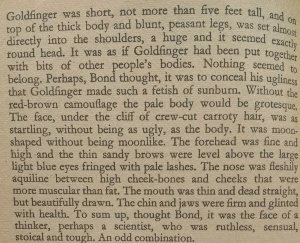 At school in English class our teacher had asked us to bring in a book with a vivid description of someone and my choice was Goldfinger. The book is about a man called Auric Goldfinger, a rich businessman who is suspected of smuggling gold. Bond is tasked to find out more and Fleming gives the reader a particularly compelling description of Goldfinger. Fleming describes him as having a body seemingly put together with parts of other people’s bodies. I always thought that was pretty good. Fleming used to write his first drafts of a book and then add in all sorts of details afterwards like the vodka martinis that James Bond liked so much and the Sea Island cotton shirts that Bond favours in the novels. It was actually Fleming who wore those particular shirts and who drank vodka martinis and also preferred scrambled eggs for breakfast. Many people have speculated who Bond was based on and my feeling has always been that in fact it was Ian Fleming himself.
 My current read is a book I mentioned last week, Charlie Chaplin and his Times by Kenneth S Lynn. Chaplin was a music hall entertainer working for the great impresario Fred Karno. Karno regularly sent teams of entertainers to the USA and while there Chaplin was invited to make a film for Mack Sennett, the famous producer of comedy films. Chaplin’s films proved to be enormously popular and so Chaplin moved on to different studios, all for better and better money until he established his own studio. I’ve always found the early days of Hollywood to be fascinating and this book is no exception.
Which books are you reading?
What to do next:
Share this post on your favourite social media!
Hit the Subscribe button. Never miss another post!
Listen to my podcast on Spotify: Click here!
Buy the book! Click here to purchase my new poetry anthology.
Click here to visit Amazon and download Floating in Space to your Kindle or order the paperback version.
 This week the lockdown has eased a little here in the UK. Groups of six can now meet together in public places and soon we will be able to go to the pub once again, as long as we stay outside. No doubt pubs who don’t already have beer gardens or some sort of outside area will be scrambling to get one set up. It will be nice to go down to the pub or restaurant again and take another step towards normality.
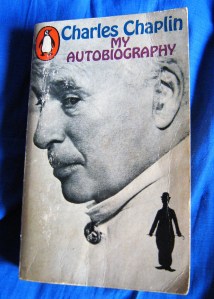 My Autobiography by Charles Chaplin.
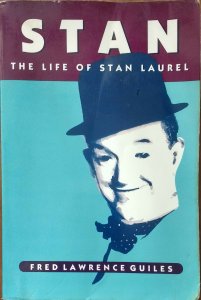 Stan, The Life of Stan Laurel by Fred Lawrence Guiles.
 Hollywood.
 I do love books and like everyone I have my favourites. Last week I wrote about reading a blog post asking the reader for their top 5 books of all time. I decided to go one better and work out my top ten. I gave you the first five of my top ten books of all time and this week it’s time for the other five, all in no particular order.
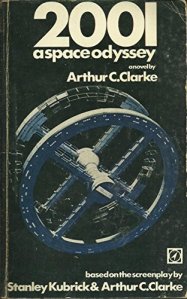 2001 A Space Odyssey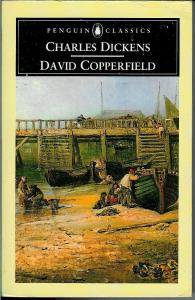
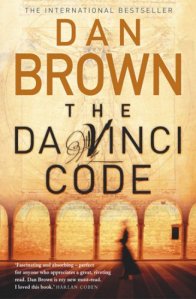 The Da Vinci Code
 page is for writers to talk about stuff, you know, publishing, agents, even actual writing but writers being a self-indulgent selfish lot, they usually just post links to their new books. Being similarly selfish I tend to add links to my new blog posts but on this occasion, I noticed something different, someone had asked a question. What are your 5 favourite books of all time?
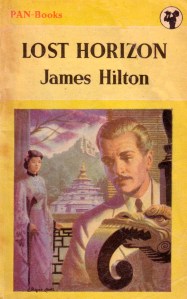 Lost Horizon
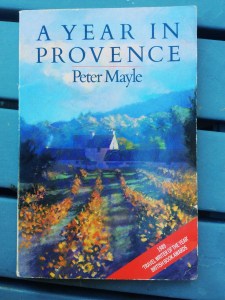 A Year in Provence by Peter Mayle
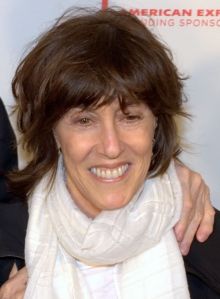
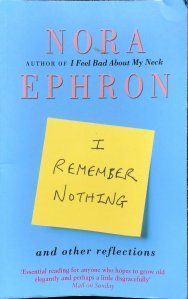 After watching the documentary film I felt even more determined to find out more about Nora so I went to abebooks on the internet and after some research ordered a copy of I Remember Nothing, a book by Nora that seemed to be a memoir. The book starts out as a sort of memoir, telling humorous stories about this and that, and her life without really giving much away. Nora wanted to be a journalist and after working for the Kennedy White House for a short while she joined the staff of the magazine Newsweek. In her book she tells the story of how Newsweek did not hire female writers and offered her a job as a mail girl. She doesn’t appear to have been upset by this despite it being blatantly sexist. She just got on with her job, still determined to be a journalist. In her book Nora makes the whole episode sound quite amusing, especially when she later writes a parody column during a newspaper strike and as a result gets invited to write for the New York Post. Over on Wikipedia, there is a slightly different story in which Ephron gets involved with a class action lawsuit filed against Newsweek for sexual discrimination.
 When I sat down on my break and flipped open the book, a small cutting fell out. It was a newspaper cutting dated November 14th 1995 from the Daily Express. An Actor Bombs went the headline and went on to tell the story of an actor:
 Today the tree has grown again, this time straight up and I can look forward to one day making apple pies again.
 I sometimes wonder why I go to all the effort of banging out a new blog post every weekend. My words like those of many others go forth into the internet and some multiply in terms of ‘likes’ and followers and some fall on stony ground. Still, what do I care? I have enjoyed the process of writing and have done ever since I was a child. I’ll go on banging out blog posts until the day when, well, the day when I don’t want to bang blog posts out anymore, when presumably I will either have found something more enjoyable to do or just shuffled off into the next world.
 The Murder of Rudolf Hess by W. Hugh Thomas
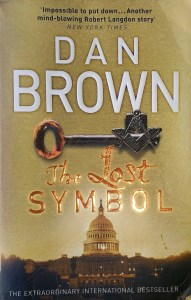 The Lost Symbol by Dan Brown.
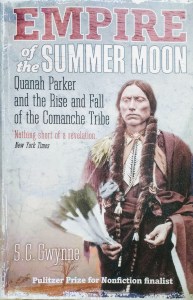 Empire of the Summer Moon by S.C. Gwynne
 half finished posts and stitch them into one. Maybe it’s worked, maybe not. Here we go . . .
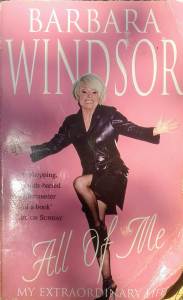 After Ronnie got the push, he was ‘aving it off’ with a blonde down at his club; Bar moved on to a younger guy and when that didn’t work out she moved onto an even younger guy. That younger guy, Scott, is still with her today and was in the news recently as Barbara has sadly been stricken with dementia and may have to go into residential care.
 Letters from an Unknown Author!