Soaps, Comedians and a DVD: This year’s Christmas TV

Now we are well into 2018 I thought I’d take a quick look back to the recent Christmas and New Year TV. I don’t know about you but for me it just wasn’t really up to standard, at least not on terrestrial TV or ‘proper’ TV as I call it. Christmas on proper TV was all about soaps, Doctor Who and old shows from the TV of yesteryear.

Coronation Street.

Eastenders has never been my cup of tea but I do like Coronation Street. What has been a little disappointing this year is that this soap, set in my home town of Manchester, has drifted away from a lot of the things I used to like about it. It’s not as ‘northern’ as it used to be, or as funny as in the Jack Duckworth and Hilda Ogden days and the current storyline about Pat Phelan which involves kidnapping and murder is just not what I want. I just wish Pat would go away and we could return to storylines about affairs, illicit relationships, and domestic issues with a large dose of tongue-in-cheek humour thrown in. In a recent Coronation Street special about Jean Alexander, who played the warbling Hilda, the many funny and amusing sides of her character were shown, including a very sad and touching  moment when she returns home after the death of her husband and opens a bag of his effects, clothes and spectacles and so on. The sight of these few simple items reduced Hilda to tears -and many viewers along with her. Those were the days when simple observations like that, some sad, some funny, took the series to ever higher dramatic standards.

Doctor Who.

Another Christmas broadcast that was pretty enjoyable was this year’s Doctor Who special which reunited the current doctor with the original, recreated by actor David Bradley and linked together their regenerations. Just to explain, Doctor Who is the UK’s longest running sci-fi show and one aspect that has helped it continue is that when the lead actor leaves the show, the doctor ‘regenerates’ into a new personality, and of course, a new actor. In this case, Peter Capaldi is leaving and Jodie Whittaker is the new and controversial female doctor. Sound a bit weird? Well, sounds very odd to me. It’s rather like those things you hear on the Internet where people call for a black or even a female James Bond. Bond of course is a white, upper class male and that is the only way to play him. A female Doctor Who? How that will work out is anybody’s guess but this year’s Doctor Who was a good episode, if a tad wordy which is the main problem for me with the modern version of Doctor Who.

Sarah Millican.

Sarah Millican, just for those who have never heard of her, is a Geordie comedian and on Christmas day Liz and I watched three of her stage performances back to back on one of the Freeview channels. Sarah isn’t for me a laugh out loud kind of comedian but she is amusing. She is one of those observational comedians, the ones who take nondescript things and make them into funny monologues. Think Peter Kaye and Garlic bread or Michael McIntyre and bad breath. I tend to prefer my comedians to just tell jokes the old-fashioned way but no, that’s not the way comics work these days. One of the funniest moments in Sarah’s routine was one in which she overheard three older ladies talking about what they would do if they became men for a day. One of the women answered, ‘knowing my luck I’d get a Tuesday –and what can you do on a Tuesday?’

As I watched these three performances, all pretty amusing, I started thinking how I could make some of my blogs into a comic routine. (They call them ‘stand up’ comedians these days so I wonder how they would class Dave Allen, the comedian who used to sit on a stool with a glass of whisky nearby?) Anyway, take one of my posts like The day the Cat War Started perhaps. That might make a reasonable comedy monologue. Introducing the neighbours, then the cats, then the confusion of the cats I was supposed to be feeding while my neighbours were away. Possible career change? Well, perhaps not!

There’s Something about Mary.

A great deal of this Christmas and New Year TV I haven’t watched ‘live’ as it were, I just pressed the record button and kept them for a quieter day so I have yet to see 50 years of Star Trek and a couple of Star Wars documentaries from BBC4 but I did watch ‘There’s Something about Mary‘ on New Year’s Eve as we declined to venture out in the face of a major rainstorm. We could have gone out later I suppose but by then the fire had been lit, the wine had been poured and the cheese was warming. The TV guide mentioned something about this film being a ‘movie classic’. Now to me, a movie classic is something like ‘All About Eve’ with Bette Davies which was shown on TV over Christmas but, sadly, I neglected to record, or ‘Lawrence of Arabia’ which I mentioned in a recent post. ‘Mary’ was mildly amusing with the occasional funny scene but was not, I must insist, a film which could now or ever be mentioned in connection with the phrase ‘movie classic’.

Harry Potter films and TV soaps seemed to be the main factor in this years TV schedule. I looked in vain to find a major new movie but the only one I could see was Spectre, the most recent James Bond film which was shown on New Year’s day. Pity really because I happened to be working then. Oh well, 50 Years of a Star Trek is still there on my hard drive so I look forward to the end of one of my late shifts when I might just start it up and relax with a glass of port.

The Intruder.

One final film, and it’s not one that you will find in the TV guide. The Intruder was a DVD that appeared in my Christmas stocking and is one of those classic British films starring the wonderful Jack Hawkins and a whole host of familiar faces from British films of yesteryear. Set in the 1950’s, former army Colonel Merton played by Jack Hawkins returns home to find he is being burgled by one of his own former wartime platoon members, Ginger, played by Michael Medwin. Ginger runs off when he thinks Colonel Merton has called the Police so the colonel decides to track the man down. He visits his former army comrades and they each tell a story in flashback that builds up a picture of Ginger, his life and that of his comrades. It must have been strange to have lived through the intensity of war and then to return home to rationing and shortages and the near normality of post war Britain. The film, directed by Guy Hamilton who also directed some of the early James Bond films, captures all that perfectly.

Despite the host of cable and satellite TV channels available these days, it’s a shame that sometimes you have to crank up the DVD player to find something worthwhile to watch.


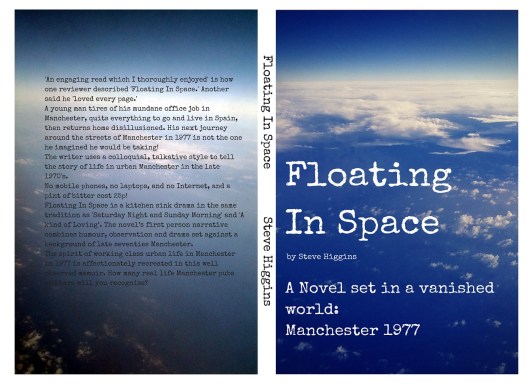
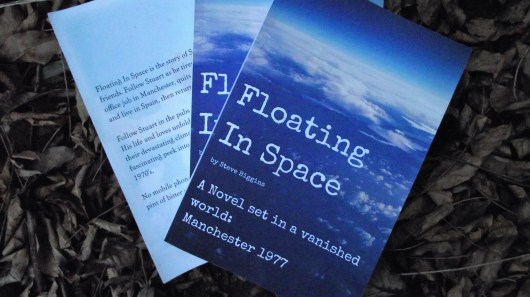
Steve Higgins is the author of Floating in Space, a novel set in Manchester, 1977. The book is available in Kindle or paperback formats. Click the icon below to go straight to Amazon.
Floating in Space

The Men in White Suits

Alec Guiness.

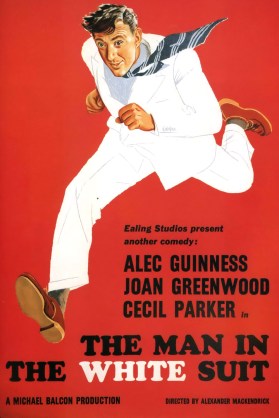
In case you haven’t seen it, and I can’t imagine for a moment that you haven’t, The Man in the White Suit was a British comedy film made by Ealing Studios in 1951. The film starred Alec Guinness as Sydney Stratton, a scientist and researcher specialising in man-made fabrics. His dream is to discover an everlasting fibre that never wears out. He is dismissed from numerous jobs because of his demands for ever more expensive facilities. Circumstances occur where he becomes an unpaid researcher at the hi-tech Stratton Mill where he finally discovers his new fibre. Sydney is over the moon as he wears his prototype indestructible suit for the first time. His new cloth is about to be revealed to the world but panic sets in; will this mean the end of the industry? After all, surely there will only be one lot of cloth to be made as it never wears out? Both union and senior executives in the textile industry unite to prevent the fabric coming out to the public domain but mill owner’s daughter Daphne Birnley, played by the husky voiced Joan Greenwood, strives to help Sydney to pursue his dream.

At the end of the film an angry mob who have pursued Sydney are united in laughter when the fabric becomes unstable and Sydney’s white suit falls apart.

One of the highlights of the film is the sound effect we hear whenever Sydney’s research apparatus is revealed. It is a rhythmic burbling sing-song sound that becomes a sort of musical motif for Sydney Stratton. At the end of the film he goes on his way and looking at his notebook has a thought, has he realised what was wrong? The burbling sound fades in as Sydney walks away.

Paul Sinha. (Picture courtesy Daily Express)

Paul Sinha.

I don’t know about you but weekday afternoons just wouldn’t be the same without the Chase. The Chase is a TV quiz show where four contestants try to build up a prize fund then play against the ‘Chaser‘, a seasoned quizzer, to take home that fund in the Final Chase. Sometimes the contestants win, sometimes not. Mark Labbett is the perhaps the most well-known chaser. He is known as the ‘Beast’ and is a former schoolmaster who had a success on the TV show ‘Who Wants to be a Millionaire’. Anyway, my personal favourite is the Sinnerman, Paul Sinha. Paul began a stand up comedy career in London while he was a junior doctor. He has appeared on his own radio show and as a quizzer competed in University Challenge, Mastermind, and Brain of Britain. Paul joined the Chase in 2011 as the fourth Chaser. His nicknames include the ‘Sinnerman‘ and ‘Sarcasm in a Suit’. He is a smiling, witty and erudite competitor and always wears his trademark white suit.

David Essex.

David Essex was a performer who made his name in the early seventies although in his youth he had ideas of becoming a footballer. He played the lead in the stage musical Godspell and then went on to star in the film ‘That’ll be the Day’. I remember seeing his album in a record shop and thinking what a cool dude he looked in his white suit. The album was ‘Rock On’ and the single of the same name went to number 3 in the UK charts in 1973.

The next year David released one of my all-time favourite tracks ‘Gonna make you a Star’ which went all the way up to number 1. He also appeared on the double album ‘Jeff Wayne’s War of the Worlds’ and went on to star in the musical ‘Evita’. In 2011, he joined the cast of TV soap ‘EastEnders’.


Steve Higgins.

When I saw David Essex singing ‘Rock On’ wearing a white suit on ‘Top of the Pops’ for the first time, I thought he was the epitome of seventies cool and it occurred to me that one way to transform my gangling self-conscious self into something better might be to get that very same white suit. I couldn’t afford a suit at the time so I settled for a jacket, a white jacket, and I well remember admiring myself in the mirror before my first Saturday night out wearing it, sometime back in 1973.

The first problem I encountered with the jacket came on the bus into town. I sat on the back seat and in those days, the back seats of our local buses were a little notorious for being dusty and grimy as they were over the engine and absorbed all the engine fumes. Also there were people who put their feet up on the seats leaving marks to which people like me (the twerp in the white suit) were highly susceptible. Another thing is that all my life I have been cursed with being clumsy and once I had met up with my friends I somehow managed to spill beer all down my sleeve. Anyway, the night went on, more or less successfully. I certainly remember having a good time although the white jacket failed in its primary function; that of attracting gorgeous girls. Later on we stopped at the kebab shop and somehow a sizeable portion of chilli sauce managed to attach itself to my jacket. Rather than feeling like David Essex, I felt a little like Alec Guinness in the aforementioned ‘Man In The White Suit‘, wanting to get away from everyone! I never wore the stained jacket again and it lingered sadly in the back of my wardrobe smelling of kebab, chilli sauce, beer and diesel fumes until my Mum, on a major clean up splurge, decided to throw it out.

Of course, it could have been worse: I could have gone out wearing jeans, a white t-shirt and a red jacket and tried to look like James Dean! (Actually, that was another night!)


What to do next: Here are a few options.

Share this post on your favourite social media!

Hit the Subscribe button. Never miss another post!

Listen to my podcast Click here.

Buy the book! Click here to purchase my new poetry anthology.

Click here to visit Amazon and download Floating in Space to your Kindle or order the paperback version.

Burton, Taylor, and the Nature of Love.

I’m always recording films and TV shows to watch and the other day I scanned through my hard drive to find that some time ago I had recorded a movie called Burton and Taylor. It’s a made for TV movie, first shown on BBC Four. I found it on the drama channel and it’s about, as if you hadn’t already guessed, Richard Burton and Elizabeth Taylor.

Back in 1983 when this film is set, Burton and Taylor were probably the most famous celebrity couple in the world. The only other couple of a similar status that I can think of are Mary Pickford and Douglas Fairbanks, a couple from a completely different era. Let me see who else comes to mind; Brad Pitt and Angelina Jolie, Kurt Russell and Goldie Hawn, Tom Cruise and Nicole Kidman, Posh and Becks. Hardly in the same class are they?

Back in the 1920’s, nearly a hundred years ago, silent movies travelled the world, unhampered by the constraints of language. Stars like Mary Pickford and Douglas Fairbanks were as famous in Moscow and Tokyo as they were in London and New York.

Fairbanks and Pickford in a postcard from the 1920’s

Mary Pickford was known as America’s Sweetheart in part due to her work during the first World War selling Liberty Bonds. She had a Canadian background but she became a US citizen when she married Fairbanks. Douglas Fairbanks made a series of swashbuckling films like Robin Hood, The Three Musketeers and The Thief of Baghdad. The couple bought an estate on Summit Drive in Hollywood which the press dubbed ‘Pickfair’. The house became the focal point of social life in the movie capital and the Fairbanks’ invited many famous people there. As well as the film stars of the day, HG Wells visited as did F Scott Fitzgerald, Amelia Earhart, Lord Mountbatten, Noel Coward and many others.

Along with Charlie Chaplin and the silent movie director D W Griffith, the couple founded the film company United Artists, but as actors they did not fare well when talking pictures came along and they retired from the screen. In retirement, Fairbanks wanted to enjoy his love of foreign travel but Pickford hated travelling, so on many occasions Douglas travelled alone. On one trip he met an English socialite, Lady Ashley and began an affair that ultimately led to the end of his marriage . Douglas and Mary were eventually divorced in 1936.

Richard Burton and Elizabeth Taylor. Image courtesy Wikipedia Creative Commons.

Richard Burton and Elizabeth Taylor met on the set of the film Cleopatra in 1961, a movie that went down in history as one of the most expensive ever made. Taylor didn’t want to make the picture so decided to ask for a ridiculous amount of money, confident that 20th Century Fox would never pay it. However, pay it they did and the troubled movie went into production. The Burton/Taylor TV film however focusses on the later years of the pair when they decided to star in a stage revival of Noel Coward’s witty play, Private Lives.

In the film, Taylor is played by Helena Bonham-Carter and Burton by Dominic West. West doesn’t really look much like Burton but captures his voice and persona well. Bonham-Carter as Liz Taylor does look surprisingly like the original and together they make a good reproduction of the famous couple.

The writer seems to believe, and whether it is true or not I don’t claim to know, that Liz Taylor engineered the theatre production of Private Lives as a way of bringing her and Burton back together again. They had already been married and divorced twice and the movie reveals that Liz clearly still had feelings towards Burton. On the first day of rehearsals she is surprised that Burton will not be lunching with her but spending time with his new girlfriend, Sally. Burton in turn is shocked that on the first read through it is clear that Taylor has not previously read the play. Burton of course knows it off by heart. He is the consummate professional actor and Taylor the consummate professional movie star. During the run when Taylor calls in sick, the production is halted rather than carry on with an understudy, as it becomes clear from the public reaction that the audience are not interested in the play without superstar Liz.

Helena Bonham-Carter and Dominic West (image courtesy BBC)

Burton and Taylor were clearly in love but love must have been difficult in the face of their superstar status, just as it was for Fairbanks and Pickford. I can imagine Burton’s upbringing in a mining community and Taylor, having been a star since childhood, were not personalities that could bend much for the other.

The film is interesting, enjoyable and gives the viewer a fascinating peek into the private lives of these two superstars of the past.

In one sequence where the pair sit down and reminisce together, Burton considers the nature of love and ponders about love’s important ingredients: Is it passion? Is it sex? I’m not even sure of the answers myself. Both sex and passion are important but so are respect, humour and understanding.

William Shakespeare was a man who knew a thing or two about love and one of his most famous sonnets, Sonnet 116 provides a quintessential definition of love. Love, according to this sonnet, does not change or fade; it has no flaws and even outlasts death.

Let me not to the marriage of true minds
Admit impediments. Love is not love
Which alters when it alteration finds,
Or bends with the remover to remove:
O no! it is an ever-fixed mark
That looks on tempests and is never shaken;
It is the star to every wandering bark,
Whose worth’s unknown, although his height be taken
Love’s not Time’s fool, though rosy lips and cheeks
Within his bending sickle’s compass come:
Love alters not with his brief hours and weeks,
But bears it out even to the edge of doom.
If this be error and upon me proved,
I never writ, nor no man ever loved.

My favourite though, has to be this one;

Shall I compare thee to a summer’s day?
Thou art more lovely and more temperate:
Rough winds do shake the darling buds of May,
And summer’s lease hath all too short a date:
Sometime too hot the eye of heaven shines,
And often is his gold complexion dimmed,
And every fair from fair sometime declines,
By chance, or nature’s changing course untrimmed:
But thy eternal summer shall not fade,
Nor lose possession of that fair thou ow’st,
Nor shall death brag thou wander’st in his shade,
When in eternal lines to time thou grow’st,
So long as men can breathe, or eyes can see,
So long lives this, and this gives life to thee.

I particularly like the two last lines. They tell us how the subject lives again in every reading of the sonnet which is a very wonderful thing that applies not only to this but to all other literary evocations of the past. Was the subject of this sonnet a real person or was it just an ode to wonderful women in general? It was a real woman, I suspect, although I am no Shakespeare expert but whoever she was, she lives again in this work, just as the author wished.

When I began writing this post about love, I was inspired by a distant memory, a quote, a distant few lines that seemed just out of reach in the back of my mind. When I finally brought those words into focus and tracked them down, I realised I must have read them in the Bond novel Goldfinger.

Some love is fire, some love is rust. But the finest, cleanest love is lust.” Wikipedia claims that when Ian Fleming used that line he was quoting from ‘The Wild Party’, a book length poem by Joseph Moncare March. Fleming changed the quote slightly in Goldfinger but I liked it so much myself, it inspired my own poem, Some Love.


If you enjoyed this post then why not try my book, Floating in Space? It is written in a talkative, colloquial style just like my blog posts. Click the links at the top of the page for more information.

Three Restored Movie Classics

edclapperboard-311792_1280So what actually is a ‘restored’ movie? Well, it is simply this; an old movie restored to its original condition, with deleted scenes added, lost scenes and dialogue inserted and basically restored to its former glory. In some cases, movies are restored to more than their former glory as on many occasions, producers, sensitive to preview audiences and running times, have unscrupulously cut movies and left many a director fuming. A lot of older films, unless preserved in the studio vault have been lost and restorers have hunted down copies of those lost films and those excised scenes that have been lost over the years. Here are three classic restored films.
Lost Horizon
Directed by Frank Capra and starring Ronald Colman, Lost Horizon was shot in 1936 and seriously went over budget. Issues that contributed were scenes shot in a cold storage area, used to replicate the cold of Tibet: The cold affected the film equipment and caused delays. There was also a great deal of location shooting and scenes where Capra used multiple cameras shooting lots of film. Wikipedia reports that the first cut of the film ran for six hours! Studio Boss Harry Cohn was apparently unhappy with the film and edited it himself, producing a version that ran for 132 minutes. Further cuts were later made and as a result, Capra filed suit against Columbia pictures. The issue was later resolved in Capra’s favour. The film did not turn a profit until it was re-released in 1942. A frame by frame digital restoration of the film was made in 2013 and various missing elements of the film were returned, including an alternative ending.
Lost Horizon is one of my favourite books ever and this movie adaptation is nothing short of wonderful, in fact it is one of my favourite films of all time. The casting of the urbane Ronald Colman as diploment Robert Conway is perfect. If you see this movie on DVD make sure you take it home and settle down for a wonderful film experience.

Spartacus.
You probably thought film restoration was only about really old films from the early years of cinema but it’s about any classic film that needs work. Spartacus was made in 1960 meaning it is 56 years old this year and was restored in 1991. The movie was produced by and starred Kirk Douglas and was directed by Stanley Kubrick, whom Douglas brought in to direct after becoming disenchanted with the original director, Anthony Mann. The film is the story of a revolution, or at least a near revolution in ancient Rome. Spartacus, played by Kirk Douglas is a slave who starts off a rebellion in a gladiator camp; the rebellion gets bigger and bigger until it threatens the entire fabric of ancient Rome. Laurence Olivier played the part of the Roman general and politician Marcus Licinius Crassus who uses the rebellion to further his own dreams of dictatorship. Peter Ustinov plays the gladiator school owner and Charles Laughton plays Roman senator Gracchus. Ustinov, Olivier, and Laughton are a wonderful trio, their performances superb, so much so that other actors who share the screen with them seem to pale in comparison.
Tony Curtis plays another slave who calls out famously; ‘I am Spartacus’ towards the end of the film, heralding a chorus of similar calls.
In the restoration, 37 mins of cuts were restored to the film including a scene where Anthony Hopkins had to dub the sound for a sequence involving Laurence Olivier who had died two years previously.

Lawrence of Arabia.

Directed by David Lean from a screenplay by Robert Bolt, Lawrence of Arabia is a visually stunning film, shot in 70mm. The movie is based on the book ‘Seven Pillars of Wisdom’ by the enigmatic T.E. Lawrence himself, and won seven academy awards including Best Director and best Picture.
Peter O’Toole stars as Lawrence although he was not the first choice for the part. Lean actually wanted Albert Finney but Finney had reservations about the film and wasn’t keen on being locked into a long term contract so he declined, despite shooting an expensive test at MGM studios in Borhamwood. It was then that Lean cast O’Toole after being impressed by his performance in ‘The Day they robbed the Bank of England’.
Director Lean wasn’t too pleased with the original script so Robert Bolt was brought in to essentially rewrite the film. A further complication was added when Bolt was arrested for his part in an anti-nuclear protest in London and so the production started without Bolt’s completed re write.
The film is famous for a number of classic shots. One is the cut from Lawrence blowing out a match to a shot of the rising sun in the desert and another is the famous long shot of Sherif Ali, played by Omar Sharif, who trots from the horizon astride his camel towards the well where Lawrence has stopped for water.

Steven Speilberg has been quoted as saying that this was the film that made him want to be a director and perhaps that is why so many of his productions have a sort of ‘David Lean’ feel about them.

The film was restored in 1989 with various cuts returned to the film. One sequence involved the late actor Jack Hawkins and Charles Gray had to dub dialogue for Hawkins’ character.


If you enjoyed this post, why not try my book, Floating In Space, a novel set in Manchester, 1977. Click the links at the top of the page for more information, or the icon below to go straight to Amazon.

Favourite Movie Directors Part 2 Oliver Stone

oliver stoneFavourite movie director part 1, which you can read by clicking here, is about Woody Allen. Allen has a directoral style that lets the viewer’s eye roam roam the scene. Oliver Stone on the other hand has a much more forceful style, a highly visual style which takes a firmer hand with the viewer.

To start with, here’s some biographical stuff about Stone:

Oliver Stone was born on September 15th, 1945. The only son of Louis Stone, a successful stockbroker and Jacqueline Goddet. His mother was a French student who his father, then in the Army, eloped with as a war bride in Paris in 1945. He grew up in New York and attended Trinity School on the west side of Manhattan and later attended The Hill, a boarding school in Pottstown, Pennsylvania.

Stone attended Yale University in 1964-65 but dropped out after one year. In 1967 he enlisted in the US Army and served in Vietnam with the 25th Infantry and later the 1st Cavalry.
Back in the USA he enrolled at university in New York and studied filmmaking. Martin Scorsese was one of his teachers. Vietnam was among the first subjects of his student films.

Oliver Stone

Image courtesy Wikipedia

Stone graduated in 1971 and took on various jobs while he wrote screenplays. His breakthrough success was in 1978 with the screenplay for the film Midnight Express for which he won the Academy Award for best adapted screenplay.

The first Oliver Stone movie I ever saw was the 1986 movie ‘Platoon.’ Stone wrote and directed the movie set during the Vietnam War and based on some of his own experiences. It focuses on a new recruit, played by Charlie Sheen and follows through pretty much what happened to Stone himself when he arrived in Vietnam. It shows Sheen getting used to the situation in Vietnam, the weather, the jungle patrols and so on. It also shows the disregard that the other soldiers have for Sheen and any other soldier new to the front line. A newcomer’s life was less valuable than the others who had served their time and put years into the war. It’s a reversal of what you might expect in warfare but the Vietnam conflict was a different war. The combatants were wondering what were they doing there, thousands of miles away from home and for what, and who, were they fighting ? That sort of thinking bred a selfish soldier. Platoon tells the story of those soldiers, all of whom are brutalised in some way by the conflict.

Oliver Stone followed up the movie with another Vietnam film, ‘Born on the 4th of July’ about Vietnam veteran Ron Kovic. Kovic was a Vietnam vet shot and paralysed from the waist down in the jungle and it is a truly shocking film, perhaps even more so than Platoon. After he has been wounded, Kovic returns to a veteran’s hospital in the USA that is grim and disgusting and as I watched it, it contrasted sharply with another war film from a different era, Reach for the Sky. Kenneth More stars as Douglas Bader who, after a terrible crash, is taken to a hospital full of crisp white sheets and antiseptic cleanliness. The contrast between the two hospitals is shocking. A third film completed Oliver Stone’s Vietnam trilogy, Heaven and Earth released in 1993.

Wall Street was a hit movie for Oliver Stone in the eighties and the character of Gordon Gekko played by Michael Douglas became an eighties screen icon. Gekko is a ruthless Wall Street player, a stockbroker and financier who looks at a hundred deals a day. Martin Sheen plays Bud Fox, a young salesman determined that one of those deals will be with him. Fox is ultimately corrupted by Gekko as he becomes involved in many shady schemes but in the end he betrays Gekko to the authorities. In Wall Street Stone first develops a mesmerising visual style almost akin to a music video and it is a style that many film-makers seem to have picked up.

In JFK, Stone takes this visual style to another level and combines various film formats to produce a stylish visual montage. The subject is a controversial one, the shooting of President John Kennedy in Dallas in 1963. Stone decides to use the investigation by New Orleans District Attorney Jim Garrison as a vehicle to explore the various theories about the shooting although ultimately an amorphous military industrial complex is blamed for the conspiracy. Criticism rained down on Oliver Stone from anti conspiracy theorists but I personally felt that the movie was a fair one and everything that was conjecture was shown as conjecture. The great treat for me was the combining of the different visuals and the inter weaving of documentary film with new footage. The movie also led to calls to release more information and led to the Assassinations Records Review Board recommending that all assassination materials be released by 2017. The John F Kennedy Assassinations Records Collection Act 1992 has since become known as the JFK act. Stone went on to make two more films about American presidents, Nixon and W, the latter film about George W Bush.

In recent years Stone made a TV series called ‘Oliver Stone’s Untold History of the USA.‘ I thought, or was led to believe by the hype, that this TV series would be a complete retelling of history. Secrets hidden from the public would perhaps emerge to show how history and events have been manipulated. To be fair, there is some of that. The dropping of Henry Wallace from Franklin D Roosevelt’s Presidential ticket was shown as a blatant manipulation of the democratic process. I might have felt more sympathy for Henry Wallace had the show not preceded this by a disparaging of Churchill in a prior segment. Stone seemed to think that Roosevelt was a man who had the measure of Stalin, especially at their last meeting but it is clear to me that in fact it was Churchill who understood Stalin and Roosevelt who only thought he did.

I have a number of Oliver Stone DVD’s in my collection. Platoon, Born on the 4th of July, JFK, Wall Street, The Doors, not to mention the TV series mentioned above which I have only just started to watch. I still think of Oliver Stone as one of the great movie directors. He is passionate about cinema and has highly political views and yet is still able to laugh at himself. In 1993 he played a small part in the movie ‘Dave’ playing himself as a conspiracy theorist who believes the President has been replaced by a double. Actually, if you have seen the movie, he has!

Oliver Stone’s latest movie is Snowden, the incredible untold personal story of Edward Snowden, the polarizing figure who exposed shocking illegal surveillance activities by the NSA and became one of the most wanted men in the world. He is considered a hero by some, and a traitor by others.


If you liked this post, why not try my novel, Floating In Space. Click the links at the top of the page or the icon below to go to Amazon!

Captain Kirk, Al Jolson, and the problem with Windows 10!

captain kirkTime passes, as Dylan Thomas said in Under Milk Wood. Time passes and the new replaces the old. Okay but why is it that the old is sometimes better than the new? Here are a few cases in point.

Star Trek.

Here is something that may be a revelation to you; if you don’t know it already it will vastly improve your understanding of Star Trek. It’s a simple truth and here it is, Star Trek is about three guys, Captain Kirk, Mr Spock and Doctor McCoy. Sometimes there are four, we can maybe throw in Scotty but that’s it, that’s the essential truth about Star Trek and that’s why things like the Next Generation and Deep Space 9 will never come up to scratch, simply because Kirk, Spock and McCoy are not involved. Even the Star Trek people themselves understand this, which is why Star Trek has been reinvented (re-imagined to use movie speak) with new actors playing Kirk and his crew in the latest Trek movies.

Forget about Mr Pointy-head Captain Picard and the cocktail lounge style bridge on his version of the Star Ship Enterprise. Why on earth does he have to run every decision over his number two, his councillor and everyone else on the bridge when Kirk would have just sorted that situation out like a shot and would even have found a pretty girl to flirt with too? Deep space 9: A load of old tosh and as for Star Trek Voyager? Well, I have to say I do like the later episodes when Captain Janeway finally got rid of her previous weird hair styles and the drippy Kes got the bullet from the show and was replaced by the rather interesting Seven of Nine, a young lady rescued from the clutches of the Borg. As much as I like Voyager, it really can’t compete with the original. Yes, in every way, old is better.

Movies.

If you are a regular reader of this blog you will know that I like my movies. I much prefer old classic movies to the latest films. The last movie I caught at the cinema was the latest Bond movie, well actually, not even the latest one, it was the one before that! I did try to see the new one, Spectre, but when I enquired at the picture house about the movie, the lady behind the counter looked at me and said: ‘Spectre? That movie has been and gone,’ as if I had been talking about Gone with the Wind. As I remember it, there were still Spectre film trailers being shown on the TV so my enquiry was not all that silly, although shortly afterwards they released the film on DVD. There seems to be a short shelf life for movies these days; they are released, shown for a while at the cinema and then whoosh –straight to DVD.

DVDs.

Talking of DVDs, one I picked up lately from e-bay for a measly few pounds was a DVD with two movies: The Jolson Story and the follow up, Jolson Sings Again. The Jolson Story is typical of the kind of movies watched in our house when I was a child. My Mum was a big musical fan and we watched a lot of musicals. I do love those movies of the forties and fifties, the ones where someone says something like ‘let’s put the show on right here!White Christmas with Bob Hope and Bing Crosby is the sort of movie I mean, some light comedy, some great songs and they put on a show in their old wartime colonel’s failing hotel. The Jolson Story has some wonderful songs, proper tuneful yesteryear classic songs and Larry Parks plays a great part. Sadly he was black listed by the House Committee on Un-American Activities and only made a few more films afterwards.

A much more modern movie I picked up recently on DVD was A Bridge of Spies starring Tom Hanks and directed by Steven Spielberg. Spielberg’s reputation as a great director precedes him as they say but for my money, I don’t really think his films are that great. I can’t rubbish this film by any means but it was a little tame and I have found that with a lot of his films, they always seem to fall slightly short of the mark somehow. Might have to sell Bridge of Spies in the same place I found it, on e-bay!

Windows 10.

Now, here is a perfect example of the old being better than the new. With my old laptop kitted out with windows XP and later windows 7 I could carry on doing the simple nerdy things I have always done on my laptop. As you know from these posts I have a long trip to work every day, I hate radio with adverts so I play a lot of discs, most of which I make up myself. I used to drop a DVD into my laptop, use windows sound recorder to copy some music or dialogue. Later I’d use various software bits and pieces to cut and paste, mix, and create a CD of favourite film music and dialogue that I could play in my car.

Anyway, in Windows 10, which I updated to not long ago, there is no sound recorder. There is however ‘voice recorder’ which I assume works in the same way only the tab on my computer is greyed out and when I click on it a message appears which says go to the windows store. Okay, I click that; a box opens up saying ‘windows store’, looks like it’s doing something for a minute than just closes. Right, so next I go to the Microsoft website, click on ‘windows store’, find windows voice recorder, click the download button and nothing happens. After a quick search I find windows sound recorder, I click on that and it says ‘not compatible with your device’!

While I’m on a rant about windows 10 here’s another thing. When I first installed windows 10, everything seemed to be in order but lately, every time I click on the start menu I get a critical error report and a box comes up saying ‘log out of windows and we will repair the error when you log back in’. So, like the box says I log out, log back in but did they keep their word? Have they fixed the critical error? No!

Wonder what Captain Kirk would do? Knowing him, a good blast from a Phaser will solve everything!


If you liked this post, why not try my novel, Floating In Space? Click the links at the top of the page for more information!

Terence Rattigan and my Movie Connections.

terence RattiganIt’s always a good feeling when you watch a movie you have really enjoyed. If you are like me then you will usually take a scan through the credits and look for familiar names. Sometimes you will see one that rings a bell; Hey, that director is the same guy who directed one of your real favourites or, that screen writer is the same writer who wrote another movie you enjoyed. That’s what I call a movie connection.

The Winslow Boy is one of my favourite old movies. It was written by Terence Rattigan and adapted from his own play. The original starred Robert Donat (who hailed from Withington in Manchester) playing the part of Sir Robert Morton and was directed by Antony Asquith. You may be more familiar with the recent version starring Jeremy Northam and Nigel Hawthorne which, all things considered, wasn’t a bad film. Anyway, the first time I saw the original movie I made a mental note of Terence Rattigan for future reference.

Here’s another movie: The VIPs, a film about various characters delayed at London Airport due to weather. It’s a lovely movie with great performances by Richard Burton, Elizabeth Taylor and Margaret Rutherford. It was a movie I really enjoyed so I checked the credits and what did I find? Screenplay by Terence Rattigan. Directed by Anthony Asquith. Yes, I thought, that rings a bell.

A great Sunday afternoon film is The Yellow Rolls Royce. I don’t know if you’ve ever seen it but it is three separate stories, all connected by the Yellow Rolls Royce. My favourite episode is one starring Shirley Maclaine. She is involved with gangster George C Scott and they are on holiday in Italy. When her gangster lover has to return to New York to sort out ‘some business,’ Shirley is left alone with young Italian Alain Delon. She falls in love with him but realises that when George returns, her new lover’s life expectancy will be very short. So, she tells him she doesn’t love him at all and returns to the USA with gangster George. Although he doesn’t realise it, Shirley has saved Alain’s life. As I watched the credits pass by, there were those names again, Anthony Asquith and Terence Rattigan.

rattiganAsquith was the son of the British Prime Minister Herbert Asquith. He was a great friend of Terence Rattigan and they collaborated on 10 films together but it’s Rattigan I want to write about here. Who who was he? Well, he was a playwright who wrote a number of west end hits, many of which were made into films. You may recognise some from this list; The Way to the Stars,  The Winslow Boy, The Browning Version, The Deep Blue Sea, The Price and the Showgirl, Separate Tables, The Sound Barrier and the Yellow Rolls Royce.
Wikipedia says Rattigan was a ‘troubled homosexual, who saw himself as an outsider, and that his plays ‘confronted issues of sexual frustration, failed relationships and adultery.’

He was born in 1911, had quite a privileged upbringing and was educated at Harrow. His first play was ‘French Without Tears’ about a crammer where English students go to learn French. Rattigan joined the Royal Air force at the outbreak of the Second World War and became an air gunner. He used his experiences to write a play called ‘Flare Path’ which eventually became the movie ‘The Way to the Stars’, also directed by Asquith, the DVD version of which resides happily on my DVD shelf.

Terrance RattiganRobert Donat relished the role of Sir Robert Morton in the Winslow Boy. Morton is an MP cum barrister who takes the British Admiralty to court over the sacking of Cadet Winslow. In my favourite scene, Sir Robert Morton questions Ronnie Winslow about the incident in question, that of the theft of a postal order. The questioning goes fairly gently until Sir Robert ups the ante when Ronnie, the Winslow Boy himself, mentions talking to another boy;
RONNIE I said, “Come down to the Post Office with me. I’m going to
cash a postal order.”

SIR ROBERT ‘Cash’ a postal order?

RONNIE I mean ‘get’.

SIR ROBERT You said ‘cash’. Why did you say ‘cash’ if you meant ‘get’?

RONNIE I don’t know.

SIR ROBERT I suggest ‘cash’ was the truth.

RONNIE No, no. It wasn’t, really. You’re muddling me.

SIR ROBERT You seem easily muddled. How many other lies have you told?

RONNIE None. Really, I haven’t.

SIR ROBERT I suggest your whole testimony is a lie.

RONNIE No, it’s the truth.

SIR ROBERT I suggest there is barely one single word of truth in anything you’ve said either to me or to the Judge Advocate or to the Commander. I suggest that you broke into Elliot’s locker, that you stole the postal order for five shillings belonging to Elliot, that you cashed it by means of forging his name.

RONNIE I didn’t. I didn’t.

SIR ROBERT
I suggest that by continuing to deny your guilt you’re causing great hardship to your own family and considerable annoyance to high and important persons in this country.

CATHERINE
That is a disgraceful thing to say.

SIR ROBERT
I suggest that the time has at last come for you to undo some of the misery you have caused by confessing to us all now that you are a forger, a liar, and a thief!

CATHERINE
How dare you!

RONNIE
I’m not. I’m not. I didn’t do it.

It looks like everything is all over then Sir Robert asks for all the available papers to be sent to him. ‘Is that necessary now?’ asks someone.

‘Of course’, replies Morton. ‘The boy is plainly innocent. I accept the brief.’

There is also a rather subtle flirtation between Catherine, Ronnie Winslow’s elder sister and Sir Robert. Catherine comments ‘how little you know about women’ to Sir Robert after an exchange between the two. He later replies to her when she doubts she will see him again, ‘How little you know about men, Miss Winslow!’

The Winslow Boy is a delightful film which captures perfectly that ‘upstairs, downstairs’ life in the early part of the twentieth century. Look out for excellent supporting performances from Jack Watling and Kathleen Harrison as well as those of the feature players, Robert Donat and Margaret Leighton. You may have to search ebay for the DVD version as the movie is not one of those we see often on terrestrial TV.

Remember, don’t forget to check the credits on a film. You may find a lot of familiar names on the movies you love!


What to do next: Here are a few options.

Share this post on your favourite social media!

Hit the Subscribe button. Never miss another post!

Listen to my podcast Click here.

Buy the book! Click here to purchase my new poetry anthology.

Click here to visit Amazon and download Floating in Space to your Kindle or order the paperback version.


The Remainder of the day: Three Movie books

Perhaps you won’t see straight away what I did there in that title. If I go on to say I’m going to talk about remainder books then you might start to get the picture. I’ve spoken before in this blog about my passion for books, especially second hand books. I also have quite a few books that should have been very expensive but were greatly reduced in price. Why? Because they were remainder books. So what exactly are remainder books?

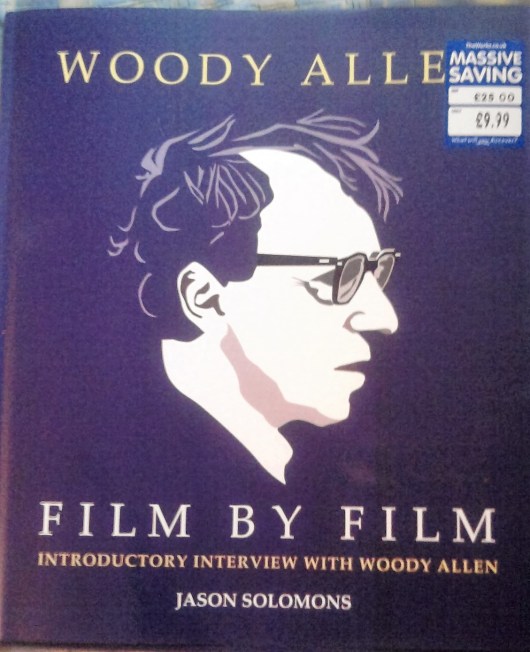
Well, they are copies of a book left over after a print run which are then sold off quickly at a cheap price. Many stores like the Works specialise in these types of books. There is a Works store in the Arndale Centre in Manchester where you will find me flipping through numerous books when I have any free time, looking to nail myself a bargain. Here are three ‘remaindered’ books in my collection, all about movie directors.

Woody Allen.

Woody Allen
Now I’ve kept the price on this book so you can see what a big saving I’ve made: A hefty fifteen pounds and a penny and in return for my £9.99 I get a big full colour hard back book which itemises all Woody’s movies all the way from ‘What’s New Pussycat’ to his 2015 offering ‘Irrational Man’. Now, I have to say  that the aforementioned ‘What’s New Pussycat’ is one of my favourites of Woody’s movies although in the book it doesn’t get such a great review. Pity because it’s a great sixties classic. You can read more about Woody Allen in one of my previous posts.

David Lean
Photo0014
Illustrated with over 400 pictures this is a lovely book to have, detailing the life and work of director Sir David Lean and written by his widow Lady Sandra Lean. David Lean is probably best remembered for his big screen epics like Laurence of Arabia, Doctor Zhivago and Bridge on the River Kwai. He started out as a teaboy with Gaumont Studios in London, later became a film editor and then moved on to become a director. He co-directed ‘In Which We Serve’ with Noel Coward although he later said Coward soon became bored with directing and left the whole thing to Lean. He would never share the directing credit again although his next three movies were adaptations of work by Noel Coward. Surprisingly, he only directed seventeen movies; I always thought his list of credits would be a lot longer. He won two best director Oscars and as a filmaker he inspired many directors like Steven Spielberg and Martin Scorcese. He died in 1991 from throat cancer.

Billy Wilder
Photo0027

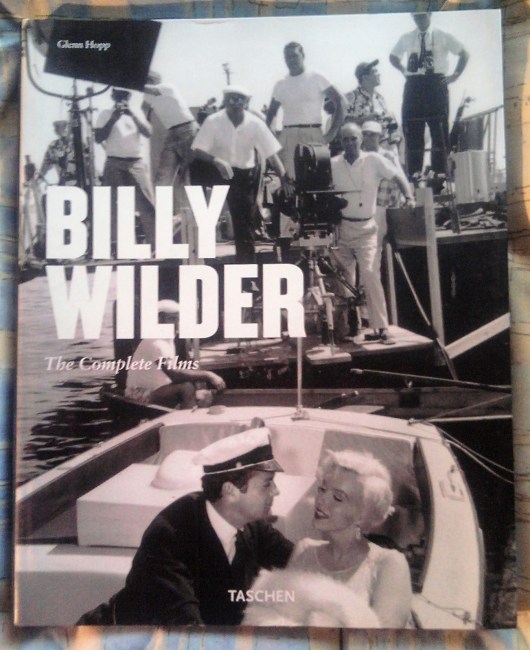
All three of the books here are big picture books with many behind the scenes photographs. If you are like me and love to hear about how movies are made then you will love all these books. Billy Wilder was an Austrian born filmmaker who fled from Berlin and the Nazis in the early 1930s, moving first to Paris and then later to Hollywood. Wilder made some classic films like ‘Sunset Boulevard’, ‘Double Indemnity’ and ‘Sabrina.’ The cover picture you can see above shows Tony Curtis and Marilyn Monroe in ‘Some Like it Hot’ made by Wilder in 1959. It’s a great movie but mostly famous for the multiple retakes required by Marilyn. It took 47 takes for Wilder to get a shot in the can where all Marilyn had to say, ‘It’s me, Sugar!’

Billy Wilder died in 2002 at the age of 95.

Just to finish off, here’s my favourite Billy Wilder story and it goes like this : In his later years he wanted, as usual, to make a movie. He approached a studio and was invited in to make his pitch, as they call it in the movie world. The executive who met with Billy was a young man. He said to Billy, “I’m not familiar with your work, could you tell me about some of your films?”

Wilder replied, “Of course; but you first!”


If you liked this book why not buy my book, ‘Floating In Space’? Click the links at the top of the page for more information or here to go straight to my Amazon page.

6 Great Kitchen Sink Dramas

So what exactly is a kitchen sink drama? If you’ve read through the pages on my site that deal with my book ‘Floating In Space,’ you’ll know that this is a phrase I use to describe my book. When I first added Floating In Space to Amazon through the Amazon sister site Createspace I came to a point where I had to define the genre of the book. If you’ve written something that falls easily into a particular niche then that’s not a big deal. Things like romance, thrillers, science fiction, and YA (young adult) are pretty easily definable but my novel is something on the lines of working class fiction from the sixties; books like A Kind of Loving, A Taste of Honey, Saturday Night and Sunday Morning, Alfie and Billy Liar. All of those works were made into films and three of them, Billy Liar, Alfie and A Taste of Honey were also stage plays but what exactly is ‘Kitchen sink drama’?

Wikipedia describes it as a British Cultural movement that developed in the late 1950’s and early 1960’s and enveloped the theatre, art, literature, television and film. It identifies the John Osborne play ‘Look Back in Anger’ as being the start of the movement and afterwards, many people who identified with the movement were known as ‘Angry Young Men.’ Osborne’s play was a sort of backlash against the theatre of Noel Coward and Terrence Rattigan and represented a move away from polite drawing rooms into council house back rooms.

Richard Burton starred in ‘Look Back in Anger’ and as much as I love the richness of his voice, his portrayal of the leading character of Jimmy Porter hardly represents the working class despite Burton’s own personal origins in a Welsh mining village. A much more representative working class voice, certainly for the North West of England is the character of Arthur Seaton played convincingly by Salford actor Albert Finney in the movie Saturday Night and Sunday Morning.

Saturday Night and Sunday Morning. 1960

Saturday Night and Sunday Morning is set in working class Nottingham. Arthur Seaton is a rebellious factory worker who works hard in the factory by day, but at the weekend he spends his money in the pubs and clubs of the town. He is involved with a married woman but starts to lose interest when he meets a single girl called Doreen and begins a relationship with her. My favourite line from the book and the movie is this: “I’m not barmy, I’m a fighting pit prop that wants a pint of beer, that’s me. But if any knowing bastard says that’s me I’ll tell them I’m a dynamite dealer waiting to blow the factory to kingdom come. I’m me and nobody else. Whatever people say I am, that’s what I’m not because they don’t know a bloody thing about me! God knows what I am.

A Taste of Honey. 1961

Written as a play by Shelagh Delaney when she was only eighteen, the work was first performed at Joan Littlewood’s theatre workshop in 1958. The movie version opened in 1961 adapted by Delaney herself and directed by Tony Richardson, who incidentally also directed the film version of ‘Look Back in Anger.’ The movie features outstanding performances by Dora Bryan and Rita Tushingham.

Alfie. 1966

Alfie was directed by Lewis Gilbert who directed some of the earlier Bond films. The script was produced by Bill Naughton and adapted from his own book and play. Alfie is a fascinating film on many levels. It’s a peek back at the swinging sixties; it explores the elements of comedy versus drama, something I’ve always loved and which I looked at recently in a post about the TV show MASH. Once again it’s about the working class and features great performances from all the principal and supporting actors. One fabulous feature is how Alfie talks directly to the camera and sometimes even says things that directly contradict something he is doing or saying to another character. In the opening sequence Michael Caine as Alfie addresses the audience and tells them not to expect any titles. There are none, except for the film title itself and the closing credits feature photos of the cast and crew. Many actors turned down the chance to play Alfie on film, including Caine’s then flat mate Terence Stamp who played the part on Broadway. Laurence Harvey, James Booth and Richard Harris all turned down the role, and Alfie became a breakthrough movie for Michael Caine. My favourite line from the film comes right at the end when Alfie is reflecting about his life: “What have I got? Really? Some money in my pocket. Some nice threads, fancy car at my disposal, and I’m single. Yeah… unattached, free as a bird… I don’t depend on nobody. Nobody depends on me. My life’s my own. But I don’t have peace of mind. And if you don’t have that, you’ve got nothing. So… So what’s the answer? That’s what I keep asking myself. What’s it all about? You know what I mean? “

Billy Liar. 1963

Billy Liar is based on the book by Keith Waterhouse and was directed by John Schlessinger. Tom Courtney played the title role and many faces familiar to TV viewers appear in the cast such as Wilfred Pickles, Rodney Bewes, and Leonard Rossiter. Billy has an imaginary world in which he plays out many daydreams and fantasies. His ambition though is to become a comedy scriptwriter and his friend Liz played by Julie Christie offers to go with him to London. In the final scenes however, Billy loses his nerve and contrives to miss his train, something that Liz has foreseen and has conveniently left his suitcase on the platform for him.

A Kind of Loving. 1962

This is another 60’s classic directed by John Schelssinger. Adapted from the book by Stan Barstow (one of my all time favourite books) with a script by Keith Waterhouse (who wrote Billy Liar) and Wallis Hall. The story is a very simple one; Vic Brown (Alan Bates)  is a draughtsman in a Manchester factory and he gets involved with secretary called Ingrid played by June Ritchie. When Vic learns Ingrid is pregnant, he does the ‘proper’ thing for the 1960s and offers to marry her. Sounds simple but this is a complex and fascinating film and looks at the subtleties of relationships and how the characters make their way through a series of difficult choices. For a northerner like me, it’s also nice to see places I recognise on film. St Annes On Sea looks a little grim, or did do in the 1960’s. Today it’s a lovely place to live.

Spring and Port Wine. 1969

Hollywood movie star James Mason, famous for roles like the drunken movie star in A Star is Born and the suave villain in Hitchcock’s North by Northwest, left Hollywood in 1963, settled in Switzerland and embarked on a more transatlantic career. One of those projects was Spring and Port Wine. The movie is set in Bolton and is about factory worker Rafe Crompton and his family. His daughter played by Susan George is acting strangely and Rafe struggles to dominate her, his other daughter played by Hannah Gordon and his sons, Rodney Bewes and Len Jones. It later transpires the Susan George character may be pregnant and the family rally round to help her.

The Family Way 1966

The Family Way is one of my very favourite films and like Spring and Port Wine above, features a classic movie actor, John Mills, in a very different role. Saying that, Mills’ film career was diverse to say the least and in this movie he plays Ezra Fitton whose son has just married Jenny, played by Mills’ real life daughter, Hayley. Various problems plague the newly weds, in particular a holiday that never happens due to a travel agent absconding with their funds. Hints are made during the film that Ezra’s son may not even be his son after all. When the truth dawns on Ezra his son asks what is wrong and Ezra replies with the most memorable line in the film; “It’s life lad. Sometimes it’ll make you laugh and sometimes it’ll make you bloody cry!” Time and time again, and I don’t know if you have ever found the same thing, but certain movies I love always seem to have a common denominator. In this case Spring and Port Wine, The Family Way, and Alfie were all penned by the same author, Bill Naughton.


One final kitchen sink drama: ‘Floating In Space’ by Steve Higgins. Click the icon below to go to my Amazon page or check out the links at the top of the page.

Second Hand Books and The World of Movie Making

Million Dollar Movie by Michael Powell.

poweelbookI really do love books, especially second hand books. I think that what is so wonderful about a second hand book is that the book has told its story before to someone else, and now if you have just bought it, its going to tell it’s story to you. I spend a lot of time browsing in book shops, both physically in actual shops or on-line in virtual book stores. The thing about on-line book stores is that you have to have a starting point, it’s no fun browsing through lists of books so I tend to browse on-line only when there is a particular book I want. In an actual book store I scan through the various sections and although I tend to linger on biographies and books about film, anything can catch my eye. A while ago I was reading a book by movie director Michael Powell called ‘A Life in Movies.’ It was a pretty thick book and took a fair old while to read and when I got the end there didn’t seem to be any indication there was another volume.
Of course, Powell was quite old when he wrote his autobiography, perhaps he thought that there wouldn’t be time for another book. Well, I’m happy to say he did write another volume and this is it, Million Dollar Movie. Powell continues the story of his life in his usual random fashion, jumping to things out of context and out of sequence. Just because he happens to visiting Hollywood for instance, he will go on to talk about Hollywood and movie people he knows there and so on. Powell made some great movies alongside collaborator Emeric Pressburger but his career stalled when he made a shocking film called Peeping Tom about a disturbed cameraman who murders his subjects and films them as he does so. Audiences were shocked and Powell’s directing career ended, although in later years fellow directors like Martin Scorcese praised the film as a classic. Liz bought me this book as a gift and the copy she tracked down comes from Austin Public library in Texas in the United States. Provenance is a word they use in the antiques business; It’s to do with the background of an item, and that is what makes this copy so wonderful; How it has come so far, from the USA to England, just so I can sit back and enjoy it.

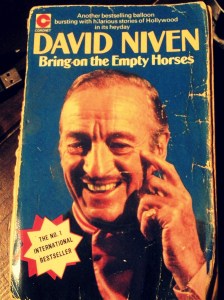
Bring on the Empty Horses by David Niven.

bringontheYou might be thinking, looking at the picture here: Couldn’t the author have found a better picture? Looking at the picture again I suppose that particular copy is just a little tatty. That’s because it’s my travel copy. I’ve got another copy, a much nicer version that resides in my bookcase that I browse through now and again. The reason I’ve got two versions is because my travel copy goes all over the place with me. If I’m travelling somewhere on the bus or train, that slightly tatty copy goes easily into my pocket or my bag because I can read it time and time again. Not only is it the best ever book written about the golden age of Hollywood, it’s also by far the most accessible and readable book on the subject ever.

Niven’s first book was his autobiography; ‘The Moon’s a Balloon’. In it Niven told how he came over to Hollywood from the UK and made the incredible leap from movie extra to movie star. The title of this book comes from Hungarian director Michael Curtiz. When filming ‘The Charge of the Light Brigade’ Curtiz wanted a hundred riderless horses to come into shot so he boomed on his megaphone ‘Bring on the Empty Horses!’ Niven and fellow actor Errol Flynn collapsed into laughter and Niven filed away the phrase for later use. The book covers the Hollywood years from 1935 to 1960 and Niven paints vivid portraits of Hollywood itself and long vanished watering holes like the Brown Derby and Romanoffs. He looks at some of the stars he has known like Errol Flynn, Clark Gable, Ronald Colman, and Constance Bennett. Other chapters profile producers like Sam Goldwyn and many other famous Hollywood personalities of the time. All his stories are told with great affection and I particularly liked the portrait of Mike Romanoff, the restaurateur who tried to pass himself off, in a slightly tongue in cheek way, as a member of the Russian Romanov family. If ever I’m travelling and need something to read on the journey I’ll always have this copy on hand. It’s like an old wine that improves with age!


What to do next:

Share this post on your favourite social media!

Hit the Subscribe button. Never miss another post!

Buy the book! Click here to purchase my new poetry anthology.

Click here to visit Amazon and download Floating in Space to your Kindle or order the paperback version.