A while back I wrote a post about my movie connections. Every time I see a great film it registers up there in the old grey matter and at some point I’ll take a closer look at the credits of those films and see if there was a connection. In the case of that particular post the connection was Terence Rattigan. Rattigan was a playwright who wrote many film scripts and adapted many of his own plays for the screen and in the course of my often extensive TV viewing I’ve come across a number of great films all written by him.
In another similar mental exercise, I examined another group of films and the common denominator turned out to be Nora Ephron. Now some of you out there may never have heard of Nora. Who was she anyway? Well Nora was a journalist, a screenwriter and a director. She’s probably most famous for penning the brilliant comedy When Harry met Sally.
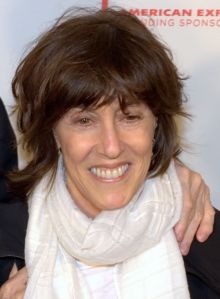
Photo by David Shankbone -, courtesy Wikipedia
When Harry met Sally is one of my all time favourite films and one that I wasn’t keen on at first. It didn’t impress me that first time at the cinema, the second time I saw it on TV I thought, hey, this isn’t so bad and I made a particular effort to seek it out a third time. After that third viewing, I loved it so much I bought the DVD version.
I was sad to hear of Nora’s passing in 2012 and made a mental note to find out more about her. Naturally, being me, a lazy semi-retired English blogger and occasional maker of YouTube videos, I never did.
A few weeks ago and eight years after making that mental note I was scanning idly through the TV listings and noticed a documentary film about Nora called Everything is Copy. The writer and director, Jacob Bernstein turned out be Nora’s son so he was clearly qualified to make a documentary about his mother. It wasn’t the greatest documentary film I’ve ever seen but it was certainly interesting. The film told the story of Nora’s life through various interviews. One surprising one was with Carl Bernstein, the famous Washington Post reporter whose articles on Watergate with Bob Woodward revealed the Watergate scandal to the world and eventually forced President Nixon to resign.
Nora was married to Bernstein and after becoming pregnant for a second time with their other son Max, Nora discovered he was having an affair with Margaret Jay, a British journalist and friend. Nora used the experience to write a book called Heartburn which was later made into a film starring Jack Nicholson and Meryl Streep. I have to say I’ve not seen the film or read the book but once again I’ve made a mental post it note and stuck it firmly up there in my brain for further attention.
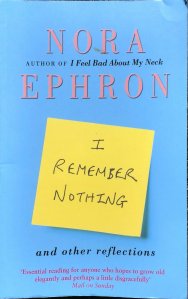 After watching the documentary film I felt even more determined to find out more about Nora so I went to abebooks on the internet and after some research ordered a copy of I Remember Nothing, a book by Nora that seemed to be a memoir. The book starts out as a sort of memoir, telling humorous stories about this and that, and her life without really giving much away. Nora wanted to be a journalist and after working for the Kennedy White House for a short while she joined the staff of the magazine Newsweek. In her book she tells the story of how Newsweek did not hire female writers and offered her a job as a mail girl. She doesn’t appear to have been upset by this despite it being blatantly sexist. She just got on with her job, still determined to be a journalist. In her book Nora makes the whole episode sound quite amusing, especially when she later writes a parody column during a newspaper strike and as a result gets invited to write for the New York Post. Over on Wikipedia, there is a slightly different story in which Ephron gets involved with a class action lawsuit filed against Newsweek for sexual discrimination.
I Remember Nothing is an amusing book although it’s a little short on copy for someone for whom everything is copy. I enjoyed it enormously although had I been reading it on holiday, I could have got through it in an afternoon by the pool. Even so, the book has some great stories, in particular I liked the one about when Nora was nearly an heiress and thought she was about to inherit a formidable sum of money. There is another one about Christmas dinner and the one about when a meal was named after her in a posh restaurant. All of the stories are nice blog post sized stories which if I were devious enough, I could easily steal for the days when I have no idea what to write about.
When Nora was married to Bernstein, she put together a screen version of All the President’s Men which was ultimately rejected (William Goldman eventually wrote the script) but her version was seen by someone else who offered her the chance to write the script for a television movie and that was how her screen career started.
Nora wrote the screenplay for When Harry met Sally in 1986 and apparently imagined herself in the role of Sally, and Rob Reiner, who directed the film, as Harry. Nora wrote the screenplay after interviewing Reiner and producer Andy Scheinman and various others about their lives.
There is one scene from When Harry met Sally that has become a classic. It’s the one where Harry and Sally are eating in what looks like a diner or cafe and Sally shows Harry how easy it is to fake an orgasm by demonstrating it there and then in the cafe. According to Wikipedia, the cafe was actually Katz’s Delicatessen at 205 East Houston street in Manhattan. Also, just while I’m in the mood for dishing out useless information, the lady in the film who says to the waiter, ‘I’ll have what she’s having‘ when Meg Ryan, who played Sally, had finishing orgasming was actually director Rob Reiner’s mother and the line was suggested by Billy Crystal who played Harry.
Personally, I’d be hard pushed to tell you my favourite scene in the film although the one where Harry tells his best friend about his divorce is a major contender. Harry says he only knew about the split when the moving men came to his house to shift his wife’s stuff. One of the movers wore a t-shirt with the legend ‘don’t f’**k with Mr Zero’ on his chest and Harry’s friend asks ‘are you saying Mr Zero knew you were getting divorced before you did?’
I thought the pairing of Meg Ryan and Billy Crystal was wonderful and I could never understand why the producers of films like You’ve Got Mail and Sleepless in Seattle paired Meg with Tom Hanks. Then again, Nora actually directed both those films so maybe she just preferred Tom Hanks.
Here’s one of the crazy things I love about movie connections. Ages ago, I caught a film on TV about a woman who wrote a cookery blog. Can you imagine that, a film, an actual motion picture about blogging? Who could do that, who could make a picture like that? I missed a few minutes at the beginning of the picture and made a mental note (yes, another one) to make sure to record it next time it was shown. No, I didn’t record it the next showing but to answer my last question, who would make a picture about blogging, the answer was, surprise surprise, Nora Ephron.
In 2009 she released Julie and Julia, a film based on an actual blog by Julie Powell, an American who decides to cook her way through the cookbook of Julia Child, a 1950’s American cook played by Meryl Streep. As Julie blogs about her cooking the film flashes back to the life of Julia. It’s a great film and the only film I can think of which focusses on blogging.
Nora died in 2012 from pneumonia, a complication of the leukaemia she was suffering from. She had not shared her illness with friends or family, thinking it might impede her career. However, in I Remember Nothing, she left a list of things she would miss when she had departed:
They include Spring, a walk in the park, reading in bed, the view out of the window, Paris, butter and taking a bath.
She was 71 years old.
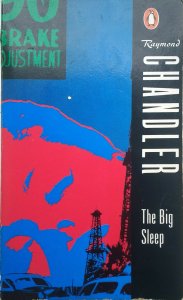 When I sat down on my break and flipped open the book, a small cutting fell out. It was a newspaper cutting dated November 14th 1995 from the Daily Express. An Actor Bombs went the headline and went on to tell the story of an actor:
 Today the tree has grown again, this time straight up and I can look forward to one day making apple pies again.
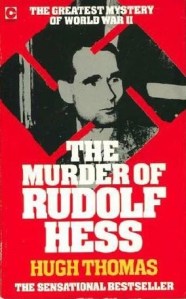 The Murder of Rudolf Hess by W. Hugh Thomas
 The Lost Symbol by Dan Brown.
 Empire of the Summer Moon by S.C. Gwynne
 A Right Royal Bastard by Sarah Miles.
 Alan Turing: The Enigma.
 Khrushchev Remembers.
 You might think that the lockdown is heaven sent for a writer. Stay at home and write stuff, perfect! After a few weeks though I have found not only have I not written much at all. Actually, I’ve been feeling a little bit bored, just like a great deal of the population I suppose.
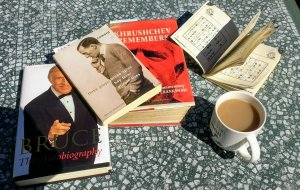 When Khrushchev’s memoirs become a little too serious and I fancy a change, something a little bit lighter, I turn to either Noel Coward or Bruce Forsyth. I picked up Bruce’s book at a church sale and although I didn’t expect much, it has been pretty interesting. Bruce was probably one of the last old time entertainers. He talks about the days of variety in the 1950’s and 60’s and about being in various shows and playing in theatres like the London Palladium and how he managed to break in to TV with Sunday Night at the Palladium which he compered for many years.
 Of course, as we are currently still in ‘lockdown’ due to the Corona Virus Pandemic, that hasn’t been possible but happily due to the nice weather, we’ve been able to drag ourselves into the garden and the fresh air.
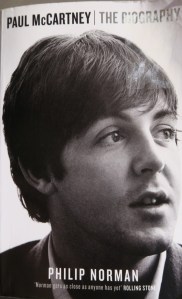 To start with it tells the story of McCartney in deep focus, taking the reader through McCartney’s younger years, his friendship on the school bus with the younger George Harrison and finally meeting the older John Lennon at a village fête in Woolton. Those few years age difference was a big thing to the budding teenage musicians but together they were the nucleus of the Beatles. There were other members, other guitarists and other drummers but when in their late teens they got the chance to play a regular spot in Hamburg, Germany, they needed a drummer and they chose Pete Best, another local lad but a quieter lad who perhaps did not really fit in on a social level with the other three. The Beatles were not well thought of by fellow Liverpool musicians but after long months playing 6 hours a day at a Hamburg night club they gradually became a better and tighter knit musical group.
 Not so long ago I read a blog post on the lines of 100 books to read before you die and as now I’m in my sixties I thought I’d better get a move on and read some more. I’m not sure if this book was on the list but I’m sure its author, Graham Greene was. Greene wrote the screenplay for ‘the Third Man’ and later the novel which I’ve always admired so I was very happy indeed to find this book in my Christmas box not so many weeks ago.
 One of my all time favourite books was Dickens’ David Copperfield but sadly there are only two of Dickens books I have ever been able to get to grips with, one is the aforementioned Copperfield and the other is this one, Great Expectations. It’s a long time since I have read this book so I was very pleased to find it on the bookshelf of our rented villa rubbing shoulders with books by David Baldacci and Sophie Kinsella.
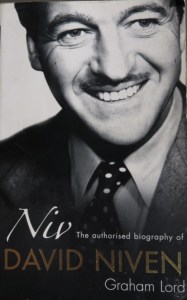 This book has been an absolute delight, in fact the perfect holiday read. The author tells the story of Niven’s life, pretty much as Niven himself set it down in his best selling autobiography The Moon’s a Balloon. However in this version the author tries to fill in the bits Niven left out of his book and correct many inaccuracies. Niven was notorious for embellishing the truth and the character of ‘Nessie’ to whom Niven lost his virginity in his book was, this author claims, pure fiction. Personally, I find that hard to believe even though no corroboration could be found with David’s many friends and those interviewed for this biography. Nessie seemed to be just such a fundamental part of his life I just don’t see how he could have invented her.

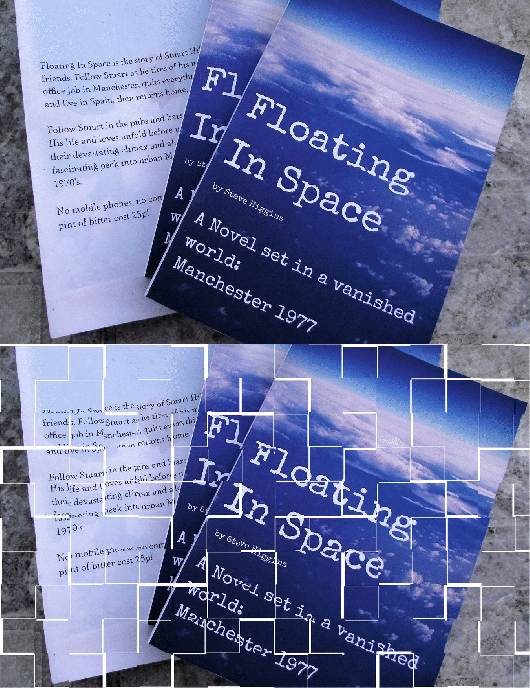
 Every blog post on this site will end with a familiar call to buy my book, Floating in Space. Floating, in case you are a first time visitor to this site, is a short novel about the life of a young working class lad in urban Manchester in 1977. A number of reviewers have heaped praise on the book, others did not find it so praiseworthy. Why should you then consider it as an addition to your library? Why should you read it? Why should you even read books in the first place? Let me give you a few reasons . . .
