Things don’t always go as planned, especially when an unexpected pandemic hits the country so instead of presenting what might have been another holiday book bag, here’s the pandemic version instead: A review of the books I’ve been reading lately, all sourced as usual from second hand book shops or the internet.
 A Right Royal Bastard by Sarah Miles.
Sarah Miles is a famous actress from the 60s and 70s. She appeared in films like Ryan’s Daughter and The Servant. A Right Royal Bastard is the first volume in her autobiography and is mostly about her childhood. I suppose normally you might expect a film star to devote a chapter or two to his or her childhood but here Sarah gives us pretty much a complete volume devoted to hers.
After the opening chapter I expected the book to move on but no, Sarah Miles tells us everything she can think of about her childhood and her schooling as well as her background and her family. I have to say I was getting a little bored but after a few chapters the book finally began to get interesting.
It’s a very frank book indeed and I wonder if it was a confessional experience for the author. Sarah tells us about her first period and then later about her first sexual experience. The story about when she was almost raped was shocking but then she proceeds to tell us about the time she shared a flat with a prostitute. One memory from that time was when she agreed to hide in a wardrobe during one her flatmate’s encounters with a male client. Sarah and that particular lady later have a bath together and Sarah soon begins to suspect that perhaps someone has got the hots for her.
Later she falls in love with James Fox. He is in the army at the time and when he goes off to join his regiment Sarah finds she is pregnant and suffers a dreadful back street abortion.
Sarah emerges from these pages as utterly different from what I had imagined, she always looks so prim and proper in her films. The book finishes with her first big part in a film and I have to say, I did find myself wishing I had the second volume. I’ll have to look out for it.
 Alan Turing: The Enigma.
I’ve been reading this book for a long time and the lockdown was the perfect opportunity to finish it off and finally put it aside. This book is well researched which must have been difficult as Turing was not well known or even famous during his lifetime and his greatest achievements were made in the greatest of secrecy during wartime. The first part of the book I found slow but tedious and it finally livened up when Alan Turing joins the staff at Bletchley Park and sets about decoding the secret messages from Nazi Germany; then it gets interesting.
Turing joined the Government Code and Cypher School in 1938 which was the UK’s code breaking organisation. In 1939 the British cypher experts were given details of code breaking by their Polish colleagues including details of the Nazi Enigma code machine and their methods of decoding the Enigma messages.
Turing recognised the importance of a machine the Poles used to help break the codes and he designed and made his own improved version known as the Bombe. In 1941 Turing and his colleagues appealed directly to Winston Churchill for more resources to help their work and Churchill, recognising the importance of what they were doing responded immediately. As a result, more than 200 bombe machines were in operation by the end of the war.
German naval Enigma messages were even more difficult to break and Turing worked hard on these codes, finally breaking them with a statistical technique that was later known as sequential analysis. It was later estimated that the work at Bletchley Park shortened the war by 2 years and saved countless lives.
Turing worked at Manchester university after the war. In 1952 he became involved with a young unemployed man named Arnold Murray who was later involved in a robbery at Turing’s home in Wilmslow. During the inquiries Turing acknowledged a homosexual relationship with Murray and was prosecuted, homosexuality being illegal at the time. He was found dead two years later in 1954 and it is thought he took his own life using cyanide although it may have been that his death was accidental.
Apart from the wartime work decoding Enigma messages I actually found this book rather heavy going. Towards the end when Alan is working in Manchester I found myself skipping through long passages about mathematical theory but I was glad to have finally reached the end. One interesting thing was that Alan lived in Wilmslow during this latter part of his life. I once lived in Wilmslow too and travelled into Manchester every day on the bus, a journey of about an hour. Alan did the same journey by bicycle so he must have been pretty fit.
Over on Goodreads readers seemed to be all in favour of the book but sadly it just wasn’t my cup of tea.
 Khrushchev Remembers.
This book has a remarkable history. Khrushchev was ousted from the Soviet leadership in 1964 in favour of Brezhnev and he was retired to a small dacha with a pension. There Khrushchev fell into a deep depression but his son suggested he record his memoirs on audio tape which he did. The KGB kept an eye on Khrushchev and demanded he turn the tapes over to them which he also did. His son however had copies secretly smuggled into the west and they were published in the form of this book. My copy is quite an old one and has a commentary by Edward Crankshaw putting Khrushchev’s memories into perspective.
The book is a fascinating read and the author takes us through his early life and we see him move ever closer to the centre of power which in Khrushchev’s early years meant closer to Stalin. Khrushchev in some ways thinks of Stalin as a good comrade and communist but in others as what he really was, a ruthless dictator. Khrushchev survives the years of Stalin’s purges when many disappeared after a knock on the door in the middle of the night. Khrushchev defends the Nazi-Soviet pact saying the Soviets knew it would never last but that it gave them time to build up defences against Hitler. Hitler finally attacked Russia with Operation Barbarossa in 1941 and for a time Stalin disappeared from view. He was finally urged into action by his generals and I have read elsewhere that when they first approached him he asked ‘have you come to arrest me?’
It would have probably been better for the Soviets if they had but they rallied around their leader and went on to defeat Hitler, and Stalin consolidated even more power. Stalin died in 1953 and he was left lying on the floor for a day as his staff were too scared to approach him. Beria, head of Stalin’s secret police initially grabbed power but Khrushchev was able to overcome him and have him arrested by the military.
In 1964 it was time for Brezhnev to snatch power himself. Khrushchev did not resist. His contribution he said, was the smooth change of power without murders or arrests.
‘Could anyone have dreamed of telling Stalin that he didn’t suit us anymore and suggesting he retire? Not even a wet spot would have remained where we had been standing. Now everything is different. The fear is gone, and we can talk as equals. That’s my contribution. I won’t put up a fight.’
Brezhnev reversed many of Khrushchev’s reforms and the world and the Soviets had to wait for Gorbachev for more enlightened leadership. To sum up, this was a great read and very interesting but one in which I was glad of the commentary to put the author’s views in perspective.
That was my lockdown book bag. What books do you have in yours?
 You might think that the lockdown is heaven sent for a writer. Stay at home and write stuff, perfect! After a few weeks though I have found not only have I not written much at all. Actually, I’ve been feeling a little bit bored, just like a great deal of the population I suppose.
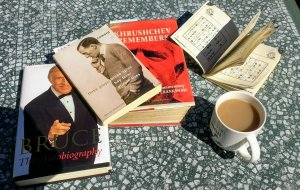 When Khrushchev’s memoirs become a little too serious and I fancy a change, something a little bit lighter, I turn to either Noel Coward or Bruce Forsyth. I picked up Bruce’s book at a church sale and although I didn’t expect much, it has been pretty interesting. Bruce was probably one of the last old time entertainers. He talks about the days of variety in the 1950’s and 60’s and about being in various shows and playing in theatres like the London Palladium and how he managed to break in to TV with Sunday Night at the Palladium which he compered for many years.
 Of course, as we are currently still in ‘lockdown’ due to the Corona Virus Pandemic, that hasn’t been possible but happily due to the nice weather, we’ve been able to drag ourselves into the garden and the fresh air.
 I’m pretty much of a stay at home sort of guy normally although I do like to go out now and again. I do love dining out for instance. However, staying at home day after day may stop the corona virus spreading but it can get a little boring. What can we do to entertain ourselves then?
 Later Julie, Jeremy’s girlfriend came forward to reveal Jeremy had told her of his plans to murder the family. Her story though had a number of flaws; in particular she claimed Jeremy had used Matthew McDonald, a friend, as a hitman for a fee of £2000. McDonald had an alibi for the night and vigorously denied any involvement in the murder.
 Jobs around the House
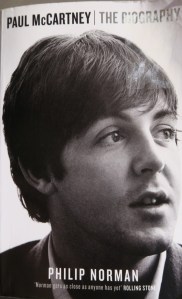 To start with it tells the story of McCartney in deep focus, taking the reader through McCartney’s younger years, his friendship on the school bus with the younger George Harrison and finally meeting the older John Lennon at a village fête in Woolton. Those few years age difference was a big thing to the budding teenage musicians but together they were the nucleus of the Beatles. There were other members, other guitarists and other drummers but when in their late teens they got the chance to play a regular spot in Hamburg, Germany, they needed a drummer and they chose Pete Best, another local lad but a quieter lad who perhaps did not really fit in on a social level with the other three. The Beatles were not well thought of by fellow Liverpool musicians but after long months playing 6 hours a day at a Hamburg night club they gradually became a better and tighter knit musical group.
 Not so long ago I read a blog post on the lines of 100 books to read before you die and as now I’m in my sixties I thought I’d better get a move on and read some more. I’m not sure if this book was on the list but I’m sure its author, Graham Greene was. Greene wrote the screenplay for ‘the Third Man’ and later the novel which I’ve always admired so I was very happy indeed to find this book in my Christmas box not so many weeks ago.
 One of my all time favourite books was Dickens’ David Copperfield but sadly there are only two of Dickens books I have ever been able to get to grips with, one is the aforementioned Copperfield and the other is this one, Great Expectations. It’s a long time since I have read this book so I was very pleased to find it on the bookshelf of our rented villa rubbing shoulders with books by David Baldacci and Sophie Kinsella.
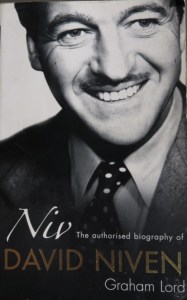 This book has been an absolute delight, in fact the perfect holiday read. The author tells the story of Niven’s life, pretty much as Niven himself set it down in his best selling autobiography The Moon’s a Balloon. However in this version the author tries to fill in the bits Niven left out of his book and correct many inaccuracies. Niven was notorious for embellishing the truth and the character of ‘Nessie’ to whom Niven lost his virginity in his book was, this author claims, pure fiction. Personally, I find that hard to believe even though no corroboration could be found with David’s many friends and those interviewed for this biography. Nessie seemed to be just such a fundamental part of his life I just don’t see how he could have invented her.

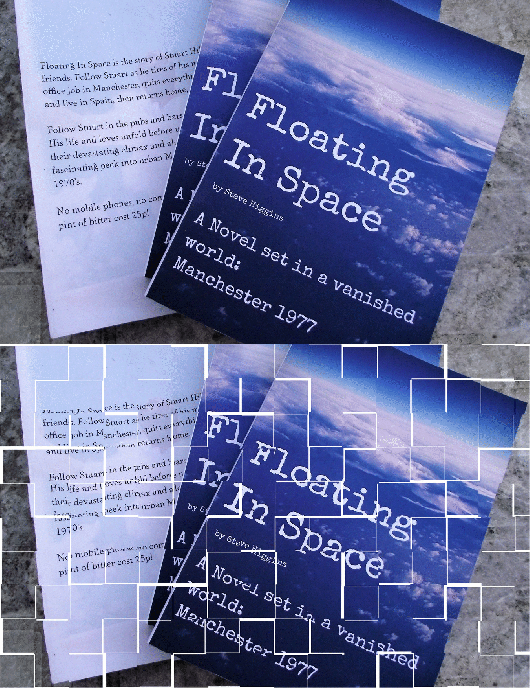
 Every blog post on this site will end with a familiar call to buy my book, Floating in Space. Floating, in case you are a first time visitor to this site, is a short novel about the life of a young working class lad in urban Manchester in 1977. A number of reviewers have heaped praise on the book, others did not find it so praiseworthy. Why should you then consider it as an addition to your library? Why should you read it? Why should you even read books in the first place? Let me give you a few reasons . . .
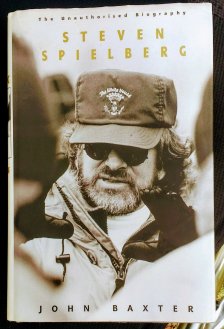 Not so long ago I thought about doing a post about the film director Steven Spielberg. I’d already done a couple of ‘favourite director‘ posts but the thing with Spielberg is that he’s not exactly one of my favourite directors so any post would be not really be complimentary so I didn’t want to get into writing something negative.
 It’s a book written from first-hand experience for starters. The author, British born movie actor David Niven arrived in Hollywood in the early 1930’s. He had decided to try his luck in the movie business and he had come to the right place because Hollywood, California was the centre of the film making universe.
 Letters from an Unknown Author!