When I was writing my post ‘The Book of the Film or the Film of the Book’ a while ago, I did consider including ‘The Cruel Sea’ as not only is it one of my favourite films, it is a pretty good book too. I didn’t include it because I couldn’t find my copy of the book, which I hadn’t read for years and also I hadn’t seen the film for years either.
In one of those odd coincidences that always happen when I set my mind on a subject and leave ideas churning over in the upstairs room in my head, I was scouring through a charity shop in St Annes when I came across the DVD of the film. It was one of those free newspaper DVDs that seem to cost anything from a pound upwards at a car boot sale but was happily on sale here for a paltry 30 pence.
After a busy late shift at work I settled down with a glass of red in one hand and a ham sandwich in the other, compulsory on these occasions of course, and began watching.
The film starts off at the beginning of World War 2 when the Jack Hawkins character is at the builder’s yard helping with the fixing up of his new escort ship, Compass Rose. His officers begin to arrive, many of whom are easily recognisable as stalwarts of the 40’s and 50’s British film industry: Donald Sinden, Denholm Elliot, and Stanley Baker and later in the film Virginia McKenna appears as an officer in the WRNS.
The cast and characters are therefore introduced and then the ship goes off for its sea trials and crew training and soon the Compass Rose is escorting its first convoy. Nothing much happens at first as this is the early part of the war but when the Nazis over run France and the ports of northern France come available to the enemy, many U-Boats converge on the convoys and a great deal of merchant ships, along with the supplies so desperately needed by Britain, are lost.
The boredom of those early dull convoys contrasts sharply with the terror and mayhem waged by the U-boats later on. The film reveals the desperate tragedy of abandoning ship in the middle of the Atlantic, the oil and grease, not to mention the cold, are terrible. Many escort vessels could not stop for survivors as they would become easy prey to the unseen U-Boats, though some did, others returning later in the light of day as the attacks usually came at night.
Leave was a great relief for the naval crews. On one trip back to England the film shows the crew at home, some enjoying some home comforts, others struggling with failing marriages, a situation made worse by the war. One crewmate takes his friend the engineer home to meet his sister. On a later voyage the engineer tells his mate how he has fallen for the sister and plans to ask her to marry him. Later, the Compass Rose is sunk by a torpedo and as the survivors struggle to stay alive in the cold Atlantic many succumb to their injuries. As they drift in the oily water the soundtrack replays echos of their recent dialogue, a marriage proposal hangs in the air over the groom who will never wed and a petty argument haunts the body of an unhappily married officer. Happily, some survive till daylight when a destroyer returns to rescue them.
It must have been difficult living during the war, trying to get on with your own personal life when everything was wrapped up in the war effort. Manchester was a target for enemy bombers because of its industrial strength and also because of its airport at Ringway, now Manchester International Airport. My mother used to tell me stories of air raid shelters and late night cocoa when the air raid warnings were on and everyone trooped into the shelter. Everyone except my granddad who always said ‘If I’m going to die, I’ll die in my bed!’ She told and still tells stories of gas masks, bomb craters and how you could tell the differing sounds of German and British aircraft.
I’ve often wondered what happened if your house was bombed? Were you given new housing? What happened to your mortgage? Did you still have to pay it? Imagine being stuck with a 25 year mortgage and a house that was just a pile of rubble.
One other observation about films in the 40’s and 50’s: People seemed to have a different pattern of speech back then, a different and faster rhythm than today with clearer and more precise diction. Is that the case or is that just the way the actors and actresses of the time were taught to speak. Speech today seems slower and less precise and sprinkled with regular use of words like ‘awesome’!
Back to the Cruel Sea and Captain Ericson alias Jack Hawkins is given another ship which he captains until the end of the war. The producer, Sir Michael Balcon said that Hawkins was always the first choice for the Cruel Sea, even going so far as to say that without Hawkins he wouldn’t have made the film. The finished picture was the hit British film of 1953.
Hawkins was the epitome of the trustworthy British authority figure. In his obituary one writer wrote that Hawkins ‘exemplified for many cinemagoers the stiff upper lip tradition prevalent in post war British films. His craggy looks and authoritative bearing were used to good effect whatever branch of the services he represented.’
Hawkins himself was a three pack a day smoker and later became ill with throat cancer. In 1966 his entire larynx was removed however he still appeared in films with his dialogue dubbed by either Charles Gray or Robert Rietti. He died in 1973.
Just as I was writing this post, one thought came back to me about the book of the Cruel Sea. It was written by Nicholas Montsarrat and on the last page, when the war is over, the captain who has always hated his safety vest, hurls it into the sea. The vest sank like a stone!
Steve Higgins is the author of Floating in Space, a novel set in Manchester, 1977. Click the links at the top of the page to buy or for more information!
It’s always a bitter-sweet experience when someone decides to make your favourite book into a film. It doesn’t always work out because maybe it was a big, thick, long book and they have cut out your favourite bit, or perhaps the cast wasn’t the one you imagined. It’s usually just the same in reverse. You see a great film and in the credits it says based on the book by so and so, then you rush out and get the book and it turns out to be a little disappointing. Sometimes it’s even better than the film!
You can read the Film of the Book part 1 by clicking here. Meanwhile, here are a few more of my film/book experiences.
Rebecca (the film)
Rebecca was directed by Alfred Hitchcock and released in 1940. Laurence Olivier plays Max De Winter and Joan Fontaine is particularly good as the shy, unworldly new wife of the rather grand Max De Winter.
Max and his new wife, who is never named in the novel as she is also the narrator, meet in the south of France, marry and return to Max’s grand country house Manderley, in Cornwall. There they settle into country life rather uneasily, as lurking always in the background is the spectre of Max’s late wife Rebecca who died in a boating accident.
Also lurking in the background is the housekeeper of Manderley, Mrs Danvers. She was devoted to Rebecca and her presence seems to cloak the house in a sinister gloom. George Sanders plays his usual suave smooth talking self; in this film he is the apparent lover to the late Rebecca. A number of incidents occur making the new wife believe her husband resents her and prefers Rebecca. Nothing could be further from the truth as we find out when Rebecca’s body is discovered in the cabin of her sunken boat just off the coast. Max reveals he had an argument with Rebecca, struck her and she fell, hitting her head on some heavy fishing tackle. He carried her dead body to her boat, took to sea and scuttled the small vessel, creating the lie of her death at sea. Now the body has come to light, George Sanders’ character comes forward with a letter from Rebecca, inviting him to visit on the day of her death and with this he decides to blackmail De Winter as this shows she could not have contemplated suicide.
There is a nice twist at the end which I won’t give away but Rebecca is a wonderful film, well worth looking out for on one of the many movie channels available these days.
One disappointing aspect of the film was the rather cheap model of Manderley used at the beginning and end of the film. If I was Hitchcock I would have been tempted to revisit the film in the 1960’s and add some better model effects.
Rebecca (the book) by Daphne Du Maurier
The book is written in the first person by the unnamed new wife of Max De Winter. It’s a very good read indeed and I enjoyed it very much, so much so I had to take it out of my work’s bag (I’d been reading at work during my dinner breaks) and take it into the garden on a lovely sunny day as I was so keen to get to the end. It is very similar to the film although in the book De Winter actually shoots his wife unlike the film where De Winter strikes her and she falls and hits her head. The ending is also rather abrupt but an excellent read, well worth picking up if you see a copy for sale.
Serpico (the film)
Al Pacino stars in the true story of Serpico, a New York City cop who tried to fight the culture of bribery and corruption in the NYPD in the 60’s and early 70’s. This 1973 film is directed by Sidney Lumet and is shot in a gritty natural style. It starts with Serpico being shot in the face and then on his way to hospital it flashes back to tell the story of rookie cop Frank Serpico and his graduation to detective and his refusal to take bribes. It is shot and acted in a very natural documentary style and the film portrays Serpico’s ongoing disappointment with his superiors and those he trusts to look into the situation very well indeed. A brilliant example of 70’s moviemaking at its best.
Serpico (the book) by Peter Maas
It’s a long while since I read the book and despite a lengthy search I couldn’t get my hands on it for a read through for this post. It was a fascinating read as I remember, reading more like a work of fiction than the true story it really was.
Serpico (the DVD)
Since I couldn’t say much about the book I just want to throw in a quick comment about the DVD. One thing I love about DVDs are those special versions with extended features, documentaries and so on. On the DVD of Serpico there is an interview with the producer Dino De Laurentiis where he tries to explain the character of Serpico this way; He and Serpico go to a screening of a film in New York. They are checking out possible directors or something, anyway, the theatre is empty and ignoring the no smoking sign, De Laurentiis decides to light up. ‘Wait a minute’ says Serpico, ‘you can’t smoke in here.’ De Laurentiis replies ‘what does it matter? There is no one here but us.’
Serpico points to the no smoking sign and replies ‘look, you just can’t smoke here’ and makes the producer put out his cigarette. That, says Dino on the DVD, was when he began to understand what Serpico was about. There were no grey areas with him, everything was black and white.
The Big Sleep (the book) by Raymond Chandler
The Big Sleep, which refers to death in American gangster speak was the first of Raymond Chandler’s novels to feature his famous detective Philip Marlowe. Marlowe was described by one reviewer as ‘a 20th-century knight who treads the mean streets of Hollywood and Santa Monica, and who also visits the houses of the stinking rich, with their English butlers, corrosive secrets and sinister vices.’ I couldn’t have put it better myself. In the Big Sleep Marlowe is summoned to the house of General Sternwood whose daughter is being blackmailed by a seedy bookseller.
Sternwood, a crippled old man spends his time in a heated conservatory and seems to draw strength from the overwhelming heat. He engages Marlowe who sets off on a trail of blackmail and murder. I have to say the film rather confused me and it was only after reading the novel that I began to understand some of the intricacies of the plot.
The Big Sleep (the film)
Director Howard Hawks was also aware of the complexity of the novel. He once asked Raymond Chandler who had shot the chauffeur. Chandler replied that he had no idea.
The movie version from 1946 stars Humphrey Bogart and Lauren Bacall and I used to think that this was the film where Bogart and Bacall met although in fact it was actually another movie, ‘To Have and Have Not‘, also directed by Howard Hawks. By the time of ‘The Big Sleep’ their romance was in full swing. Later Bogart left his wife Mayo and he and Bacall were free to marry.
The opening of the film where Bogart meets the general is brilliant. The wayward daughter remarks he is not very tall. ‘I try to be’ Bogart replies. Later, the other daughter played by Bacall says she doesn’t like Bogart’s manners. He replies ‘I’m not crazy about yours. I didn’t ask to see you. I don’t mind if you don’t like my manners. I don’t like them myself. They’re pretty bad. I grieve over them on long winter evenings.’
My advice, get yourself the DVD, pour yourself a large glass of red, press play and relax and enjoy.
The Silence of the Lambs (the Film)
The film was released in 1991 and it’s one of those films that seemed to naturally self-publicise itself, one of those word of mouth films that everyone at the time was talking about. It’s a gruesome film in parts and not really my usual sort of film but what is appealing is the slow relentless process the FBI makes to track down the killer and the procedures and techniques they use. Jodie Foster plays FBI trainee Clarice Starling. She is sent by the head of the FBI’s Behavioural Science Unit to interview captured serial killer Hannibal Lector played by Anthony Hopkins, in the hope he might give some clue or insight into helping with the capture of a new serial killer known as Buffalo Bill.
Hopkins gives a chilling portrayal of the psychotic serial killer and Jodie Foster and the other principals were given much acclaim for their performances. The film was only the third to win Oscars in the top 5 categories: Best Picture, Best Actor, Best Actress, Best Director, and Best Adapted Screenplay. It is perhaps the only horror film ever to win the best picture award.
The Silence of the Lambs (the Book) by Thomas Harris
The book, like the film, focusses on the FBI and their attempts to trace the killer known as Buffalo Bill. Trainee agent Clarice Starling builds up a relationship with imprisoned murderer Doctor Hannibal Lector where Lector dribbles out bits of information in exchange for personal details about Clarice herself. Clarice, the vulnerable young FBI agent is a sort of counterpoint to the evil Murderer Dr Lector.
The book like the film is more of a horror story than a detective novel. I felt drawn to the passages that were chilling and gruesome in a strange way, almost like when a spider appears and I’m compelled to watch it even though I hate spiders. The relationship between Lector and Starling is intriguing and is really more of a focus than the capture of the Buffalo Bill and I did find myself wondering whether Lector might want to murder Clarice or perhaps his interest in her is something different.
I read the follow up book, Hannibal, expecting more of the same but it was even more gruesome and had a strange implausible ending. Since then I’ve steered clear of Mr Harris’ books but Silence is a great read.
Floating in Space is a novel set in Manchester, 1977. Click the links at the top of the page to buy or for more information.
It’s always a bitter-sweet experience when someone decides to make your favourite book into a film. It doesn’t always work out because maybe it was a big, thick, long book and they have cut out your favourite bit, or perhaps the cast wasn’t the one you imagined. It’s usually just the same in reverse. You see a great film and in the credits it says based on the book by so and so, then you rush out and get the book, and it turns out to be a little disappointing. Sometimes it’s even better than the film!
Anyway, here are a few of my film/book experiences.
The Horse Whisperer. The book.
I picked up this book in a charity sale last year. This is what I said about it in Book Bag 4:
I’m not even sure why I picked up this book; it’s not anything I would normally be interested in. I bought it for a few pence at a church table top sale and I think I bought it one, because I wanted to give something, a few pence to the church fund and two, I faintly remembered the book had been made into a film with Robert Redford, although I had never seen it. The reviews on the back of the book said things like ‘a page turner’ and ‘the hottest book of the year’. Anyway, I bought it ages ago, and on a whim threw it into my book bag. I really hate having a book and not reading it.
From the beginning the book was a page turner giving a hint that something exciting and interesting was coming. I liked the idea of a horse whisperer; someone who could train a horse without hurt or pain, merely by whispering. I envisaged a native American Indian perhaps or some mystic horse guru. The fact is that the story of the horse is nothing but the background to a love story, involving a New York magazine editor and a Montana cowboy. Written in a sort of matter of fact magazine style, it turns out that writer Nicholas Evans is a screen writer and much of the novel reads rather like that, a screenplay, and each character comes with extensive background notes like the writer’s character notes on a screenplay. At the half way point this novel lost steam for me. I read it to the end but the ending was so contrived I was just glad to have finished it. Somewhat disappointing. Wonder what the movie is like?
The film. The other day I noticed this film was showing on the Sony Movie Channel and set my hard drive up to record it. The result was an OK sort of film although a little on the slow-moving side. I’m tempted to say it was more of a woman’s film but Liz watched it alongside me and she wasn’t impressed either. I felt the casting was not right. Robert Redford just looked too smart and tidy to be a cattle rancher and cowboy. He actually looked as though he came from the Roy Rogers school of cowboying although he also directed the film. If I was casting I would perhaps have gone for someone like Kevin Costner perhaps, and the female lead, played by Kirstin Scott Thomas, needed a stronger, more assertive woman, perhaps a native New Yorker and not an English actress.
The ending was different in the film which was a good thing as the book’s ending was so poor as I mentioned above. Rotten Tomatoes report 74% positive reviews but sadly, I think I was part of the 26% negative ones.
2001: A Space Odyssey. The film.
I first saw this movie back in 1968, which was quite a fascinating year for me. I wrote about the experience of seeing the film in a earlier post about film music and here is, in part, what I had to say:
I first saw the film in the summer of 1968. I was only 11 at the time and I remember my Mum being surprised I had spent hours at the cinema on a lovely hot day. I watched the film in the huge movie theatre in Northenden, now a Jehovah’s Witness assembly hall. There were only a few people in the picture house that day and it was wonderful having this huge place almost to myself and seeing this incredible film in 70mm on the big screen. I recall being somewhat confused by it all, especially the jump from Neanderthal times to the future, until I bought the novel by Arthur C Clarke which explained things in a way the movie did not.
2001 is a particularly visual film. Kubrick cut out a lot of dialogue because he wanted the film to stand as “basically a visual, nonverbal experience” that “hits the viewer at an inner level of consciousness, just as music does, or painting.”
Picture courtesy Flickr.com
According to Wikipedia, despite the few people in the cinema with me that day in 1968, the movie went on to become the highest grossing North American movie of that year.
2001 set the pace for the sci-fi movie with its depiction of spacecraft drifting slowly and silently through space. The first Star Trek movie was heavily influenced by 2001 which made it look a little dated when the movie Star Wars was released and did the opposite thing, showing spacecraft whooshing across the screen at lightning speeds.
The book.
As I mentioned above, I was rather confused by the film and there were quite a few moments when I was wondering what was actually happening, for instance the jump from Neanderthal times to the future, the moment when the monolith sends its deep space signal and various other things too. I went out and bought the book by Arthur C Clarke and went straight into a wonderfully well written, plausible space adventure. All the technology that Clarke wrote about had its origins in science fact, both the space missions and the computer technology which make up the main parts of the story. If you have never seen the film or read the book (shame on you) 2001 is about a mysterious monolith which appears on earth in neolithic times and helps the ape men of the day to develop. Later, in the future, the mysterious monolith is found buried on the moon and when it is exposed to sunlight for the first time, it blasts off a signal to Saturn. (In the movie the destination is Jupiter, as director Stanley Kubrick thought that the special effects department would struggle to create Saturn’s rings.)
Anyway, the scientists of the day decide that the monolith is part of some extraterrestrial intelligence and set up a manned space mission to investigate. As the mission progresses, the onboard computer, HAL, decides to have something of a nervous breakdown which creates an unexpected hazard for the crew.
Verdict: The book is a wonderful read, one of the classics of science fiction and the movie has deservedly become one of the most influential films of all time.
The Great Gatsby. The book.
I can’t really remember when I read this book for the first time. It was many years ago and ever since, this short novel has been in my personal all time top 10 reads. The story concerns Jay Gatsby who lost out in the love stakes because he was born on the wrong side of the tracks and not an appropriate suitor for the lovely debutante Daisy. Off he goes to the first World War, comes home to the USA a much more worldly-wise fellow than when he left and one way or another he becomes a millionaire.
Gatsby has a huge mansion in the Long Island suburb of West Egg. Renting a cottage in the grounds is the book’s narrator, Nick Carraway. Nick is fascinated by the lavish parties held at the mansion and soon meets Gatsby himself. It turns out that Gatsby’s parties are a device, a lure to attract the beautiful Daisy who Gatsby still loves and hopes will one day come to him like a moth to a flame.
It’s a simple story of love and desire but it becomes something much more in the hands of the author F. Scott Fitzgerald. I often think of it not as a short book, but as a long lyrical poem that has an intrinsic beauty fashioned by the most wonderful turns of phrase. In particular I love the last page and this final paragraph:
Gatsby believed in the green light, the orgastic future that year by year recedes before us. It eluded us then, but that’s no matter. Tomorrow we will run faster, stretch out our arms farther. . . . and one fine morning . . So we beat on, boats against the current, borne back ceaselessly into the past.
The Film.
I noticed on the Internet that there was a 1949 version with Alan Ladd which I have never seen but the latest film version was released in 2013 and starred Leonardo DiCaprio with Baz Luhrmann as director. That particular film had been lying dormant on my hard drive recorder for quite a while, just waiting for a quiet few hours for me to watch. As I was part way through this post this seemed to be the perfect opportunity to start it up. So, I settled down with a glass of French red and clicked the play button.
The first part of the movie didn’t really do it for me and the depiction of Gatsby’s famous parties seemed more like a music video than anything, especially with the strange substitution of modern techno music for the jazz music of the time.
Later on, the picture comes into its own. Leonardo DiCaprio is good, indeed very good as Gatsby. Overall, tone down the special effects and the music video feel and this could have been an outstanding film adaptation.
The film version I adore though is the one from 1974 starring Robert Redford as Gatsby and Mia Farrow as the fragile Daisy. I may have written above about Redford being miscast for the Horse Whisperer but he is perfect as Gatsby, so much so that now, whenever I re-read the book I always see Redford’s face in my mind.
The screenplay was by Francis Ford Coppola who directed The Godfather and there are some memorable moments in the film. One of the ones I like particularly is the one where one of Gatsby’s associates is introduced to Nick, thinking him one of Gatsby’s dubious business connections. Redford as Gatsby, firmly but politely indicates a mistake has been made and we get a hint at something questionable behind Gatsby’s facade. Is he a gangster or a bootlegger perhaps? Another is the moment when Gatsby and Nick meet at one of Gatsby’s parties. Nick doesn’t realise he is talking to Gatsby himself when he says he doesn’t even know who is Gatsby is!
Verdict: Brilliant book and a lovely film.
Lost Horizon. The Book.
I picked up this wonderful gem of a book at charity shop years ago for the bargain price of twenty-five pence and if I could convert the pleasure this book has given me into pounds, shillings, and pence, it would be a figure that far eclipses that initial outlay. James Hilton has become one of my favourite writers and one of my personal writing heroes. (Check out my blog about him here!) This highly original novel reflects the fear and sadness that many must have felt in the days before World War 2. There must have been a feeling then that with new technology, the approaching conflict could be the end of civilisation.
In this wonderful book, a group of Lamas in a monastery, hidden from the world by a chance of geographical fate, decide to look ahead and make sure that the riches of the world, not gold or silver, but literature, art and music, should be preserved should a holocaust engulf the world. To ensure that their creed of respect and compassion endures they kidnap a British diplomat, Robert Conway, to carry on their work and set about bringing him to Shangri-La. Shangri La is a small community in Tibet insulated from the world by mountains on all sides and the people here enjoy unheard of longevity.
Despite his capture Conway is taken into the confidence of the High Lama and given his task of continuing the community and its traditions, but his fellow captives have differing ideas, especially Mallinson, his young vice-consul who is desperate to escape.
The story is told in an interesting way, one that enhances the mystery by a chance meeting between civil servants, one of whom is anxious to talk about Conway and his mysterious disappearance. The story is told about how Conway is found in Tibet with a loss of memory and how his memory suddenly returns and Conway tells of his abduction and escape from Shangri-la. I have to admit that this novel is one of my top ten books of all time, and one I return to time after time.
The Film.
Directed by Frank Capra and starring Ronald Colman, Lost Horizon was shot in 1936 and went seriously over budget. Issues that contributed were scenes shot in a cold storage area, used to replicate the cold of Tibet. The cold affected the film equipment and caused delays. There was also a great deal of location shooting and scenes where Capra used multiple cameras shooting lots of film. Wikipedia reports that the first cut of the film ran for six hours! Studio Boss Harry Cohn was apparently unhappy with the film and edited it himself, producing a version that ran for 132 minutes. Further cuts were made and as a result, Capra filed suit against Columbia pictures. The issue was later resolved in Capra’s favour. The film did not turn a profit until it was re-released in 1942. A frame by frame digital restoration of the film was made in 2013 and various missing elements of the film were returned, including an alternative ending. Sadly, some of the visual elements were so poor that they have been substituted with stills as only the soundtrack was useable.
Ronald Colman is superb as the hero of the film, the slightly world-weary diplomat and politician who finally comes to believe in the ideas of Father Perrault, the High Lama, who wants to keep safe the treasures of the world until the famine of war has passed by.
This movie adaptation is nothing short of wonderful, in fact it is one of my favourite films of all time. If you see this movie on DVD make sure you take it home and settle down for a wonderful film experience.
A book written by the author which sadly has yet to be made into a film is Floating in Space, set in Manchester, 1977. Click the links at the top of the page for more information.
I don’t know if you remember that old British movie, Green for Danger? I’ve not seen it myself for a while but this week I’ve been thinking about it and even done a search through my old VHS video tapes to find my copy.
If you’ve not seen it, the film is a murder mystery set in World War 2, and Inspector Cockrill, who is sent by Scotland Yard to investigate, is played by none other than one of my favourite actors, Alastair Sim. Although the film is a serious one, as usual Alastair Sim adds just the right amount of whimsical humour to make it just a shade lighter than perhaps it might have been. In one scene Sim crouches down expecting the crash of a German Doodlebug only to find a tractor passing by. A number of great British actors are also in the movie, Trevor Howard and Leo Genn to name but two.
The film is narrated by Sim in the form of a letter of resignation to his superiors after the case is finally resolved although not in quite the way he would have liked.
This week, I too have written my letter of resignation. It has not been a great week for me at work. I’m a deputy manager but deputising in my organisation is slightly different. I work in an emergency control room and most of the time I am just an operator, just like my colleagues. When my boss is not around, either off sick or on leave then it is me, as his deputy, who steps up and manages the shift. When he comes back I must once again step down and join my colleagues on the shop- sorry, control room- floor.
Still, it’s not a bad arrangement you might think, surely a step up the corporate ladder? Wrong. Maybe in an organisation that takes notice of its staff perhaps, maybe in a company where senior management are actually aware of the performance of the lower echelons and the efforts they make, yes, but here in a place where anonymous panels judge staff by their form filling abilities, it’s not a great situation.
Anyway, a while ago the management undertook a ‘refreshment’ -to use their word- of the deputy management situation. In basic terms, anyone who was a deputy had to re-apply in order to stay on as a deputy and now I find after six years I have not made the cut and I am no longer able to call myself a deputy manager.
Perhaps I am not that good at my job you might think, perhaps I am no longer up to the task of managing. Well, after six years of deputising I am older and wiser and although I have more backache than I used to have, I can still run the control room as well as I have always done. I wonder if I skimmed over the application too quickly; approached it too flippantly? Surely though, with six years worth of experience under my belt I must be better, more knowledgeable, more experienced than before. Does that matter? Apparently not. Am I a bad form filler? Perhaps yes.
All this started me thinking about a much simpler time many years ago when I became a bus conductor at the tender age of nineteen. I had returned from hitch hiking around Europe, sunburned and penniless and my Dad was not at all happy that I moped about the house all day winding up his electric bills by playing music constantly. That’s where the bus conducting job offered a solution. Well paid work while I looked for a proper job.
My driver was a guy called Jimmy. He was older than me and became a sort of, not a father figure but more an older brother figure to me. He mentored me in the arts of bus conducting and people management and laughed at my timid efforts to chat up the girls on our bus. Jimmy was a big speedway fan and quite a few times I joined him at Belle Vue and other venues watching the sport. At the time Jimmy had a three-wheel Reliant van and we chugged our way about the country to various speedway venues and after a late shift Jimmy would drop me off at home to save me from waiting on the grumpy staff bus drivers’ pleasure.
In return, I once gave Jimmy this big Lego set that my brother and I had. It had been a joint Christmas present to us years before; a great assortment of Lego bricks in a big wooden box that over time my brother and I added to with more bricks and bits and pieces and gradually built it up into a pretty big Lego set. It was no longer used and my Mum had suggested I give it to Jimmy for his children.
Jimmy was over the moon with the Lego and told me several times how his kids loved it.
One day I had the call from the chief inspector and he told me it was time for me to go in the driving school to become a driver. I wasn’t keen on leaving Jimmy and asked if I could defer driver training for a while. He agreed and Jimmy and I carried on our teamwork up and down the roads of south Manchester. Not long afterwards Jimmy had the call too, only he was called to become a one man operator. One man operators were paid much more money than conventional bus crews and being a fellow with a wife, children and a mortgage, it was not something Jimmy could refuse.
On our last shift together, we had arranged to have a fish and chip treat to mark the occasion. We were on the 148 route from Manchester to Woodford where we had a long layover at the terminus. I think we had a twenty-minute drop back but as we had so much extra running time at the far end of the route we could easily put our foot down and extend that to twenty-five minutes. We stopped in Cheadle Hulme, I nipped out and bought the chips and then we raced up to Woodford. Just as we arrived a man was running for our bus, waving his hands presumably as he thought we were about to drive off and leave him behind. We pulled up in the layby and set ourselves up at the back of the bus. Jimmy poured us a brew but the guy was knocking on the window. I eventually let him in and he was glad he had seen us because he was in a rush to get to Bramhall, a place about ten minutes down the road. We told him that he had a long time to wait and that we weren’t due to leave for another twenty minutes but he sat down a couple of seats from us at the back, watching us eating our chips and looking at his watch, all the while carrying on a moan about buses and timetables and public transport in general. He completely ruined that last fish and chip supper on our final day of working together. We left on time and dropped our one passenger off at a place which was hardly a five-minute walk from where he had boarded our bus.
Jimmy settled down as a one-man bus driver but I left and came back to the company quite a few times as well as transferring to other depots and other rotas. On another occasion I took a job working in the coaching unit and then got a position in the bus control room. In those days I was always on the look out for something new and doing the same old thing bored me very quickly.
Years later I bumped into Jimmy and we had a long natter and a brew at the bus canteen in Stockport. I’d not seen him for many years and I was so pleased to see him again. ‘Listen my mate,’ he said, he always called me ‘my mate’. ‘I need to see you again, why don’t you meet me back here tomorrow?’
I met him in the car park the next day and he opened up the boot of his car with a big smile and there was the old Lego set. His kids had grown up and he was returning the Lego set to me for my kids.
Sadly, I never did have any children and the Lego set was lost, probably left forgotten in the attic on one of numerous house moves. Jimmy and I lost touch and I never saw him again.
I remember once sitting with Jimmy at some nameless bus terminus and he turned to me and told me how much he loved his job and how he knew he would stay as a bus driver until he retired. That’s the same feeling I used to have here at my present job; that this was the place where I would finish my working career. Yes, used to have: until they demoted me.
Anyway, back to the letter of resignation. What was it Alastair Sim said at the end of the film?
In view of my failure — correction, comparative failure — I feel that I have no alternative but to offer you, sir, my resignation, in the sincere hope that you will not accept it.
Yes, I think I’ll put my resignation on hold, for now!
If you enjoyed this post, why not try my book Floating in Space? Click the links at the top of the page or watch the video below for more information!
I’m not a great lover of classical music but the classical music I do know and love has come to me through the medium of film. Yes, movies have inspired almost all of my favourite classical music choices.
The Blue Danube
The Blue Danube is a waltz written by the composer Johann Strauss II. He was an Austrian composer known as the ‘Waltz King’ and was largely responsible for the popularity of the waltz in Vienna in the 19th century. I first heard the music in the movie 2001: A Space Odyssey, the memorable sci-fi movie directed by Stanley Kubrick. Kubrick used numerous classical pieces in the movie and the Blue Danube is used during the space station docking and lunar landing sequences.
I first saw the film in the summer of 1968. I was only 11 at the time and I remember my Mum being surprised I had spent hours at the cinema on a lovely hot day. I watched the film in the huge movie theatre in Northenden, now a Jehovah’s Witness assembly hall. There were only a few people in the picture house that day and it was wonderful having this huge place almost to myself and seeing this incredible film in 70mm on the big screen. I recall being somewhat confused by it all, especially the jump from neanderthal times to the future, until I bought the novel by Arthur C Clarke which explained things in a way the movie did not.
2001 is a particularly visual film. Kubrick cut out a lot of dialogue because he wanted the film to stand as “basically a visual, nonverbal experience” that “hits the viewer at an inner level of consciousness, just as music does, or painting.”
Picture courtesy Flickr.com
According to Wikipedia, despite the few people in the cinema with me that day in 1968, the movie went on to become the highest grossing North American movie of that year.
2001 set the pace for the sci-fi movie with its depiction of spacecraft drifting slowly and silently through space. The first Star Trek movie was heavily influenced by 2001 which made it look a little dated when the movie Star Wars was released and did the opposite thing, showing spacecraft whooshing across the screen at incredible speeds.
2001 is a wonderful movie and as well as continual enjoyment, it has also given me a love of Johann Strauss.
March of Pomp and Circumstance.
The March of Pomp and Circumstance was written by Sir Edward Elgar and there are actually six marches altogether. The most famous is the ‘Land of Hope and Glory’ march which traditionally ends the last night at the proms. I first heard this classical piece in the movie ‘Young Winston.’
The music for the movie was written by Alfred Ralston and includes his original work as well as arrangements of Elgar’s music. I used to have the soundtrack to Young Winston on vinyl and on the back cover there were extensive notes by the producer. He rather pompously announced that neither he nor Richard Attenborough, the director, had any interest in making a film about the British Empire, which is rather sad because the British Empire, in my view, was something we British should be rightly proud of. Anyway, Churchill himself was certainly proud of the Empire and his part in it, and in making this film the producers therefore did what they say they didn’t want to do. The movie is based on Winston’s early life, indeed his autobiography of his early days was entitled just that: ‘My Early Life.’ It is a wonderful read and has been made into a lovely film.
One interesting feature of ‘Young Winston’ is that at the end of the film there is a rather poignant scene where Winston, in his later years, falls asleep in his study and has a dream about his late father, his relationship with whom, as we see in the movie, was not good. In the sequence his father, Randolph Churchill, returns to him; he and Winston discuss life and finally part with a sort of understanding nod to each other. I have always thought that it finished the film off rather nicely but whenever I see Young Winston on TV, that scene has been cut. Years ago I bought the video version and the scene had been cut on the video too, so if I ever decide to buy the DVD version, I’ll be checking the running time before I buy!
Manhattan
Manhattan is Woody Allen’s ode to New York. I have always loved that opening sequence with the monologue by Woody. He narrates the opening of his book and is not satisfied with it so starts the book over again. The dialogue goes something like this;
‘Chapter one. He adored New York City. He idolised it out of all proportion.
No, make that he romanticised it out of all proportion.
To him, no matter what the season was, it was a town that existed in black and white and pulsated to the great tunes of George Gershwyn.
Oh no, let me start this over.
Chapter one . . .’
When he finally gets the book opening he wants, then the music of Gershwin’s ‘Rhapsody In Blue’ roars into focus. Manhattan is a movie shot in black and white and is one of Woody Allen’s most famous and successful films. Allen plays a 42-year-old writer who is involved with a 17-year-old girl played by Mariel Hemingway. The photography is wonderful as is the movie. There is a lovely part played by Meryl Streep who plays the part of Allen’s ex-wife who has written a book about their former life together.
How have the movies influenced your music choices?
What to do next: Here are a few options.
Share this post on your favourite social media!
Hit the Subscribe button. Never miss another post!
I don’t know about you but there are certain things I hang on to in life. One of those things are my diaries. The other day, looking through my schoolboy diary from 1973 I noticed that one entry mentions that I watched a film called The Inspector with Stephen Boyd. It was a movie made in 1962 and it’s about a jewish girl trying to get into Palestine. It’s not a classic movie but I’ve always liked Stephen Boyd and he was rather good in movies like Fantastic Voyage where a mini submarine and her crew were shrunk to minute size and then injected into a man’s body. Have you ever seen The Inspector? I doubt very much if you have, in fact I can’t remember ever seeing that movie again on TV. There are plenty of movies I have seen, some of them over and over though, here are a few of them;
The Great Escape. Ok I love it, I really do but I know the script off by heart I’ve seen it that many times!
Great Expectations. David Lean’s cinematic version of Dicken’s novel. Great movie but I’m fed up of seeing it on Film 4!
The Man In The Iron Mask! Seen this so many times with Richard Chamberlain and Patrick McGoohan and of course it was re made in 1998 with Leonardo Di Caprio but what about showing the 1952 version with Louis Hayward? Now that is a movie I’d love to see again.
Goldfinger, or any of the Bond films. As much as I love James Bond 007, most of the films, especially the older ones, I have seen again and again so I need a break from them. Strangely, I have a few of my favourite Bonds on DVD. I don’t think I ever watch them but I’m so familiar with the Bonds that if I come home from work and one is on TV and I’ve missed the first thirty minutes – well, it doesn’t matter!
So who is it at the BBC or Channel 4 or Sky who decides what films we can see and why is it that some are shown over and over and some only get aired rarely? What happens in the world of the TV scheduler? I really hope those guys are reading this blog because there are movies out there I want to see and a whole bunch of ones, like those above that I am fed up of seeing! Anway, here are a few recommendations for any TV schedulers reading!
Charlie Bubbles. This is a great film penned by northern writer Shelagh Delaney and it’s about a (surprise) northern writer played by Albert Finney who journeys back up north from London to see his son. It’s a well observed and fascinating film and for a northerner like me it’s great to see the Manchester of the 1960’s up there on the movie screen. Writer Shelagh Delaney shot to fame in the sixties when she wrote her play ‘A Taste Of Honey’ and had it accepted and performed by Joan Littlewood’s theatre workshop. There’s a rather telling line in the movie when a waiter played by Joe Gladwin, (an actor familiar to UK TV audiences of the 70’s), asks Charlie, played by Finney, “are you still working or do you just do the writing?” Somehow I can imagine that line came from Delaney’s personal experience! Interestingly, this movie marked Albert Finney’s debut as a director. Have you seen the movie? I don’t think you have unless maybe you’ve sourced the DVD version.
In my large but slightly redundant VHS video box I’ve a copy of a wonderful film starring Alec Guinness called ‘Last Holiday’. Guinness plays a pleasant mild mannered salesman called George Bird who has no friends or family and finds out he only has a few weeks to live.
He decides to spend the time he has left by going to a rather posh residential hotel where the residents find him a sort of enigma. His star rises here as he becomes involved with the residents and staff and people start to wonder about him. Who is he? Is he rich? Lucrative job offers come his way as well as love but only one person knows his secret, a member of staff that he confides in.
In the end Mr Bird finds out he was wrongly diagnosed but the film ends on a sad note when he is killed in a car crash. Penned by author J.B.Priestley, it’s another wonderful British picture full of excellent performances with a whiff of sadness and poignancy about it. Have you seen it on TV? Well, not recently because the last time I have noticed it broadcast was in the 1980’s when I taped it with my trusty VHS video recorder. What happens to classic movies like this and why are they rarely seen on British TV? I wish I knew but I’d love to see this movie again.
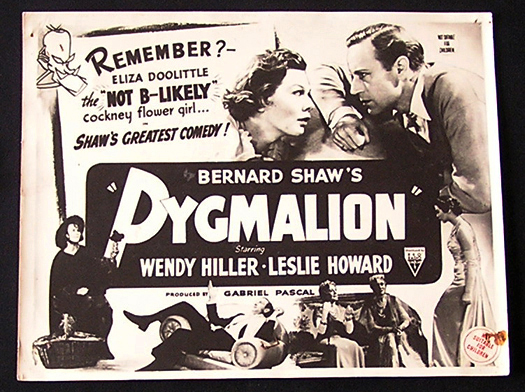
Pygmalion Movie Poster
Pygmalion. You’ve probably seen the movie ‘My Fair Lady’ with Rex Harrison as Professor Higgins and Audrey Hepburn as Eliza Doolittle but I’d be surprised if you’ve seen this, the original, non-musical version, on TV. Leslie Howard plays Higgins and Wendy Hiller plays Eliza. Hiller is much more believable as Eliza, no disrespect to Audrey Hepburn and Howard is a bright, eccentric Higgins. I’ve never seen this version on TV at all, in fact I picked up the movie on one those free newspaper DVDs. What is interesting from researching the film on the internet is that a controversial (at the time) line was included in the film: Eliza saying ‘Not Bloody Likely!’ This made Wendy Hiller the first person ever to swear in a British film. Dear me, how times change!
Robinson Crusoe on Mars. Sounds a bit mad doesn’t it, a sort of 1950’s B picture. In fact this was shot in colour in 1964 and starred an actor called Paul Mantee who appears in many US TV series of the 1970’s and 1980’s. It pretty much follows the original story of Robinson Crusoe only it’s about an astronaut who crash lands on Mars. He thinks he’s had it but finds that certain rocks contain oxygen which is released when they are heated so he is able to replenish his oxygen supplies. He even finds an alien ‘Friday’ on Mars who has escaped from an alien slave camp. Sounds a little far-fetched I know but it was actually a pretty good movie. I remember watching it on TV on a cold weekday afternoon in the early eighties and it certainly warmed me up. Since then I have never seen it on British TV but it’s well worth a search on e-bay for the DVD version. The day they show it again on TV I’ll be parked up on my favourite armchair ready to enjoy! Come on TV schedulers, get your act together!
Which movies would you like to see on the small screen?
If you liked this post, then why not try my book, ‘Floating In Space’? Click the links at the top of the page for more information.
I’ll come straight to the point; my favourite movie director? Well, it’s complicated because I’ve got more than one; hence the part 1 in the title, but anyway, Woody Allen is probably my very favourite. Now why a working class guy like me brought up in a suburban council estate in Manchester would relate to the Jewish intellectual New York humour of Woody, well, I don’t know but I just love this guy’s films.
My very favourite moment from one of Woody’s film is probably the one from take the Money and Run when he goes into the bank to rob it and hands a note through the window. The note says “Give me the money, I have a gub!”
“Does that say gub?” asks the bank teller.
picture courtesy wikipedia
“No that’s gun! I have a gun!” replies Woody and soon all the staff are discussing the spelling and the robbery is forgotten. That movie was right at the very start of Woody’s career when he was a stand up funny man turned movie maker and as his movies got gradually more serious and more thoughtful, well, I probably loved them even more.
I love the opening of Manhattan where Woody narrates over the opening sequence;
“Chapter One. He adored New York City. To him it was a metaphor for the decay of contemporary culture. The same lack of individual integrity that caused so many people to take the easy way out was rapidly turning the town of his dreams in… no, it’s gonna be too preachy, I mean, you know, let’s face it, I wanna sell some books here. Chapter One. He was as tough and romantic as the city he loved. Behind his black-rimmed glasses was the coiled sexual power of a jungle cat.”
Another Allen movie that opens with a monologue is Annie Hall. His character, Alvy Singer, says: “There’s an old joke. Two elderly women are at a Catskill restaurant. One of them says, ‘Boy, the food at this place is just terrible.’ The other one says, ‘Yeah I know. And such small portions.’ Well, that’s essentially how I feel about life. Full of misery, loneliness and suffering and unhappiness – and it’s all over much too quickly.”
Apart from Woody himself and his casual comedy chatter I’ve always like the look of Woody’s films from the black and white of Annie Hall, Manhattan and Broadway Danny Rose to the full colour Hannah and her Sisters and the jump cuts of Deconstructing Harry. I like the way the camera moves, or really doesn’t move. In Hannah and her Sisters Woody doesn’t follow Michael Caine when he goes into the bedroom and continues a conversation. Why should we? We all carry on long distance conversations with our partners in the bathroom or dining room when we are in the kitchen. We don’t need to see the other person, just hear them.
Woody’s films have a natural unobtrusive style which enables you to sit back and enjoy his humour and his observations. Another great Allen movie is Crimes and Misdemeanours. It’s a movie with a dark side but with the same flashes of Allen humour to keep you smiling. Martin Landau stars in the film and gives a wonderful performance. No longer the rather wooden actor from the TV series Mission Impossible or that Hitchcock movie North By Northwest. Here, Landau delivers a thoughtful and human performance and there are lots of the usual Woody Allen touches like returning to old homes and discussing morality then flipping to the next scene where Allen and Mia deliver some more comedy as a counterpoint.
I can’t write a blog about Woody Allen without mentioning Bananas. If I need to cheer myself up, this movie works every time, especially the bit at the end where Woody and Louise Lasser’s wedding night becomes a TV sports event with commentators and interviewers.
It’s almost an ‘in’ joke with Woody about how his older movies are funny and the later ones are not but all his movies have a certain something; not always laugh out loud humour, but some well observed human element. I love Woody himself in his movies which is why it’s a little odd that one movie I can watch over and over again is Radio Days. Like it says in the title, the movie is set in those days before TV when people had their ears glued to the great shows and performers of the time. Woody narrates the movie and we see him as a little boy entranced by a crime show, so much so that his parents take him to see the Rabbi. ‘You speak the truth, my faithful Indian companion’ quotes the young Woody much to the dismay of his parents, not to mention the Rabbi. In some ways I can see myself as a young lad, obsessed with the TV shows of my day and this is the crux of Woody’s films because in many ways he is turning the camera round, and the camera is pointing at us, the viewer.
My love affair with the movies encompasses many genres but when I want to smile it’s usually the Woody Allen DVD I pull down from the shelf.
Hope you enjoyed this post. Click the links at the top of the page to find out more about my novel ‘Floating In Space.’
It may be that you are totally assimilated into the DVD age but it also may be that you are, like me, still with one foot in the VHS video age and also, like me, you may have a huge stack of VHS tapes in big boxes gathering dust and no idea what to do with them.
When I stay at my Mum’s house I’ve got an old TV and VHS player in my bedroom and I sometimes go through my box of VHS tapes and find something to watch.
Here’s one example, take the movie Charlie Bubbles for instance. That may not ring a bell to you as I taped it from channel four way back in the eighties and I’m pretty certain I’ve never seen the film broadcast again, which is a pity as it’s a great movie.
It stars Albert Finney who also makes his directing debut in the film and co-stars Billie Whitelaw, Colin Blakely, and has an unlikely appearance by Liza Minnelli. It’s written by playwright Shelagh Delaney who wrote the play ‘A taste of Honey’, which was also made into a wonderful movie.
Charlie Bubbles is a writer, played by Finney who has a sort of gloomy and despondent view of the world and he returns to Manchester to see his son. It’s great for a Mancunian like me to see Manchester as I remember it growing up. The film goes on to show the clash between Charlie’s working class background and his new life as a writer. In one of my favourite parts of the film Charlie meets a friend of his father who asks “are you still working or just doing the writing?”
Charlie replies thoughtfully that he is ‘just’ doing the writing.
Pixabay.com
Another great movie I have on VHS and not often seen on TV is ‘Seven Days In May’. Burt Lancaster plays an army officer who attempts to overthrow the US government in a coup d’état. Kirk Douglas sees that something strange is going on and alerts the President played by that fine former silent movie actor Frederic March. Interestingly, part of the movie was filmed at the Kennedy White House. Perhaps President Kennedy wanted to send a message to his Generals!
What’s quite interesting is that there seem to be movies that are shown time after time on TV, films like Die Hard for instance. (Hey, I love that film but I don’t need to see it every other week! ) Show me some movies I haven’t seen for a while! Some great films I’ve got on VHS are Saturday Night and Sunday Morning again starring Albert Finney, and A Kind Of Loving both films looking at working class life in the sixties (they used to call them kitchen sink dramas.)
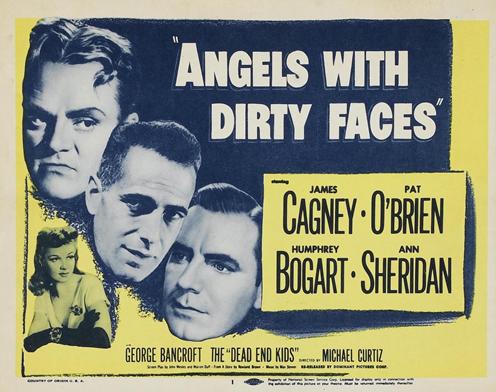
Another great movie, just perfect for a wet and windy Saturday afternoon is one I found in that box at my Mum’s the other day, it’s ‘Angels with Dirty faces’starring James Cagney.
I remember watching this years ago on a Saturday afternoon. I was watching it with my Dad and strangely me and my Dad were brought up on the same movies only I saw them first on TV and he saw them originally on the cinema screen. Like all great movies my Dad was pulled into the film, totally reliving it and right at the end he said:
“Cagney’s going to cry in the gas chamber, they’re going to ask him to cry!”
Yes, my Dad blew the ending of that movie for me but something else I found on a tape was sadly ruined by a complete technology foul up.
Lee Meriwether in the Time Tunnel control room. (Picture courtesy Wikipedia)
I found an episode of the Time Tunnel, a sixties sci fi show that I’d not seen for years. It was re run back in the eighties when I was at the height of my TV recording passion. I stopped the tape, nipped downstairs to make a cuppa, got myself settled again and pressed play. I time travelled right back to my childhood watching ‘two American scientists trapped in the swirling maze of past and future ages’ as the TV voice over used to say. James Darren and Robert Colbert were the scientists and Lee Meriwether was the lady back at the control room trying to get the guys back home.
Half an hour later the screen went blank. I’d run out of tape!
Wonder if the Time Tunnel is on DVD?
If you liked this post, why not try my book, ‘Floating In Space’. Click the links at the top of the page or the icon below to go straight to Amazon.
As I’ve mentioned many times before, I write because I’m a writer. That’s what I do, I write and I’ve been writing since I was a school kid. Something else that comes hand in hand with writing is the idea that one day; one fine distant day, I might just get somewhere and get my book published and actually become an actual fully fledged, bona fide writer. Of course, when that happens it will bring a degree of fame which I can imagine being pretty nice. You know what I mean, going into a restaurant and the staff know me and say stuff like ‘the manager would like you to have this bottle of expensive wine on the house’, and ‘could you sign this menu’ and people asking you for an autograph and maybe being interviewed on TV about my latest book (whoa, steady on there!) Anyway, stuff like that.
Of course fame in some ways can be something of a prison. I don’t think life was that great for Elvis Presley for instance. Elvis turned his whole life upside down to escape the pressures of fame. He slept all day and came awake at night. He would hire a whole cinema to run the latest movie for him and his friends. He hired bowling alleys and fairgrounds to open up, during the night, just so he could enjoy life away from the attention of his fans.
picture from flickr
Another famous man and probably the most famous man there ever was, was Charlie Chaplin. Chaplin had a fame almost a hundred years ago that perhaps no one will ever realise again because Chaplin’s movies went all around the globe. People anywhere could understand Chaplin because his movies were silent. All you needed to understand them was the universal language of laughter. People in Russia, Japan, China, the Ukraine and countless places across the globe laughed and cried with Charlie, as well as moviegoers from the USA and Europe.
Chaplin became a rich man and he hung on to his riches by building his own studio and producing and directing all his films. He did one other thing as well. In an age when a movie had a shelf life of a few months at the most, when no one thought about saving or preserving films for another age of moviegoers, Charlie did just that, he secured the rights to the negatives of all his movies and ensured they lived on into the age of TV, video, DVD, and the modern digital age.
I do love the Golden age of Hollywood and do think sometimes about visiting America to see Chasens’, Romanovs, The Brown Derby, Schwab’s drugstore, Pickfair, The Goldwyn Studios, and even Chaplin’s old studio that he built for himself on the corner of La Brea and Sunset in Hollywood in 1917.
The thing is, out of the above list only one remains. Chaplin’s studios, now owned by Jim Henson and complete with a statue of Kermit the frog on the front gate, in Chaplin’s tramp costume of course.
Who today has the fame that Chaplin enjoyed? Well, out of interest I did a quick search on google and the results were these; Number 1 is Michael Jackson even though he is no longer with us, followed by Lady Gaga, Justin Beiber and Jennifer Aniston. Completing the top ten are Eminem, Johnny Depp, Will Smith, Katy Perry, Beyoncé and Leonardo DiCaprio. Not a completely inspiring list is it? I wonder which of those celebrities, if any, will be fondly remembered in 2114?
My brother sent me a text a few days ago, it read simply ‘You don’t remember me do you?’ Probably a little confusing to the man on the street but I knew exactly what he meant. I responded with; ‘I remembered you the moment I saw you!’ My brother texted back straight away; ‘By the nose huh?’ The thing is, my brother and I are movie buffs, or to be more accurate, classic movie buffs and we sometimes text in movie dialogue.
Here’s another text; ‘Meatballs!’
I replied with ‘Definitely!’
Picked up on the movie yet? Well that it’s one of the great motion pictures of all time. It starred Marlon Brando in an Oscar winning performance, much better, much more exciting and above all, much more human than his other Oscar winning role in the Godfather. Here are some more text clues;
My Brother: ‘What did that man mean just now?’
Me: ‘Oh don’t pay no attention, he’s drunk, falling down . .’
My Brother: ‘He’s just a juice head that’s hangs round the neighbourhood, don’t pay no attention.’
Another text read ‘Some people have faces that stick in your mind.’ And some movies have dialogue that can stick in your mind too, especially if you like your movies in black and white and served with a large helping of classic.
image courtesy wikipedia
The movie was ‘On the Waterfront’ and it’s probably famous for the double act of Marlon Brando and Rod Steiger playing brothers but there are plenty of other wonderful performances and scenes. My personal favourite is when Brando and Eva Marie Saint walk together in the park and Eva drops a glove which Brando picks up but keeps hold of and eventually pulls onto his own hand and we know that Eva wants it back but, well watch the movie, believe me it’s a great scene.
My brother and I do text each other a lot but we also chat on the phone too. The thing is though; we tend to talk on the phone with East European accents. We starting doing it one day then began a sort of unspoken contract to carry it on. Sometimes I’ll get a call and he might say, in his best Hungarian accent ‘ Gut Evenink my friend.’
‘Gut evenink to you also my friend’ I tend to reply. It’s fun but sometimes I get odd looks, especially if I’m in Sainsburys or at the bar of my local pub. Which brings me finally to another text he sometimes sends; ‘Extraordinary behaviour!’
(In case you didn’t get that one, remember the 1955 movie ‘The Colditz Story’ ? Eric Portman says the line towards the end of the film!)
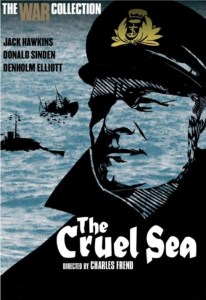 When I was writing my post ‘The Book of the Film or the Film of the Book’ a while ago, I did consider including ‘The Cruel Sea’ as not only is it one of my favourite films, it is a pretty good book too. I didn’t include it because I couldn’t find my copy of the book, which I hadn’t read for years and also I hadn’t seen the film for years either.
 It’s always a bitter-sweet experience when someone decides to make your favourite book into a film. It doesn’t always work out because maybe it was a big, thick, long book and they have cut out your favourite bit, or perhaps the cast wasn’t the one you imagined. It’s usually just the same in reverse. You see a great film and in the credits it says based on the book by so and so, then you rush out and get the book and it turns out to be a little disappointing. Sometimes it’s even better than the film!
 It’s always a bitter-sweet experience when someone decides to make your favourite book into a film. It doesn’t always work out because maybe it was a big, thick, long book and they have cut out your favourite bit, or perhaps the cast wasn’t the one you imagined. It’s usually just the same in reverse. You see a great film and in the credits it says based on the book by so and so, then you rush out and get the book, and it turns out to be a little disappointing. Sometimes it’s even better than the film!
 The Film.
 I don’t know if you remember that old British movie, Green for Danger? I’ve not seen it myself for a while but this week I’ve been thinking about it and even done a search through my old VHS video tapes to find my copy.
 Classical Music and Three of my Movie Favourites




 As I’ve mentioned many times before, I write because I’m a writer. That’s what I do, I write and I’ve been writing since I was a school kid. Something else that comes hand in hand with writing is the idea that one day; one fine distant day, I might just get somewhere and get my book published and actually become an actual fully fledged, bona fide writer. Of course, when that happens it will bring a degree of fame which I can imagine being pretty nice. You know what I mean, going into a restaurant and the staff know me and say stuff like ‘the manager would like you to have this bottle of expensive wine on the house’, and ‘could you sign this menu’ and people asking you for an autograph and maybe being interviewed on TV about my latest book (whoa, steady on there!) Anyway, stuff like that.