 Not long ago I came across a blog post about the best documentary films of all time and looking through it I noticed one about Marlon Brando. When I was younger I was very interested in Brando. I thought he was a great actor, one of the greatest in fact even though I think his stature has become diminished by his poor choice of roles in his later life.
Brando’s earlier films are a list of classic cinema greats and if he had perhaps died early like James Dean I’m sure many writers and cinema fans would have wondered what would have happened if Brando had lived, what great movies would he have made? Actually the answer is, not very many.
Anyway, before I get to Brando let’s look at some other examples of movie actor documentaries.
Peter Sellers as he filmed it.
The BBC Arena team made this film about Peter Sellers in 1995. It was created largely from cine film shot by Sellers himself, who was a lifelong camera enthusiast. The original documentary was made in 1995 and if I remember correctly, Sellers’ widow, Lynne Frederick had died and left behind a lot of Sellers’ effects, including his home movies which is how the film came to be made.
Normally, I’d say that you have to be interested in movie people and how movies are made to like this documentary but this film is so special I don’t think that rule applies.
The original film was in three parts and began with Sellers’ early days and his early films. The first cine films we see are black and white movies and as Sellers’ career takes off, his cine equipment also improves and he upgrades to colour and then on to sound. His own images show his young self as a sort of ‘spiv’, a Flash Harry sort of character with his double-breasted and shoulder padded jackets. An uneasy relationship with his mother emerges, as does a rather spoilt and volatile personality. His first wife talks about their early days and their life together and friends like Spike Milligan talk happily about successes like the Goon show and their beginnings in show business. Milligan had a 8mm camera and Sellars a 16mm one. Of course ‘Peter was richer,’ comments Milligan. ‘Richer by 8 millimetres!’
Sellers’ cine film is blended with interviews from various people who played a part in Sellers’ life.

Sellers as Group Captain Mandrake in Dr Strangelove.
A fascinating section concerned Casino Royale, the spoof James Bond film. Various directors were involved but Joe McGrath shot one segment with Peter Sellers and Orson Welles. McGrath was a TV director relishing the move into feature films, that is until Sellers told him he didn’t want to be in the same shot as co-star Welles. A heated debate ensued which became physical. Sellers said he was going off to calm down. He never returned and if you ever see the completed movie, you’ll understand why Sellers’ character abruptly disappears too!
Sellers claimed to have no personality of his own and ‘borrowed’ them from the characters he impersonated. It’s interesting to watch the TV interviews included in the film where Sellers seems to mimic the Yorkshire tones of Michael Parkinson and again, in other snippets he is taking on the accents and style of his interviewers.
The film overall has a sort of melancholy feeling which I feel accurately represents Sellers’ persona. He was a sad character, disappointed in his life and loves. He was not happy with his last wife, Lynne Frederick and he even junked many of his cine films prior to his death as they didn’t seem to match his expectations. The mood of the film is further enhanced by a wonderful soundtrack full of sad saxophones and jazz tones.
There are some that put down documentaries that are full of so-called ‘talking heads’ but personally, if the talking head has something interesting to say, I like to hear them. However, in 2002 the BBC re edited the film by taking the soundtracks from the ‘talking heads’ and combined them with Sellers’ self filmed visuals. The result is now available as a BBC DVD. The original is much better though, in fact you can see all three parts on the video sharing site Vimeo:
Becoming Cary Grant.
The BBC does do a good documentary and a few months back I settled down to watch a documentary about the film star Cary Grant: Becoming Cary Grant.
Grant was the smooth talking and sophisticated star of many a Hitchcock film, indeed the documentary revealed ‘Hitch’ to be his favourite director. Grant and Hitchcock were both immigrants from the UK.
Cary Grant was born Archibald Leach in Bristol in the southwest of England. He had a rather sad childhood during which his mother disappeared. Various explanations were put to the young Archie including the lies that she had gone on holiday and later that she had died. In fact his father had his wife committed to an asylum where she languished until her rich and famous son returned to her much later. In fact, Grant did not learn that his mother was still alive until he was thirty-one years old.
Archie’s father remarried but Archie was not included in the new family. Instead he was sent to live with his grandparents. At school he developed a love of theatre and spent much time helping and later working at small theatres in Bristol. When he was only 11 he began working with a small troupe known as the Pender Troupe and when they went to undertake a new tour in the USA, the young Archie went with them, following in the footsteps of other performers like Charlie Chaplin and Stan Laurel.
In the USA, Archie toured the vaudeville circuit with the Pender Troupe and decided to stay on in the USA when the troupe returned home. He and some others formed their own troupe and Archie spent a lot of time doing various acts like stilt walking and unicycle riding. Gradually he moved on to better roles in various theatre productions and even had a screen test in the early 1930s, which was shown on the documentary. Archie, now using the name Cary Grant comes over as a loud-voiced individual, making many faces for the camera. Of course, as a vaudeville actor he was used to talking loudly and making exaggerated expressions but he soon learned to tone down his performance for the cameras.
The documentary uses text from Grant’s unpublished autobiography and it is clear an experience in later life had a great effect on him. Grant took part in a form of psychoanalysis using LSD which enabled him to confront issues from his early life which the actor felt had unduly affected his relationships as an adult, particularly with women, in fact he was married five times.
The film was interesting but focused mainly on the unpublished autobiography and many of his friendships and relationships that I have read about in other books were not even mentioned. A great part of the film also was Grant’s collection of home movies which were used throughout the film although many times what we were seeing was not properly explained. Towards the end of the film Grant’s daughter was interviewed and visits Cary’s old home. In one scene we see her visiting the patio shown in a earlier shot on one of Cary’s home movies. More interviews and perhaps some more location footage would have benefited this film enormously. Still, it was interesting and can be found on the BBC i-Player if you missed the original broadcast.
Listen to Me Marlon
After reading about this Brando documentary I did a quick search on eBay, found a very cheap copy for a couple of pounds including free delivery, and sat down to enjoy it. It is different to the two films above because rather than home movie or the written word, the prime source of the film is audio tapes that Marlon recorded for himself. The big problem there is that while many are good recordings, others are not only poor quality, but Marlon’s non acting speaking voice is rather difficult to understand. He has a strange lisping, mumbling voice completely unlike the strong voice of many of his roles.
On top of that a droning piano accompanies much of Marlon’s recordings and many times I found myself rewinding to find out what he had actually said.
The Brando that emerges from this film is a sad man made sad perhaps by memories of a drunken mother and a violent father. In an early sequence Marlon senior joins his son the film actor on a TV show and the voice on one of Marlon’s tapes tell us how both of them were acting, one playing the loving son, the other playing the caring father. Marlon spent a lifetime looking to psychoanalysis for help, feeling inadequate despite his fame and success as an actor. It seems also that he despised his craft even though it gave him financial security to do and live however he wished.
Acting he reveals was the first time he did anything that he was praised for and the first to see his talent was Stella Adler, an actress who trained and nurtured him as an actor.
Brando appeared in a number of classic films including A Streetcar named Desire, Viva Zapata, and the Oscar winning On The Waterfront. Some of his later choices of film roles were just frankly disappointing especially during the 1960s. By the end of that decade he was persona non grata in Hollywood and when Francis Ford Coppola decided he wanted Brando to play Don Corleone in The Godfather, alarm bells were ringing in the executive offices at Paramount. Not only was Brando held in low esteem as an actor he also had a reputation as a troublemaker who caused delays and added more dollars to production schedules and costs.
I’m not sure Brando ever really appreciated what Coppola did for him. As well as giving him an Oscar winning role Coppola rehabilitated Brando in the film industry and made him a bankable star once again. Later, when Brando appeared in Apocalypse Now, he appeared on set massively overweight forcing Coppola to shoot him in darkness and shadows. Brando complained about the script too and began rewriting his own dialogue. On his personal audio tapes Marlon rants on about his treatment by the director but really, it was Francis Coppola who should have been complaining.
Listen to me Marlon was fascinating but ultimately a disappointing film. If I ever do a blog post about the best documentaries ever I’m sorry to say I won’t be including this one.
 Lockdown has been eased slightly here in the UK but even so, the day when things will be back to normal seems pretty distant. Even then I keep seeing things in the media about the ‘new normal’. What will the new normal be like? I don’t know but one day we will all be back out again, going back to bars and restaurants and flying to Europe and even further afield for our holidays. Still, I can imagine everything being ever so slightly different though with much more handwashing and social distancing.
 I started off on this lockdown waking up at about 8 ish and now after 5 or 6 weeks of lockdown I’m waking up at 10, if I’m lucky. Of course I’m staying up much later than usual too, sometimes till 3 in the morning watching TV or listening to music on my new favourite app, Spotify.
 Last weekend should have been the weekend of the Monaco Grand Prix. It didn’t take place because of course the 2020 season has yet to start, affected like everything else by the Corona Virus pandemic. Pity, because I do love the Monte Carlo event even though it is essentially a race won during qualifying. It is so difficult to overtake around the narrow streets of this small but exclusive principality that make up the race track that pole position is essential.
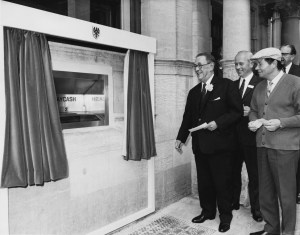 Back in the 1980’s I received my first debit card just like many other people. Debit cards were a new concept back then. We already had credit cards but a debit card, what was that about? Back in pre-debit card days when everything was in black and white like an old film, we used to have to go into the bank to withdraw cash. I remember queuing at the bank on a Friday lunchtime in Manchester City centre waiting to draw some cash out for that weekend’s activities. The way we did it back then was to write a cheque to yourself or as I was taught to do ‘pay bearer cash’. In 1987 debit cards were first introduced in the UK although they had been around for a while in the USA. As you can imagine I didn’t actually know that, I had to look it up so while I’ve got that Google page open here are a few interesting facts from the BBC:
 Here’s another number: 14. Yes 14 was the number of the house I lived at as a child. My parents house was a council house and it was my grandad and grandmother’s house until they bought their own house and moved away to Wales. My mother managed to take the house over on the understanding that her brother and sister could continue to live there although by the time I came along they had both found their own homes.
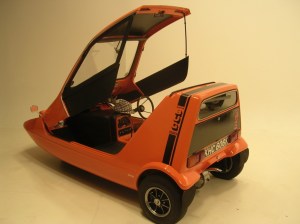 My very first car had the registration plate PDB71M. It actually caused a lot of confusion when I bought it because I traded in my motorbike, a Honda CB250 with the very similar registration PDB1M. Incredibly, checking on the Gov.UK website my motorcycle is still registered. It was a green Honda first registered in 1974. It has no tax or MOT so presumably it is languishing in the back of someone’s garage, rusting and probably neglected. My car was a Reliant Bond Bug which does not come up on a website search so presumably it went to the scrap yard many years ago. I bought it because I failed my first two attempts at the driving test and was really getting fed up. Of course we didn’t have a family car so the only driving I could do was the one hour a week on a Saturday morning that was my actual driving lesson. The Bond Bug was a three wheeler car and could be driven on a motorcycle license. After a few months regular driving I booked the test again and sailed through it.
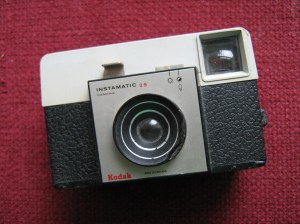 While I’m on the subject of firsts, my first camera was either a birthday or Christmas present and it was a

 You might think that the lockdown is heaven sent for a writer. Stay at home and write stuff, perfect! After a few weeks though I have found not only have I not written much at all. Actually, I’ve been feeling a little bit bored, just like a great deal of the population I suppose.
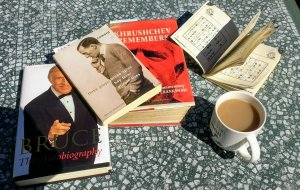 When Khrushchev’s memoirs become a little too serious and I fancy a change, something a little bit lighter, I turn to either Noel Coward or Bruce Forsyth. I picked up Bruce’s book at a church sale and although I didn’t expect much, it has been pretty interesting. Bruce was probably one of the last old time entertainers. He talks about the days of variety in the 1950’s and 60’s and about being in various shows and playing in theatres like the London Palladium and how he managed to break in to TV with Sunday Night at the Palladium which he compered for many years.
 Of course, as we are currently still in ‘lockdown’ due to the Corona Virus Pandemic, that hasn’t been possible but happily due to the nice weather, we’ve been able to drag ourselves into the garden and the fresh air.
 2001 set the standard for the sci-fi movie with its depiction of spacecraft drifting slowly and silently through space. The first Star Trek movie was heavily influenced by 2001 which made it look a little dated when the movie Star Wars was released and did the opposite thing, showing spacecraft whooshing across the screen at lightning speeds.
 In the 1950’s, Senator Eugene McCarthy, aided and abetted by the head of the FBI, J Edgar Hoover, began to accuse hundreds of Americans of being either communists or communist sympathisers. Hoover had designed President Truman’s loyalty and security program and his agents carried out background checks on federal employees. This information was supposed to be secret but in 1950 when the Korean War began, Senator McCarthy produced a list of supposed communist party members or supporters working for the state department and presented it to the press. Much of his information came from Hoover.
 I do like my food. Like everyone I have my likes and dislikes, for instance, I’m not a great lover of fish although I’ve been known to eat cod, hake, calamari and even mussels. Good food though is more than just ingredients or produce and a good chef is in his own way as much of an artist as a great painter or a poet. I do love watching great TV cookery shows and although I am not a great cook, I have sometimes tried to follow the advice of various TV cooks who have inspired me to make something exciting. The results will not be spoken about here but getting back to those TV chefs, who is your favourite?
 Letters from an Unknown Author!