The Problems of a Self-published Writer.
 I was at a pub quiz the other week and one of the questions was ‘name an author who has written 723 novels.’ Seven hundred and twenty-three novels. Can you believe that? The answer, in case you didn’t know is Barbara Cartland. She has a place in the Guinness book of records and is known as one of the world’s most prolific authors. At the other end of the scale there is me, Steve Higgins, with my one book, Floating in Space.
I have probably written more words, in my blogs and tweets and other social media posts promoting my book, than are actually in the book itself. Oh well, that is one of the facts of the self-publishing world: Writing a book is one thing but marketing is an entirely different ball game altogether and of course the competition is fierce with more than 5000 new books released on Kindle every day! Is it worth it you might ask? Why do I do it? Well, quite simply I do it because I like doing it and when the enjoyment has gone I’ll start thinking about doing something else with my spare time.
Nothing improves and hones your writing skills more than the writing process itself and as a blogger with a deadline of 10:00 am on a Saturday morning I have even started to feel like something of a professional writer. Nothing gives me more pleasure than to log into WordPress and find someone has liked one of my posts, or better still has left a comment. I’ve always thought that an intrinsic element of the human condition is finding that out that there are others in the world who think the same way as you do and like the things that you like.
I do tinker quite a lot with Floating in Space and some time ago I added a version which hopefully corrected the book’s various grammatical mistakes and I also added a small index to help explain 1977 to my younger readers. Recently I went a step further. I’ve not always been completely happy with the cover of my book. I used the cover designer built into createspace and KDP select to create a cover from various stock elements but I’ve always thought I could do better.
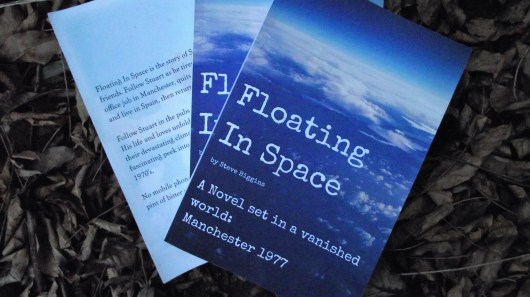
Using the web site canva.com which has a Kindle cover template I designed a new cover using a background photograph I had taken myself. I’ve always envisioned the cover as being a lovely cloud filled sky and the image of a man floating there, hands outstretched. That image is the whole essence of floating in space and although I’d like to explain further I don’t want to give away the ending for any potential readers. Anyway, there is no floating man on the new cover (yet) but there is a rather lovely cloud filled sky. I was pretty pleased with the result so I exported it to Kindle and there it was, working pretty well I thought as my new cover. Take a look below at the old and new versions.
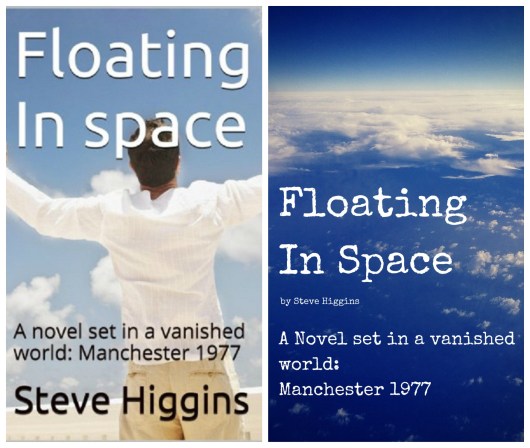
Old cover to the left, new cover to the right.
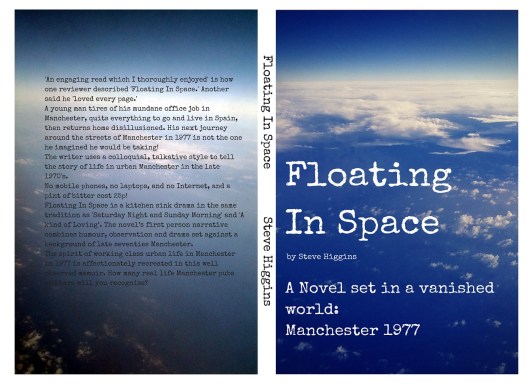
I then added it to my paperback version in createspace and after uploading it I ordered a copy for promotional purposes. Now I’m glad I did that because the book arrived with its smart new cover but I found there was no lettering on the spine and the entire back cover blurb had gone. Now, after some research, I find that to create a cover for the paperback, you have to create a full book jacket including the front and rear of the book! Looks like it’s back to the drawing board for now for the paperback cover!
I’ve had to be a little creative in using the paperback for my web site photos. The one below shows the new version but the one underneath showing the rear cover is the old version!
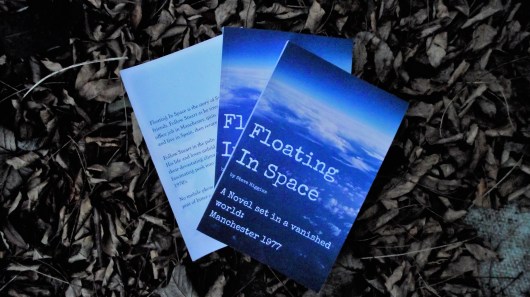
A lot of the videos I have on this site were made at animoto.com and it was great to find I can just edit my original videos, take out photos of the old cover and insert the new one, except of course for shots where I’m actually holding a copy of the book.
Wonder if Hemingway ever had all this trouble!
If you want more information about Floating in Space click the links at the top of the page. Have a look at the updated video below to hear more about the way the novel was written and a little bit of background information:
Update.
I wrote the above post last week and now, after a few days work, here’s the finished cover which is now live on Amazon if you fancy a paperback to read while you while away those dark winter nights.

 I’ve spent a couple of afternoons this week slumped in front of the TV after an early morning shift. Starting at 6 in the morning does tend to knacker you out and although many times I start to think I can sort this or that out in the afternoon, the lure of the TV set is sometimes too much. Over Christmas I bid on a box of Doctor Who DVDs on the shopping site
  Back in the 1970’s Jon Pertwee took over the role of Doctor Who from Patrick Troughton. William Hartnell had played the original Doctor as a grumpy and unpredictable old man, Troughton was the celestial comic and hobo and Jon Pertwee made the Doctor into a suave, smooth talking, velvet jacketed action hero with a penchant for Venusian karate. I wasn’t completely convinced at the time by Jon Pertwee’s Doctor Who but looking back I feel that his Doctor was one of the very best. All the others, even the modern ones, have kept on board elements of the first two doctors characters but Pertwee’s characterisation is just ever so slightly different. I can’t say I remember the first episode of Doctor Who being shown, I was only seven at the time but I Do remember William Hartnell and the strange thing is that I have grown up from a child to a middle aged man with this TV show always in the background. Jon Pertwee was with me in the seventies, Tom Baker in the eighties and so on and when the Doctor returned after a long absence in 2005 with the part played by Christopher Eccleston, it was like the return of a long lost friend.

 Formula One racing isn’t the sport it used to be. Well, it’s certainly different from what I used to enjoy as a schoolboy. Still, I’ve followed the sport since I was twelve or thirteen and it’s hard to break the habit of a lifetime so here’s a personal look back at the 2016 season.
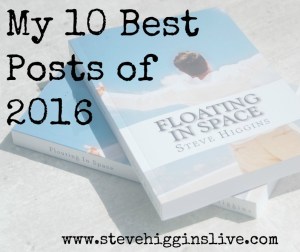 It’s that time of year again when we look back and take stock of what we did in the last twelve months and try to arrange everything neatly, tidy things up, add labels and pop everything onto the shelf of past memories before it gets consigned to the distant past. Bloggers are pretty much the same and I thought I might be a good idea to look back at my last twelve months of blogging.
 2.While on holiday in Lanzarote, I did one of my usual posts, My Holiday Book Bag. I do love books and this is one of a series talking about the books I take on holiday. The idea stemmed from reading a biography of Richard Burton, who had a voracious appetite for books and always took a book bag away on holiday with him. On this occasion I’d thought I’d go one step further and make the post into a VLOG, a video blog, with me sitting in front of the camera giving out a good old rabbit about the various books I had with me. Later this spawned another blog,
 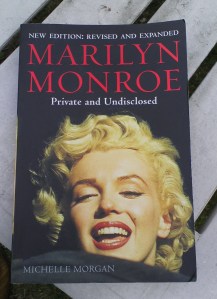 3.Whilst on the subject of books, I wrote a post about Marilyn Monroe books back in July. It was called 1
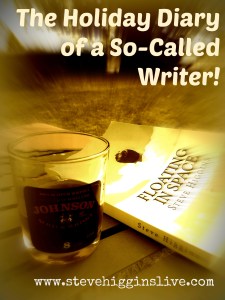 10.
10. 
 TV this Christmas wasn’t particularly great but I did watch a few things. One film I was looking forward to watching was the Lady in the Van, a mostly true story about a bag lady, in a van, who came to live outside playwright Alan Bennett’s home in London. Bennett takes pity on the lady and lets her move the van into his drive when parking restrictions force her to relocate. He combines her story with that of his relationship with his mother but the odd thing about the film is that Bennett gives himself two personas, one Alan Bennett the writer and the other Alan Bennett who is experiencing all these events. The two even confer together. This did confuse me at first but I eventually worked it out. Not a brilliant film but original.
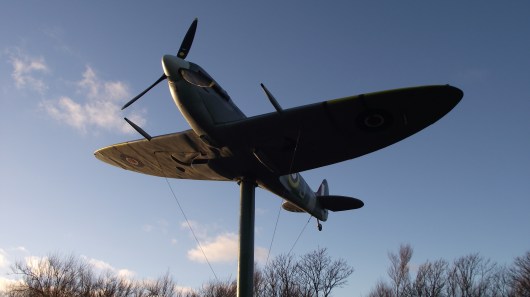 On Wednesday I changed to the night shift and spent a few hours during the day with Harry and Theo, Liz’s grandsons. We went out to the park and then had a drive down to the ‘front’ in St Annes. Many holiday towns seem to look a little forlorn out of the holiday season. A prime example is Blackpool, a few miles further up the road. It looks like a tired film set waiting for the actors and cameramen to return and brighten it up again. St Annes though is a lovely, friendly town that looks good to me whatever the season. Along the front we passed the Spitfire aircraft, mounted on a tall plinth looking just like it was taking off over the sand. The other day on a TV quiz show one of the questions concerned the Spitfire which must surely have a prime place in the annals of British history. This icon of the skies was the backbone of the RAF in the dark days of 1940 and the lady on the Chase or Tipping Point or whatever quiz it was, who had never heard of a Spitfire, was the brunt of a shower of abuse which I directed at her through the medium of my TV screen. Never heard of a Spitfire? What was she even doing on a quiz show?
 Men are just not cut out for cleaning. OK, it’s a fact. I’m not being sexist or anything but there it is, just a cold hard fact. It’s just not in the male make up. Women are far better qualified to do the job. Here’s an example. I remember one far off Christmas spent with my former wife in our small home in Newton Le Willows. I had some time owing me so I had taken a few days off after Christmas. It had not been a great Christmas as it was the first one since my wife’s mother had died and she had sadly put the previous year’s Christmas card from her mother in pride of place right on the top of the TV.
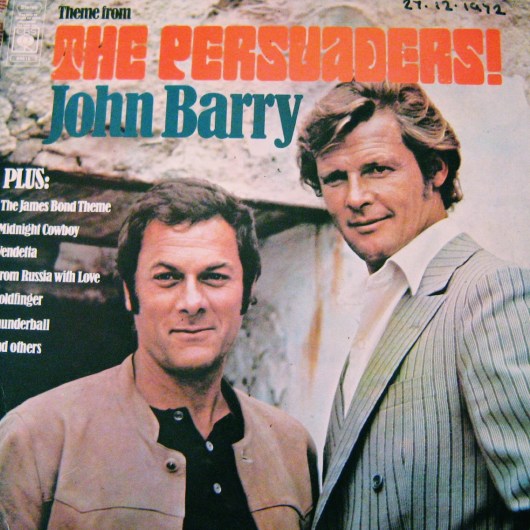
 My Christmas present in 1972, my shared present I might add, which I shared with my brother, was a record player. I don’t actually remember getting any records to play on it though but a few days afterwards I bought a collection of TV and film themes by John Barry in the post Christmas sales.. Barry scored the early Bon
 The first single I ever bought was by my childhood heart-throb Olivia Newton-John. I actually bought two singles together, The Banks of the Ohio and What is life. A single back in 1973 cost thirty-eight pence if I remember correctly and as both those singles had dropped out of the charts I was able to get the two singles for half price, nineteen pence each. Olivia Newton-John started out as a country/folk singer but found greater fame as John Travolta’s co-star in the hit movie Grease. Sorry Olivia but Grease just didn’t do it for me.
 I’ve never been one for albums, I’m much more of a singles man but in the 1970s I was very fond of Elton John’s music. When I first heard his records I just assumed he was an American so I was pretty surprised to find he was English and hailed from Pinner in Middlesex. His first hit single was ‘Your Song’ from his second album, Elton John but the first album I bought was ‘Goodbye Yellow Brick Road’. Elton worked closely with lyricist Bernie Taupin to produce some memorable songs. Taupin wrote the lyrics in the fashion of poems, passed them over to Elton who worked them into a song, which is the way they work together today some five decades later. I still have all my Elton John albums but after Elton made Rock Of The Westies I lost interest in his music a little. In the CD era I picked up some of my favourites of his music on CD and I have found some of his newer work that I really like, in particular Made In England which must count to me as one of his best ever albums.
 Back in my single buying days a work colleague lent me his copy of Jeff Wayne’s War of the Worlds. I didn’t really fancy it but my friend was insistent that I would love it and he was right. The idea of a whole album telling a single story including snippets of dialogue and sound effects is brilliant. I copied the album onto cassette tape and today I have two CD versions, one for in the home and one for my car.
 So, what music do you have on the soundtrack to your life?
 Last week I picked up a vomiting bug from Liz that came from her grandson Harry via her daughter Tania and finally to me. I only had one day off work but I felt so tired that I booked off my night shifts. I thought great, some time off to write and do those
  Easy, we can just use the new non celebrity celebs and pass them off as real celebs! I don’t know if I’m a Celebrity Get Me Out of Here passes as a reality show, I suppose it does in a way but the current series stars three celebrities I actually recognise. Carol Vorderman, the former numbers and letters lady from countdown is one. Larry Lamb is another, an actor I’ve seen in various TV shows. I don’t actually watch Eastenders but I believe he has a part in that. The third one is Martin Roberts, the guy from a daytime property show I have occasionally watched when nothing else worthwhile is on. There is also some guy from Emmerdale (don’t watch it) some comedian (never heard of him) a girl from Gogglebox (what?) a footballer (hate football) and, well some other people I don’t know. Wonder if the producers have ever tried to get people of the calibre of Tom Cruise or Tom Hanks? I did notice Hanks on a UK TV talk show the other week so surely that’s not such a remote possibility. Maybe if Hanks decided to make a sequel to the movie Castaway it would be a good publicity stunt to appear on I’m a celebrity? (Gosh, I should have been in PR!)